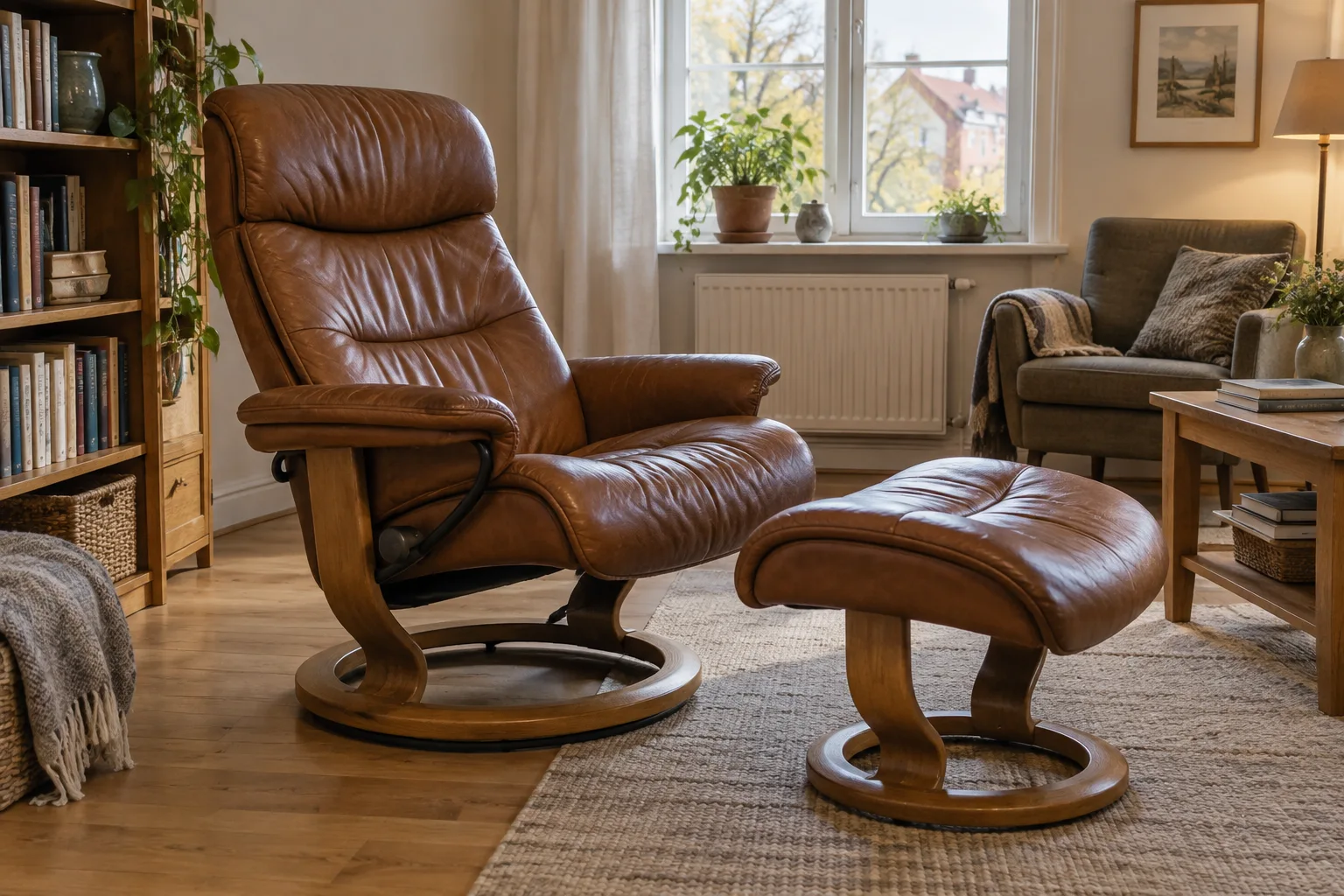
Reno has been around longer than that particular chair
The familiar padded leather chair and separate stool have an appeal beyond a fashionable silhouette: they make a dedicated place to put your feet up. Decide whether you want that whole arrangement. An ottoman you must keep moving out of the doorway can make a comfortable chair surprisingly irritating.
Stressless dates the Reno’s introduction to 1996 and was still presenting it in new colours and a different base in 2024. That gives you a useful test of a listing: “Reno, designed in 1996” is compatible with a much later chair. It does not establish a 1990s production date.[1]
Ask which part of the description comes from a label or receipt and which is the seller’s identification. Save a complete front and side view, the production label where accessible, and a photograph of the base. A close-up of a familiar logo alone will not resolve the size or the production period.
S, M and L belong to a model
The maker’s current size page shows Mayfair in three sizes and explains that many recliners have different dimensions and base choices. It does not provide a universal size chart for every older Stressless. Use it to understand the system, then find the product sheet or catalogue appropriate to your candidate.[2]
A dated example makes the problem concrete. The manufacturer’s 2016 product book lists these two chairs at the same overall width. A width of 31.1 inches alone therefore cannot distinguish their sizes. The sheet describes that production specification; it does not identify or date an older chair in a listing.[3]
| Version | Overall width | Seat height |
|---|---|---|
| Reno Small, Signature base | 31.1 in (79.0 cm) | 16.9 in (42.9 cm) |
| Reno Medium, Classic base | 31.1 in (79.0 cm) | 16.5 in (41.9 cm) |
Make one line for each chair you are considering: model, claimed size, base, evidence for age, overall width and depth, seat height, usable seat depth and clear space between the arms. Ask how the measurements were taken. Depth with the back upright is a different number from the space occupied while reclining.
If a seller calls a chair large but its measurements disagree with the matching document, leave the size unresolved. A different base, altered padding, an imprecise measurement or a wrong model name may explain it. Do not choose the explanation merely because it makes the purchase fit.
Try the reading position you will actually use
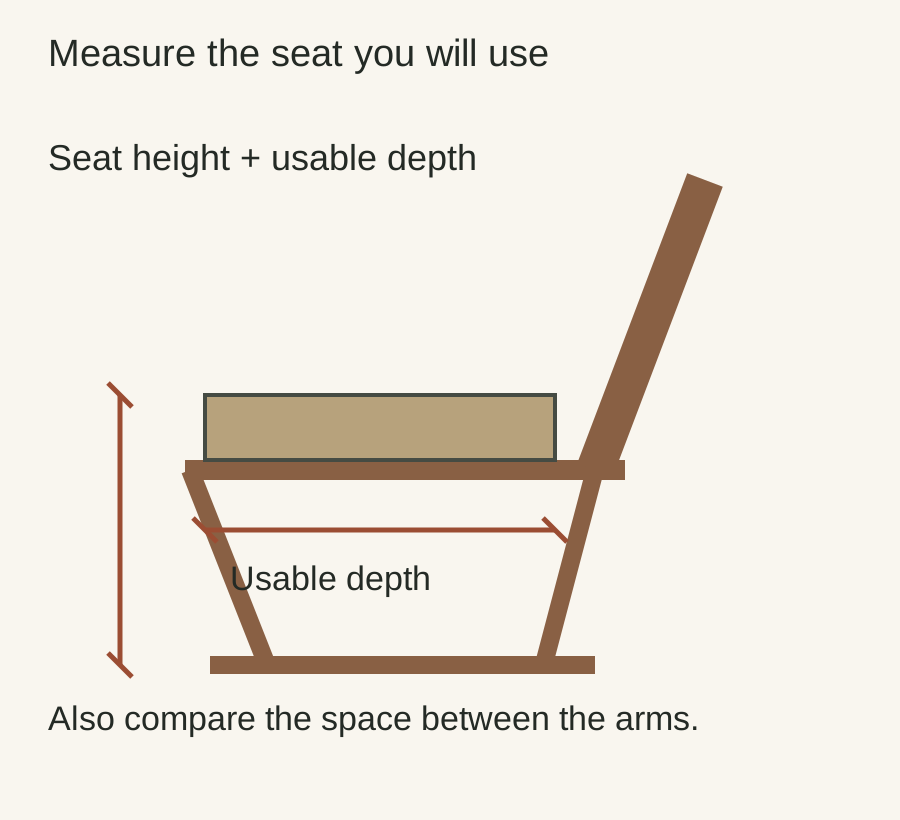
Once the normal operation has been demonstrated and any movement fault resolved, sit back in the chair with the footstool out of the way. Can your feet rest comfortably? Does the front of the seat press behind your knees? Notice whether you slide forwards to reach the floor, leaving the back support behind.
Now use the footstool and recline as you would at home. Bring a book or imagine the screen position. The head support should work with that task; a pleasing first impression is less useful if you keep lifting your head to read. Try the arms, reach for an imaginary side table, and get up again.
Two people of the same height can prefer different seats. Use your favourite existing chair as a comparison for usable depth and arm spacing, not a rule that converts body height into S, M or L. If the intended user cannot attend, make the limits of a remote purchase part of the decision.
Check the replacement route before buying a project
Older leather often has a mixture of creasing, fading and previous treatment. Decide what appearance you can enjoy as it stands. If comfort depends on replacement padding or a mechanism part, obtain a model-specific assessment before treating the asking price as the complete cost.
As checked in September 2026, the US Stressless FAQ limits its stated parts availability to selected parts for models made within roughly the previous 10–15 years. It asks for product and production-label information. That is a US service statement, not a promise for an older European chair; ask the relevant retailer about your exact piece.[4]
A useful retailer enquiry
I am considering this used chair, described as [model and size]. Here are the complete chair, base and production-label photographs, measurements and the seller’s account of changed parts. Can you help establish the version, and confirm whether the specific repair it needs can currently be supplied in my country?
Leave room for the stool as well as the chair
Mark the chair and footstool positions on your floor, including your preferred gap between them. Add the reach of the reclined back and swivel movement, following the matching instructions. Then walk past the occupied arrangement. A chair that fits only while upright has not yet earned its corner.
Choose the example that fits you and has a clear account of any necessary work. The seller’s enthusiasm is useful company during a viewing; it is not a substitute for your own sitting trial.
For the moving parts and seller demonstration, use the manual recliner inspection guide.