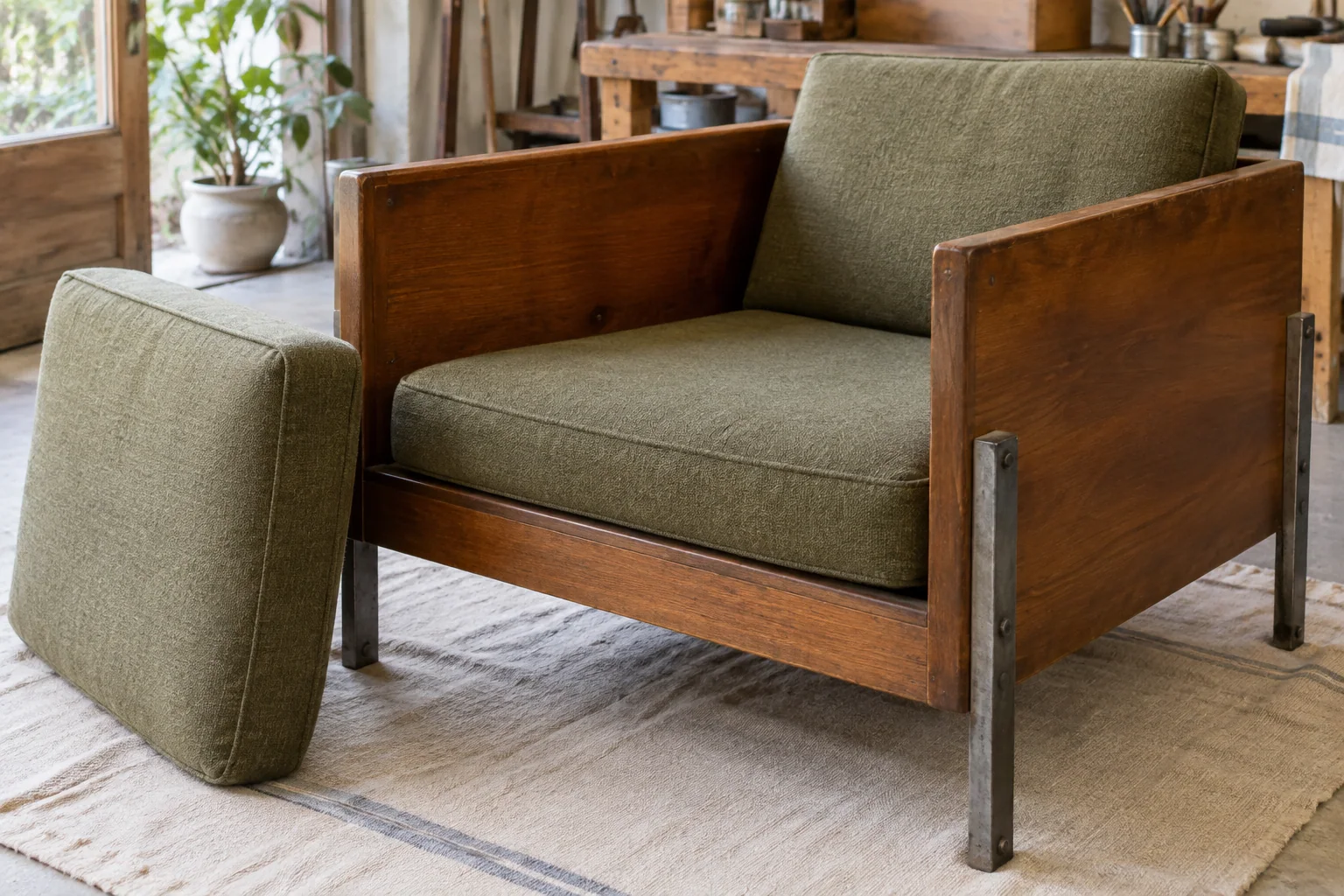
The wooden box is part of the design
The Robin and Lucienne Day Foundation records Forum for Hille in 1964, describing its hardwood frame, comb joints and externally mounted legs. It also identifies current licensed production by Case Furniture. Those facts help distinguish the design’s history from the age and producer of the chair or sofa being offered.[1]
Ask for the entire rear, both outer sides, corner joints and metal-leg attachments. A seller’s front view can make the cushions do all the talking. You need to know whether the wooden case remains the part you want to see once the furniture is placed away from the wall.
Photograph any maker or retailer marks in place and keep purchase records with them. A retailer name can be a useful clue, but do not turn it into a manufacturing date without supporting documents. If a listing claims an early Hille example, the price should rest on more than a familiar silhouette.
Decide which marks you want to keep
Look for opened joints, splits near attachments, replacement fasteners, local colour changes and prior surface work. A small stable mark on a broad wooden side may be part of what you like. A repaired joint needs a description of the work and an assessment of its present condition.
Tell the restorer which appearance you want to preserve before asking for a quote. “Refinish the frame” can mean much more work and change than attending to one damaged area. A newly uniform colour is not automatically a better result on a case whose older surface attracted you.
Ask how the piece will be handled and transported. External metal legs and projecting parts deserve an agreed plan; removable cushions do not mean the wooden structure is intended to come apart.
A cushion job can be a useful, bounded improvement
Take A Pew’s customer account for Forum sofa cushions describes replacement cushions for an existing sofa. It is evidence that a cushion-focused project can be undertaken, not a price guide or a promise that another Forum needs no other work.[2]
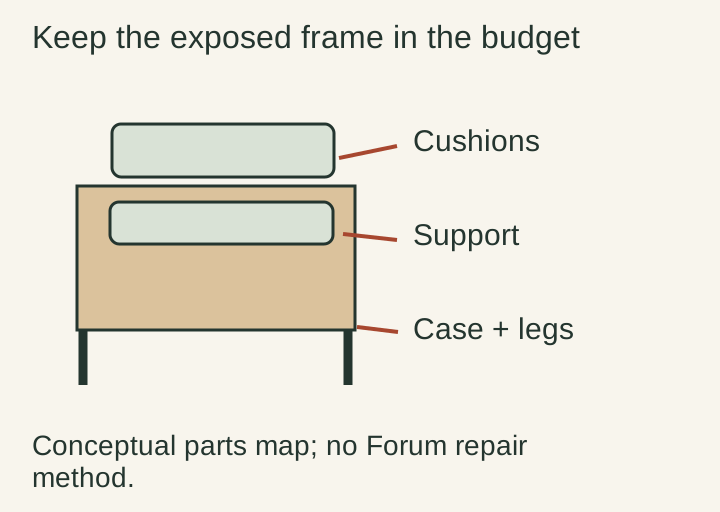
Before ordering, show the upholsterer the actual support, frame openings, existing cushion shapes and the occupied seat position. Ask whether the support underneath is suitable to keep. Define the finished seat height, cushion depth, filling feel, piping and how the back cushions sit against the wood.
A thicker seat can leave the wooden arms feeling lower; an overfull back can reduce the usable seat depth. Compare the proposed position with the one you like now. The aim is not to fill every apparent gap, but to make a comfortable, deliberate arrangement.
| Task | Ask the workshop to state |
|---|---|
| Wooden case and legs | Repair locations, surface treatment and exclusions |
| Seat support | What stays, what changes and why |
| Loose cushions | Number, finished shapes, filling and textile allowance |
| Transport and opening-up | Charges and the point at which extra work needs approval |
Pay for the Forum you would choose after the work
Ask the seller
Could you show the wooden case, corner joints, leg attachments and seat support without loose cushions? Please identify the production evidence and describe any repairs or replacements. I would like to know which cushion and support work has already been assessed.
Compare the delivered purchase and confirmed work with a complete example whose finish and seating you already like. Keep the project when the frame is right for you and the upholstery has a clear result. A low asking price does not compensate for a case you plan to disguise.