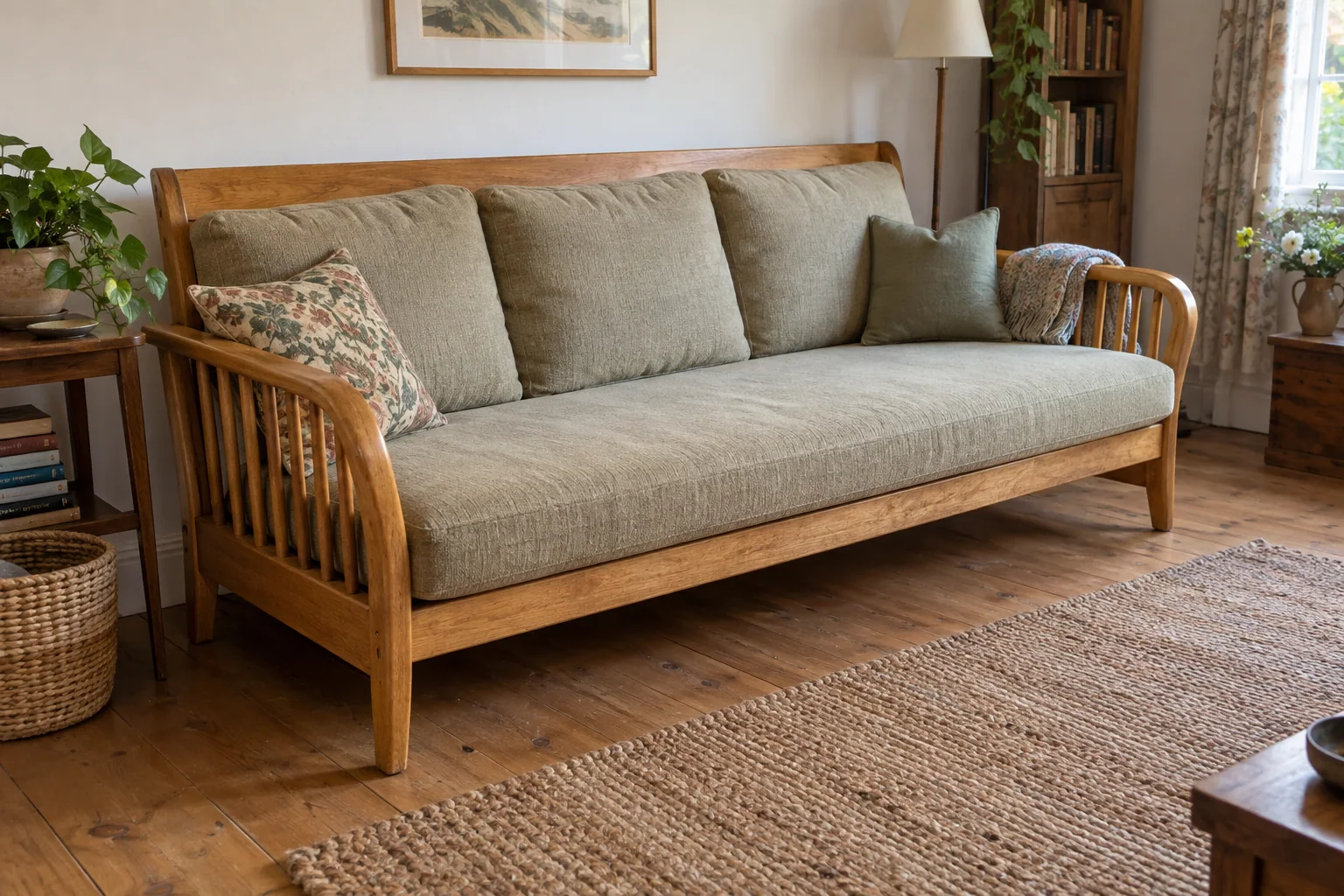
The name has outlived one specification
Ercol’s 1956 catalogue describes the No. 355 with a removable back, an elm backboard, beech supports and a seat supported by reinforced rubber. The present Studio Couch listing describes solid ash. That difference matters when an advertisement calls a couch simply “solid elm” or uses a current product page to describe an older example.[1][3]
Begin with a complete rear view, the label in place where accessible, dimensions and any purchase or repair record. Compare those with the relevant period document. The catalogue establishes a design and specification; it cannot date the particular couch in the seller’s room. A replaced backboard or cushion is a change to record, not an automatic reason to reject it.
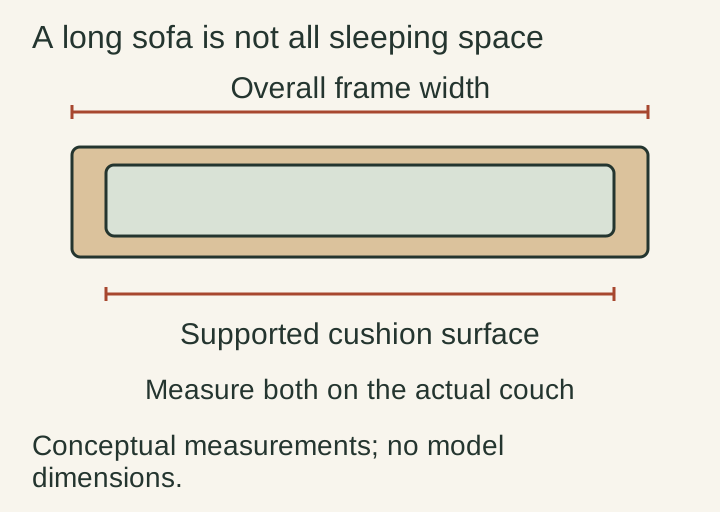
The current sofa is listed as 205 cm wide, with a 188 cm seat width. Even on that documented version, the outside dimension and sitting space are different measurements. Do not transfer either figure to an old frame without measuring it.[3]
Look behind the cushions before choosing the fabric
Have the seller show where the backboard connects to its supports and where the arms and legs meet the long frame. A split through a fixing area deserves a repair assessment; a pale patch on an otherwise stable board may be a cosmetic choice. Ask whether the back moves in ordinary use and whether any screws, brackets or wooden parts have been changed.
The catalogue’s removable-back feature is not an invitation to pull on an unfamiliar old mechanism. Ask the owner to explain and, only if it is sound and they know the method, demonstrate how their couch works. Do not lift the couch by the backboard or make a fragile fitting prove itself for a photograph.
With loose cushions removed, request a clear view of the complete seat support. A low seat may involve the support beneath the filling as well as the cushion itself. A supplier should identify the arrangement and propose the work; “new foam” does not answer a question about failing webbing.
Try the night-time arrangement on paper
Draw the usable supported seat as a rectangle and mark the wooden ends, back position and any gaps. Compare that space with the intended sleeper and their preferred sleeping position. Check the cushion’s length, depth and firmness too: a sofa cushion is not automatically a comfortable mattress just because it is long.
Then place bedding, spare cushions and a route out of the room in the plan. If the back must be moved, decide where it can stand safely overnight. A couch that fits neatly between two cabinets in daytime may be awkward to prepare once the room is full.
For occasional use, accept that this may be a compact guest arrangement rather than the equivalent of a separate bed. If regular sleeping is the main job, try the actual arrangement before committing to upholstery.
Send the frame details before ordering a set
Ercol’s 2026 ReCover information lists Studio Couch 355–7355 cushion and webbed-seat options. It is a useful service lead, but availability in a brochure does not confirm the fit or scope for your altered older couch. Send the supplier the model evidence and photographs before ordering.[2]
Ask the seller
Could you show the back connections, the complete seat support without loose cushions, and every cushion included? Please measure the supported seat and explain any replacement parts, movement or repairs. If you have previously removed the back, how does this particular couch release and refit?
Compare the delivered purchase plus the confirmed work with a complete couch you would happily own. A sound frame with tired, replaceable cushions can be a satisfying project. An unpriced structural repair should stay a separate decision, even when the fabric sample is perfect.