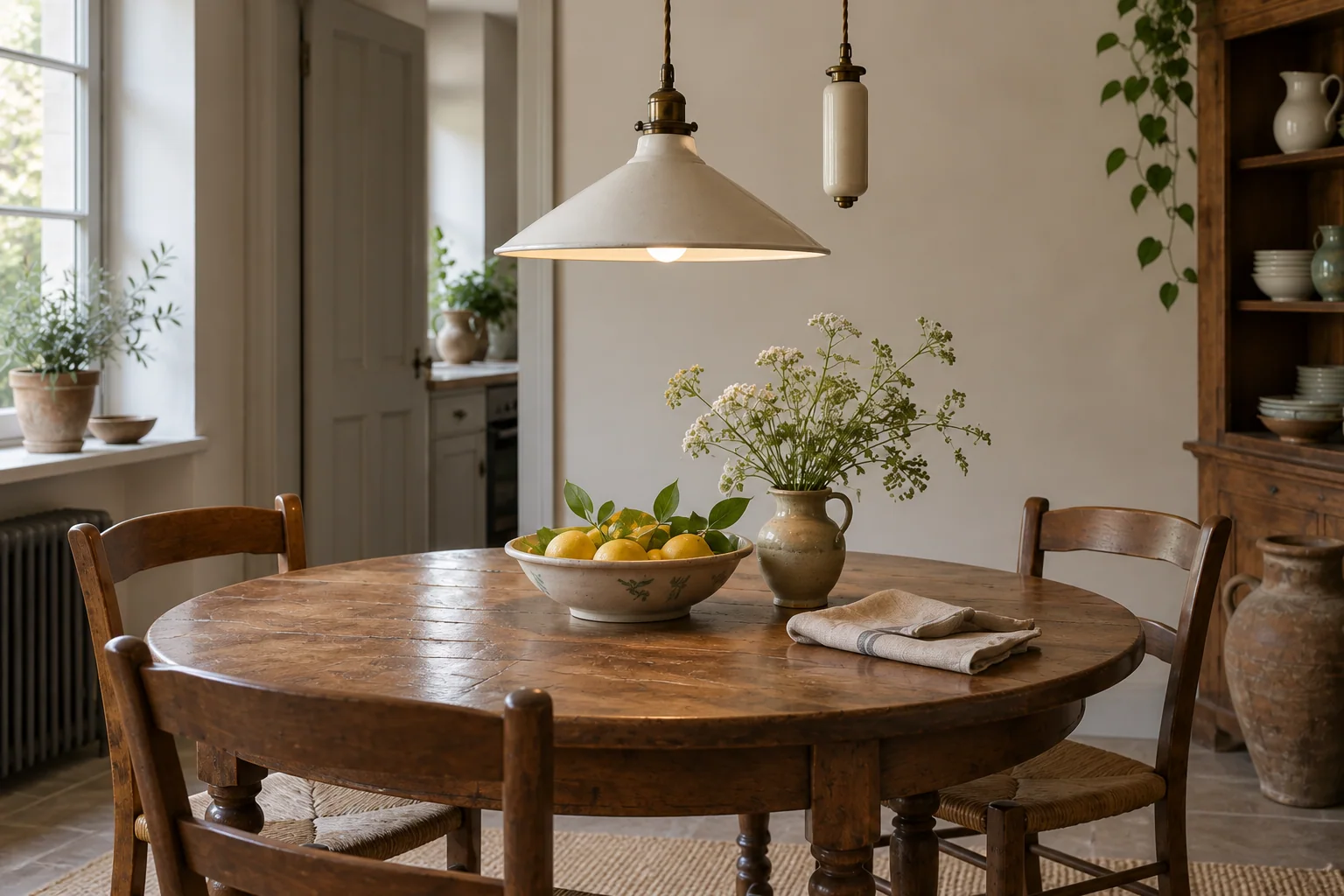
Start with the mechanism above the shade
Ask the seller to identify how height is controlled and show the ceiling fittings, suspension, shade connection and counterweight where present. Keep every loose piece in the inventory. A simple-looking weight can be an essential part of the balance rather than decoration.
Original BTC’s current Rise & Fall School Light is a useful manufacturer example of a counterweighted design, with separate minimum and maximum drop specifications. It illustrates the information to request. Its parts, weights and dimensions should not be transferred to an unidentified older pendant.[1]
Do not add weight, change the shade or substitute a cord to make an old mechanism behave. Ask a lighting specialist to assess the complete assembly and its intended movement. A new lampshade can change the mechanical question as well as the appearance.
Draw the highest and lowest positions
One owner-listed vintage copper pendant records a 40 cm shade and a drop ranging from 50 to 105 cm. The same listing says the wiring needs replacement despite describing a functioning mechanism. That is a useful example of electrical work and movement being separate parts of the purchase.[2]
| Record | Include |
|---|---|
| Highest intended position | Ceiling reference to the lowest part of the shade. |
| Lowest intended position | The same reference and the complete shade. |
| Counterweight travel | Its highest and lowest positions and nearby obstructions. |
| Table and room | Tabletop height, position, headroom and the ceiling fixing location. |
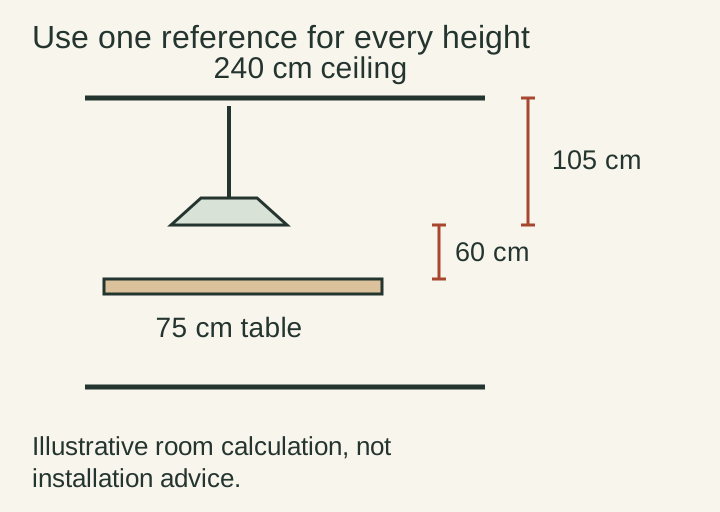
For an illustrative calculation, if the ceiling is 240 cm above the floor and the lowest shade point hangs 105 cm below it, that point is 135 cm above the floor. Over your measured 75 cm table, the gap would be 60 cm. Those numbers explain the geometry; they are not a recommended installation height or a specification for the listed lamp.
Have the installer confirm what a seller’s drop measurement includes. Measuring to the top of the shade instead of its bottom can change the usable clearance considerably.
A short video should show the complete movement
If the seller can safely demonstrate an already supported assembly, ask for one uninterrupted movement through its normal range, including pauses. Does it hold without drifting? Does a cable catch, a wheel hesitate or the shade rotate unexpectedly? Do not ask someone to improvise a ceiling support just to make the video.
Record the symptom and stop at unusual resistance. A mechanism that moves only when pulled hard needs an assessment, not a more enthusiastic demonstration. Springs or enclosed retractors should be handled by an appropriate specialist rather than opened during collection.
Arrange professional electrical inspection and installation, including moving cable sections, strain relief, suspension and the ceiling support. Ask which work is included and whether a separate mechanical specialist is needed. A wiring-only quote does not automatically repair a pulley or establish suitable attachment.
Keep the movement useful after installation
Plan the lamp in relation to the table’s usual and extended positions. A rise-and-fall fitting changes height; it does not necessarily move sideways when you shift the table for guests. Check nearby cupboard doors and the path of any weight in both arrangements.
Brief the installer
This is the complete pendant and mechanism. Please assess mechanical condition, electrical work and ceiling support, and confirm the usable highest and lowest positions above my table. Which missing parts must be sourced before installation?
The reward is a light that can change the feel of dinner with a small adjustment. Buy towards a smooth, supported movement you will actually use, with all the parts needed to keep it that way.