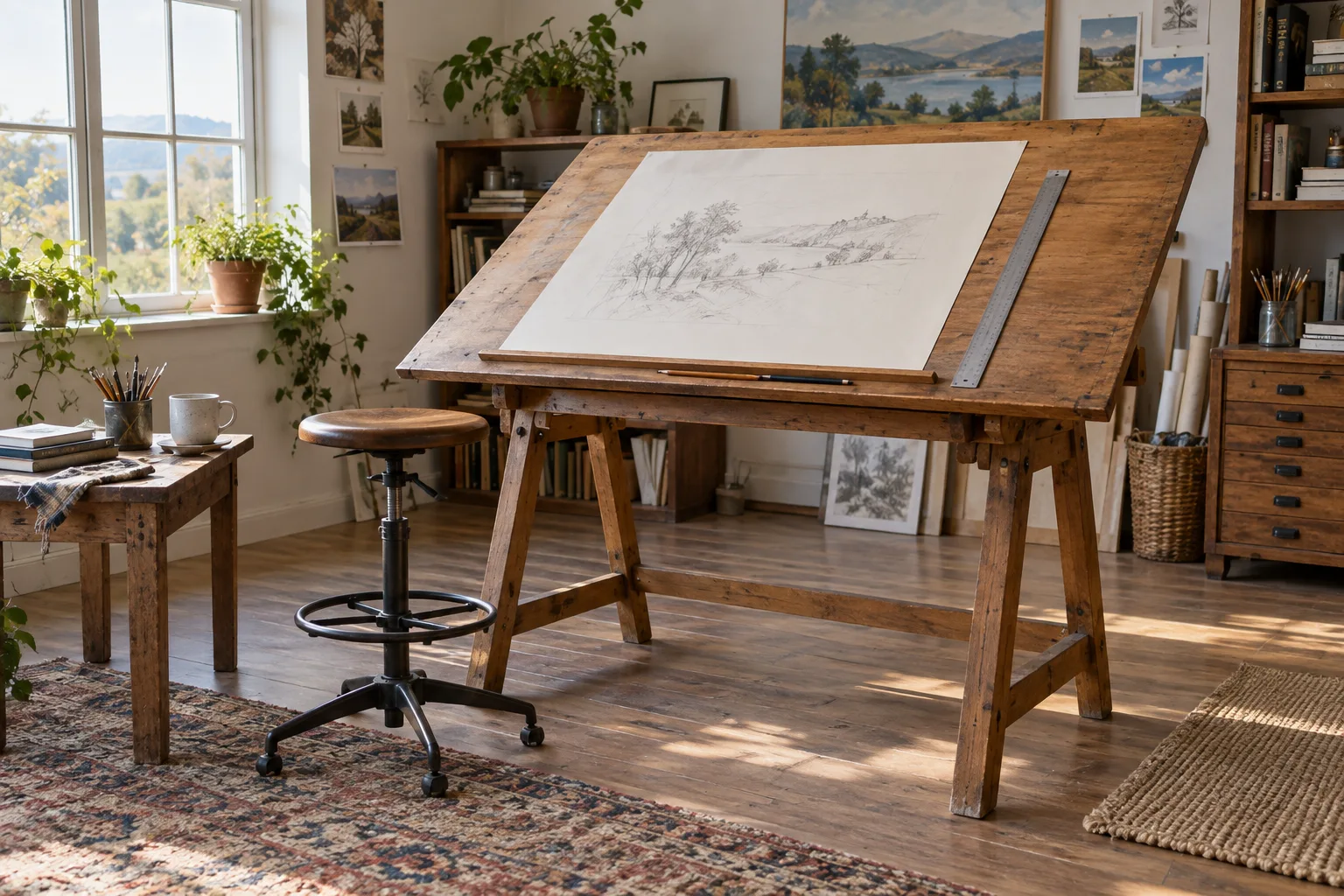
Give the table a real job
Drawing, watercolour studies, tracing and examining large sheets ask different things from a surface than typing at a laptop all day. Decide which job matters most. If the board will normally remain flat under a screen, a conventional vintage desk may give you simpler storage and legroom.
Put your usual paper and tools on a familiar table. Add the hand space you actually use, the ruler or parallel motion, and any clips. Measure that working rectangle. The draughting table’s advertised board dimensions may include areas you cannot use beside its rail or fittings.
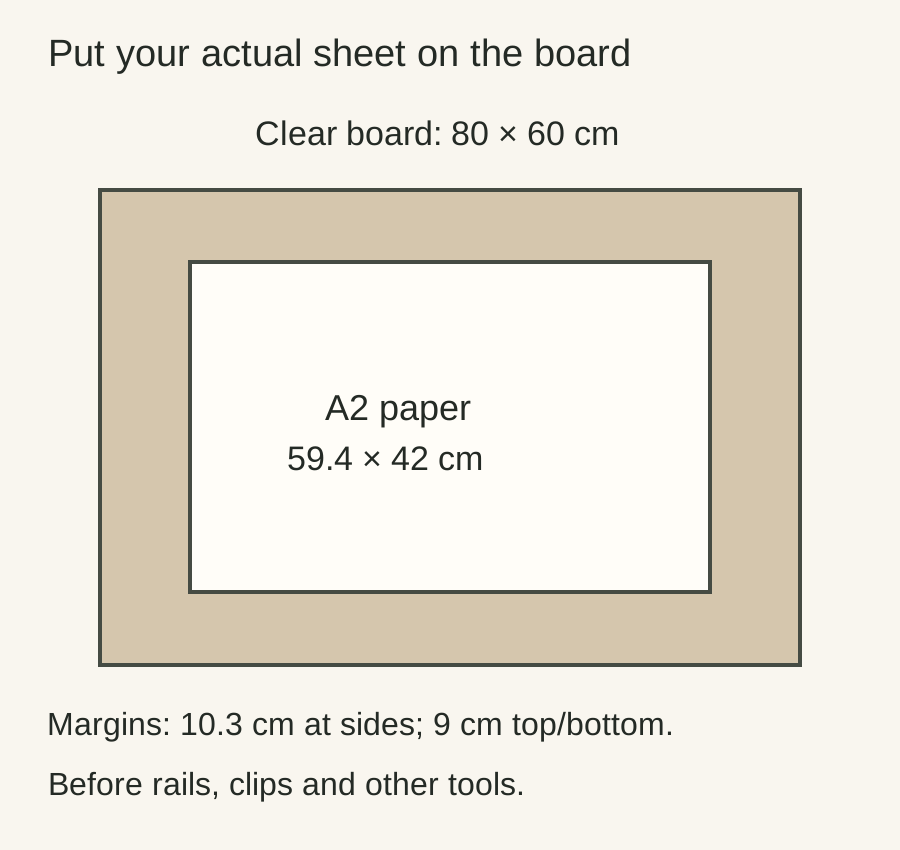
An A2 sheet is 59.4 × 42 cm. On an illustrative 80 × 60 cm clear board, centred in landscape orientation, that leaves 10.3 cm at each side and 9 cm above and below. A rail, clamp or drawing instrument reduces that allowance. Try the actual layout rather than treating those margins as a universal recommendation.
The old base may have a later top
Ask whether the board is original to the stand and whether its size, thickness or attachment has changed. An appropriately fitted later board can be a useful working replacement. A much larger top can change access, handling and the demands on the adjustment system.
Look along the surface and the edges in low side light. Describe bowing, worn corners, holes, detached covering and old attachments separately. A sheet placed over the top may improve the drawing surface, but it does not repair a distorted board or establish that its fixing is sound.
If a rail or parallel-motion instrument is part of the purchase, ask the seller to demonstrate its normal travel. Decide whether you need it before paying a premium for a complete-looking assembly. Missing instrument parts can become a separate sourcing project.
Height adjustment is not tilt adjustment
Find the maker and model where possible, then use its instructions to identify each control and support. Some tables use knobs, some notched supports, and others counterbalanced systems. Similar appearance does not mean the same release sequence.
A useful documented example is Safco’s Plan Master 3957 manual, revised in July 2016. It distinguishes the height-adjustment knobs from the board’s tilt supports and warns against completely unscrewing the adjustment knobs. That is a model-specific example of why “loosen the knobs and lift” is inadequate advice for an unknown old table.[1]
Ask the seller to demonstrate the normal adjustment with the board cleared, following the appropriate instructions. Observe whether it holds the intended working position. Keep hands out of pivots and support mechanisms; do not release an unfamiliar counterweight or test a doubtful board by leaning your weight on it.
A table which slips, needs wedging or cannot be adjusted as intended needs assessment before ordinary use. Price a known repair with someone familiar with that mechanism. A beautiful cast base cannot compensate for an unavailable or unsafe support part.
Bring the stool into the decision
Try the intended seated or standing position after the table’s normal operation has been established. Can you approach the front edge without a crossbar meeting your knees? Can your feet rest on the floor or a suitable stool support? Notice whether the pencil ledge presses into your forearms.
Check reach to the upper part of your working sheet without repeatedly hauling yourself forwards. A very large board may suit standing work but be inconvenient for the smaller drawings you make each evening. Tilt can help present the work, provided the actual position suits you.
If computer work is also planned, consider the screen, keyboard, chair and lighting together. HSE’s workstation guidance treats the complete setup as the assessment, not the desk alone. Do not assume a drawing stool and inclined board make a suitable all-day computer position.[2]
Tools need a level home
Give pencils, water, a lamp and anything that rolls its own stable place. A small level side table may be more useful than crowding a narrow ledge. Check the board’s sweep and rear reach while it changes angle, along with room to get on and off the stool.
A useful seller request
Please show the table flat and at a normal working angle, identify the height and tilt controls, and provide the maker’s instructions if available. Has the board or its attachment changed? Please describe any slipping, missing parts or repairs, and give the usable board dimensions and the footprint in the intended position.
Choose the table when you can picture using it with an actual sheet in front of you. Scratches from an earlier working life can be part of its appeal. A mechanism you cannot use or a board you cannot comfortably reach is a less romantic problem to solve.
For a mainly computer-based workspace, compare choosing a vintage desk.