Start by identifying the production
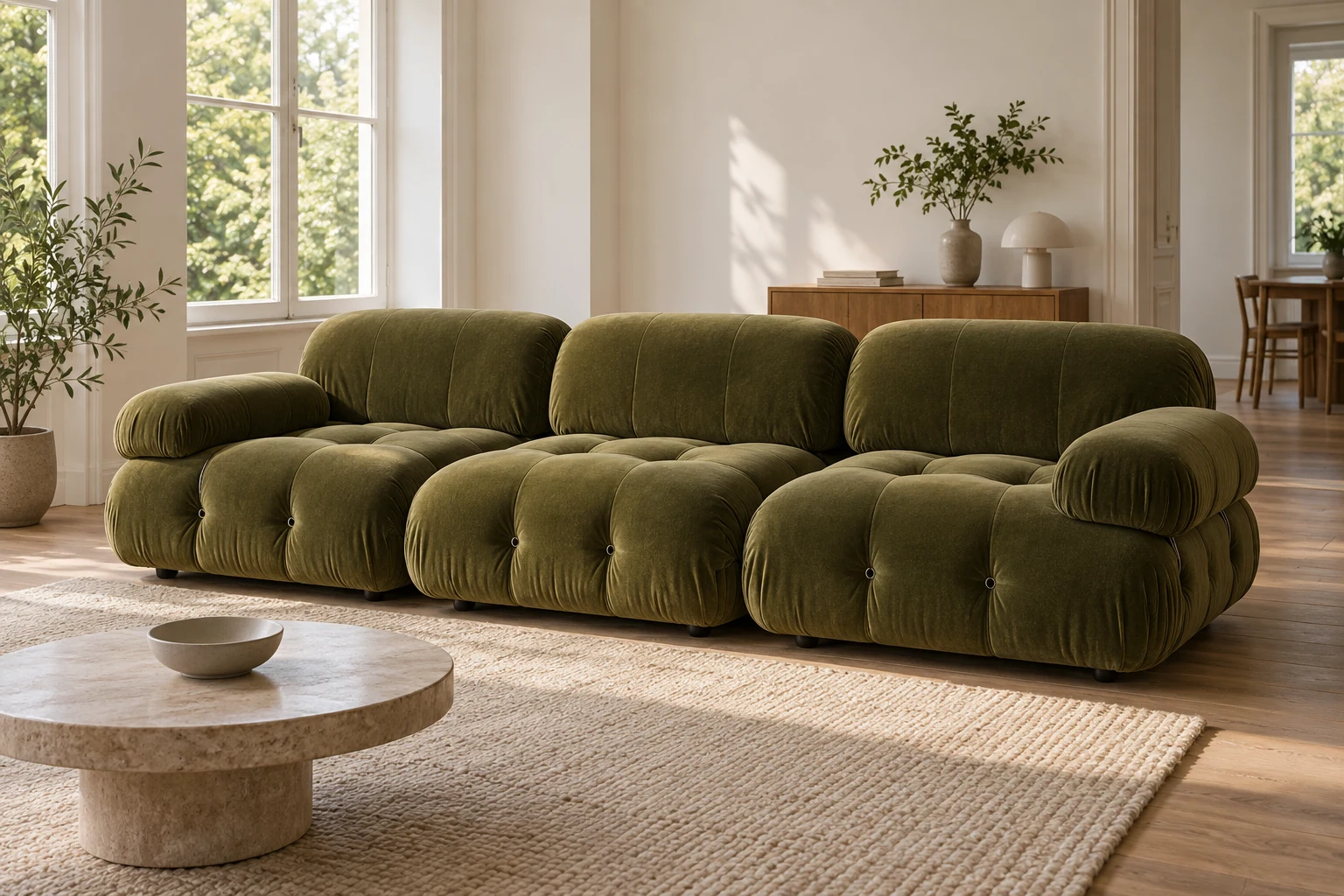
Camaleonda is easy to recognise as a soft landscape of rounded, deeply tufted blocks. A sale photograph can show that effect while telling you very little about the sofa’s age or what has happened inside it. Begin with the production claim and the records that belong to the offered components.
B&B Italia’s account connects Mario Bellini’s 1970 design with the 2020 version. It describes the later interior as redesigned, while retaining the characteristic modular form. An older reupholstered example and a used later edition therefore need their own construction and repair histories.[1]
Ask whether all the pieces were acquired together. Where a composition has grown through later purchases, keep the records for each addition. Similar upholstery does not demonstrate a shared production date, and new fabric can make separately sourced pieces look like a single original order.
For restored pieces, request what was retained inside the seat, back and arm elements, along with any changes to filling, covers and attachment parts. “Fully reupholstered” is a starting description. The actual scope helps explain why one module might feel or sit differently beside another.
Turn “pieces” into a composition
Ask the seller to show every included item in one annotated photograph, then identify the seats and the back or arm elements attached to them. Give each seat a letter. A three-seat row with a back behind each position and an arm at each outer end calls for three seats, three backs and two arms, plus the appropriate feet and joining parts.
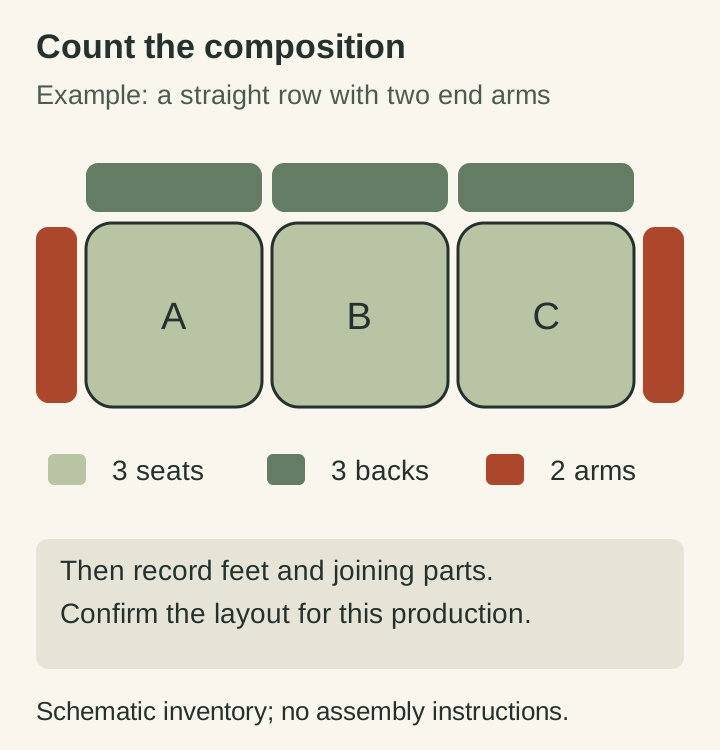
The distinction matters when reading a short advertisement. Three seats and two backs could offer two backed positions plus an ottoman, if those components are suitable for that use. They cannot provide three backed positions without another appropriate back. Write down the actual arrangement you would accept today.
B&B Italia describes the design’s cables, hooks and rings as central to its form and modularity. For a purchase, ask to see the relevant joining parts on the actual pieces and the intended layout assembled using the correct method. That design principle alone does not confirm interchangeability between old and later components.[1]
Record an arm and a back as the specific element supplied, including its dimensions and attachment. Do not assume that a small upholstered block can do either job, or that a fitting found elsewhere will join the pieces. A named missing part gives a service contact something concrete to assess.
Why the 90 cm description can mislead a floor plan
The manufacturer’s design description refers to a 90 × 90 cm seat module. Its 2020 Masterguide, however, lists the CM96C central element at 96 × 96 cm overall and 67 cm high. Those figures serve different purposes. Use the component’s complete dimensions when planning the furniture you will bring home.[1][2]
| Reference | What the number describes |
|---|---|
| 90 × 90 cm | The seat module in B&B Italia’s design description. |
| CM96C: 96 × 96 × 67 cm | Overall width, depth and height of the central element listed in the 2020 Masterguide. |
| Three widths: 3 × 96 = 288 cm | An initial sum for three such elements; verify the complete assembled layout and its end conditions. |
Using 90 cm three times would give 270 cm, an 18 cm difference from that width sum. That is enough to matter beside a doorway or radiator. The calculation shows why you need the right reference; it is not a promise that every three-piece Camaleonda measures 288 cm.
The same Masterguide distinguishes the CM96P ottoman at 96 × 66 × 40 cm from the deeper central element. A similarly coloured low block is therefore not automatically a full-depth seat module. Match the offered component, its code where established and its measured shape before designing a longer row.[2]
Try the arrangement you intend to live with
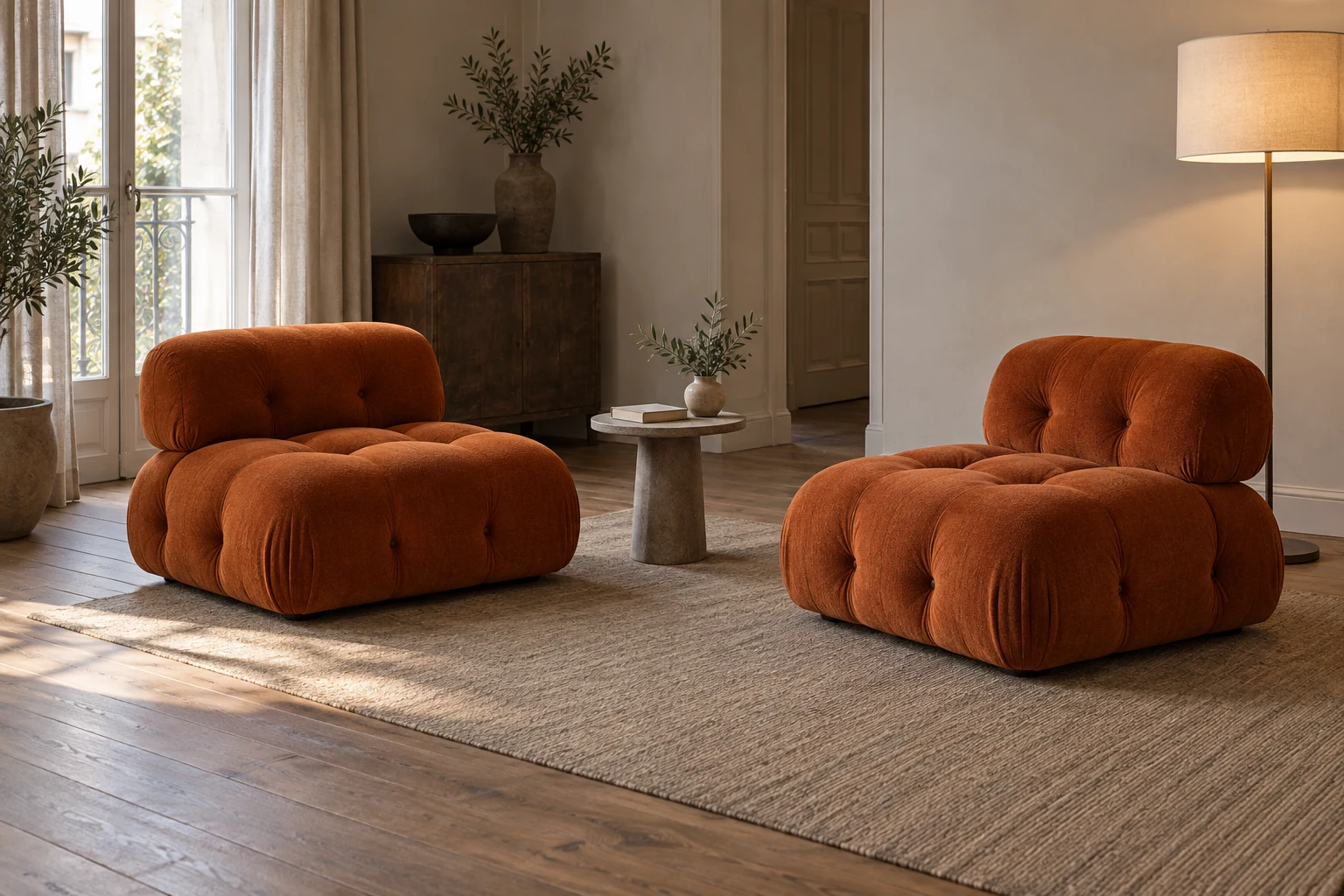
Place the intended arrangement on a room plan, including the usable route past it and access to the table. Then try more than one of the actual seats when their condition permits. Compare usable depth, back support, seat height and firmness. A composition can look even while adjacent places feel quite different.
Sit near the join you expect to use. Decide whether you prefer the sofa as a continuous row, separate seats or a lounging arrangement with an ottoman. Each choice changes the backs and arms you need, the space around the table and which sides of the upholstery remain visible.
Inspect the surfaces that a new layout would expose. A faded rear, a repaired outer edge or a difference between cover batches may be hidden when the pieces stand against a wall. Ask for those views before paying extra for flexibility you might not enjoy using.
Quote the work by component
Give the upholsterer the same labelled inventory you received from the seller. Ask them to identify cover work, internal rebuilding and attachment work for each seat, back and arm. A price for one seat cover will not tell you the cost of restoring an entire three-seat composition with all its surrounding elements.
B&B Italia’s shop FAQ directs enquiries for additional Camaleonda carabiners through its design service or showrooms. It also recommends a skilled upholsterer for cover removal. These are useful enquiry routes for the relevant production; get older-part compatibility and the actual work confirmed before committing.[3]
Include the confirmed missing components, repair, collection and return delivery in your comparison. Get transport dimensions and an agreed dismantling plan for the specific set. Keep small parts with a labelled inventory so the sofa can be reassembled as agreed after delivery.
A message to send with your floor plan
I would like to make this arrangement. Could you label every included seat, back and arm, give its actual dimensions and show the feet and joining parts? Please identify the production and any separately acquired or restored pieces. Can this layout be assembled with what is included, and which exact parts or work would still be needed?
An incomplete composition can be worthwhile when you enjoy the arrangement it already makes or have confirmed how to finish it. Choose on that basis. A hypothetical matching module in a future listing should not be doing essential work in today’s budget or floor plan.