Design story

Panama: a wall lamp that reaches into the room

A wall is a useful place to fix a lamp, but it is rarely the place where a book or tabletop needs light. Panama makes the distance between those two places part of its visible form.

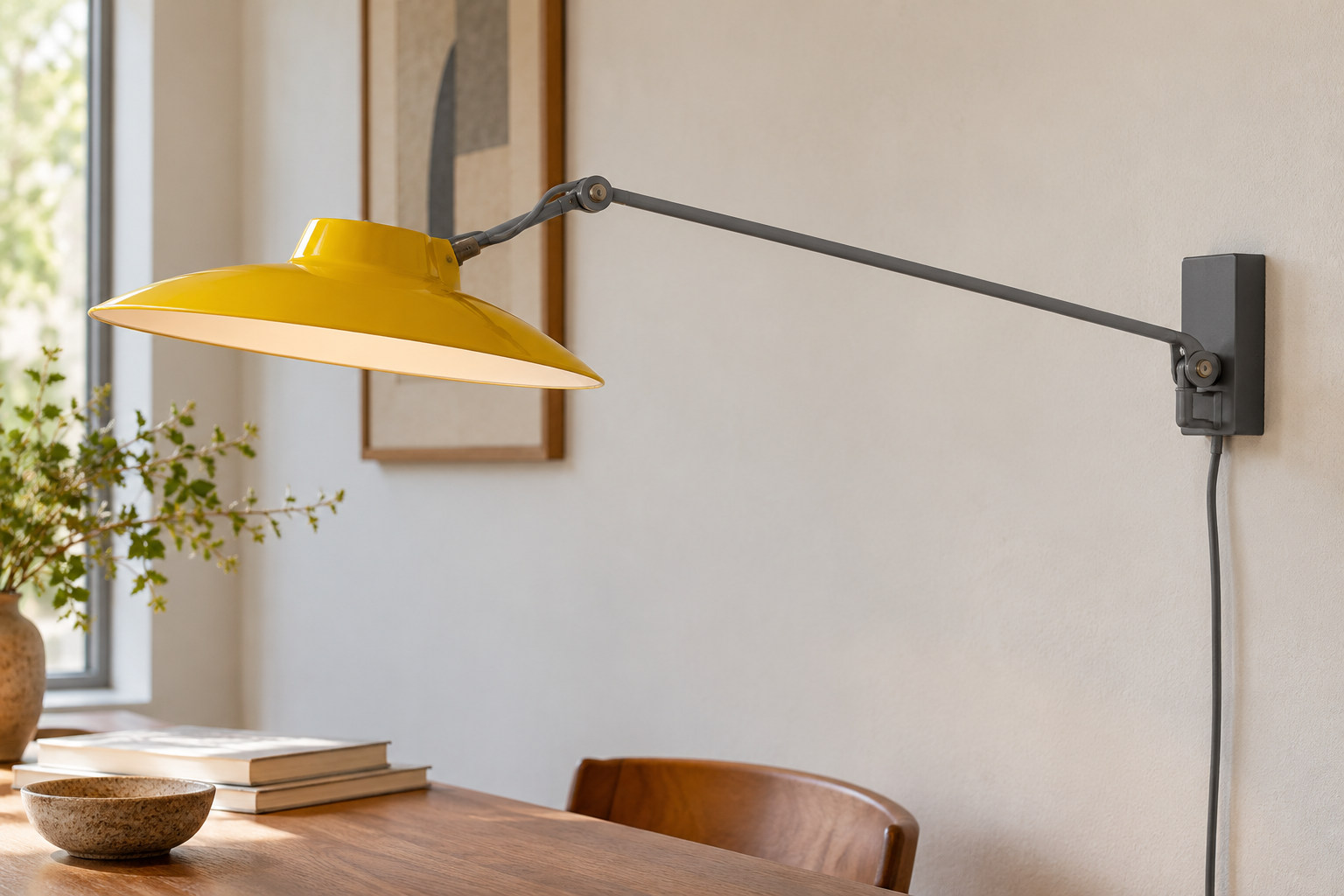
Yellow broad-brimmed wall-lamp shade carried into the room by a fine jointed grey arm, with the wall attachment visible.
PatinaHall editorial reconstruction. It is not a documentary photograph. This interpretation emphasises reach and the broad shade’s outline. The pictured setting is imaginary and provides no installation, adjustment or electrical-safety evidence.
On this page
Key facts & takeaways

At a glance

Subject
Giso 4050 (Panamahoed)
Entry
Design story
Last reviewed
23 October 2026
Designed
1956documented

Three things to remember

  1. The Gispen foundation lists wall lamp 4050 in 1956.
  2. Boijmans records the model as Giso 4050, or Panamahoed.
  3. The broad shade and reaching support play different spatial roles.

Put the shade where the room needs it

The Panama’s wall attachment and broad shade occupy different places. Between them, the support crosses an interval of empty space. The arrangement is easy to understand visually: the wall carries the lamp while the shade reaches towards an activity.

Stichting Gispen Collectie lists the wall lamp numbered 4050 in 1956. Museum Boijmans Van Beuningen records the model under Wim Rietveld as Giso 4050 (Panamahoed). The nickname and model number lead back to the same design.12

A broad brim at the end of a fine line

The shade brings a large surface to the end of a relatively slender support. That difference in visual weight is the lamp’s memorable gesture. The broad brim gives the object its hat-like character, while the arm explains its reach.

Read the lamp against the room rather than as a small sculpture isolated from it. Its outline includes wall, distance and the place beneath the shade. Furniture and lighting can work on the air between things as well as on the things themselves.
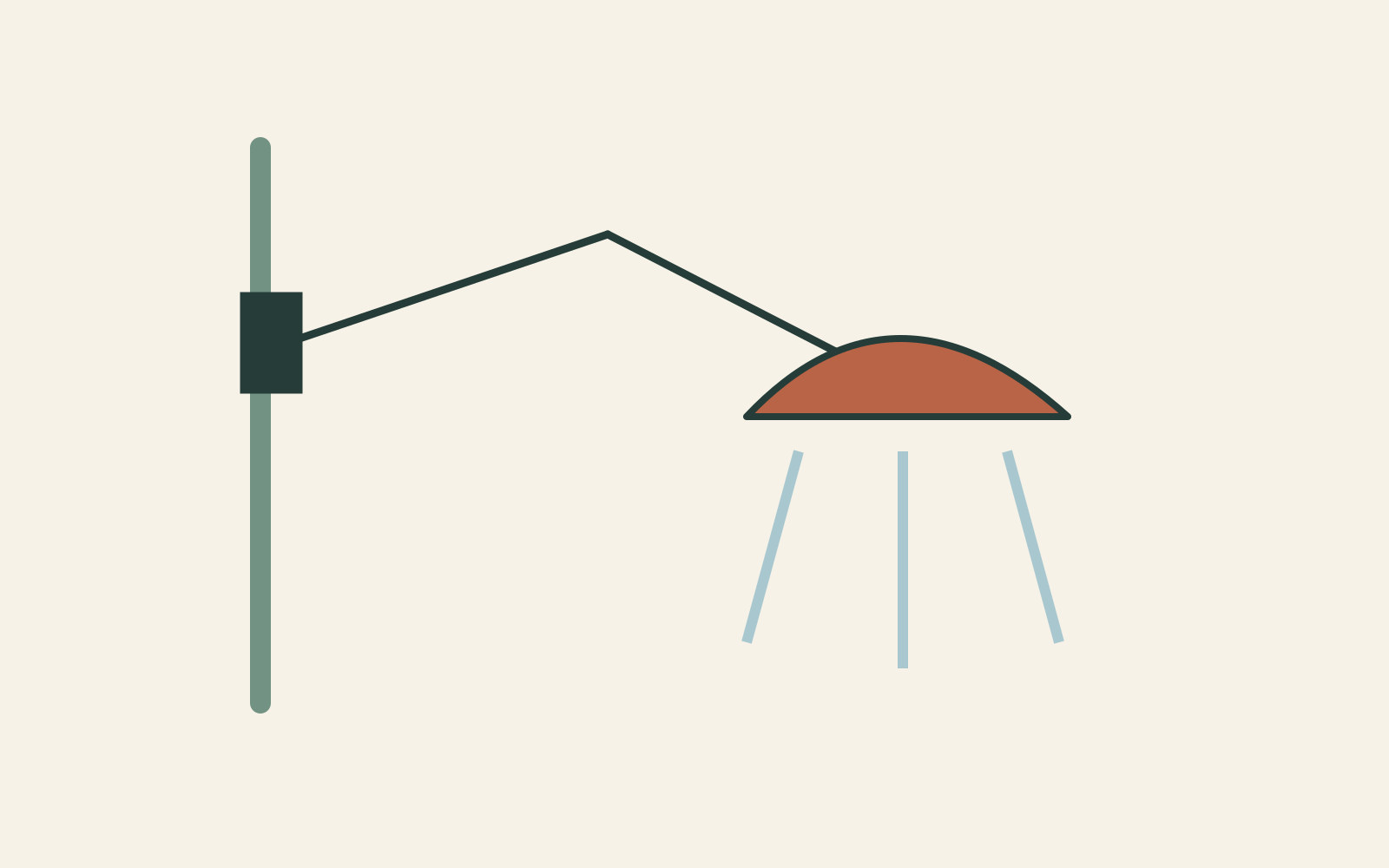
A wall line supports an extended jointed arm and broad shade, with pale strokes suggesting a separate area below it.
Original PatinaHall schematic, not to scale. The wall, reaching support and shade occupy different places. Pale rays mark the idea of an addressed area, not a photometric beam pattern, recommended clearance or installation instruction.

Construction belongs inside the idea

The Gispen foundation describes Rietveld as a technically trained designer who grouped elements according to available materials and production possibilities.1 That account makes the lamp’s legible arrangement particularly satisfying: support and shade have clear jobs.

Panama’s generosity is spatial. It allows a lamp fixed at one point to address another part of the room, and makes that simple relationship worth looking at.
Research notesEvidence, connections and limits

Stichting Gispen Collectie lists wall lamp 4050 in 1956; Boijmans identifies it as Giso 4050 (Panamahoed). The historical design account establishes neither the condition nor electrical safety of an individual lamp.

Evidence map

Connected subjects and evidence

Reviewed facts

  • Designed 1956documented

    Stichting Gispen Collectie lists wall lamp 4050 in 1956; Boijmans identifies it as Giso 4050 (Panamahoed). The historical design account establishes neither the condition nor electrical safety of an individual lamp.

    Reviewed 23 October 2026 by PatinaHall editorial.
    • Source 1Belangrijke ontwerpen: 1956 Wandlamp no. 4050; technical approach

Reviewed connections

  • Giso 4050 (Panamahoed)designed byWim Rietvelddocumented

    The cited primary or institutional record identifies this designer for the repeatable model or coherent project family. A design credit does not identify the manufacture of every example.

    Reviewed 23 October 2026 by PatinaHall editorial.
    • Source 1Belangrijke ontwerpen: 1956 Wandlamp no. 4050; technical approach
  • Giso 4050 (Panamahoed)manufactured byGispendocumented

    The source establishes this maker relationship in its stated scope. A historical example, current production and the original design date are separate facts.

    Reviewed 23 October 2026 by PatinaHall editorial.
    • Source 1Belangrijke ontwerpen: 1956 Wandlamp no. 4050; technical approach

Research trail

Sources and further reading

  1. Wim Rietveld: wall lamp 4050, 1956Stichting Gispen CollectieAccessed 23 October 2026
  2. Wim Rietveld collection: Giso 4050 (Panamahoed)Museum Boijmans Van BeuningenAccessed 23 October 2026

Last reviewed 23 October 2026. Found an error or a stronger primary source? Contact PatinaHall.