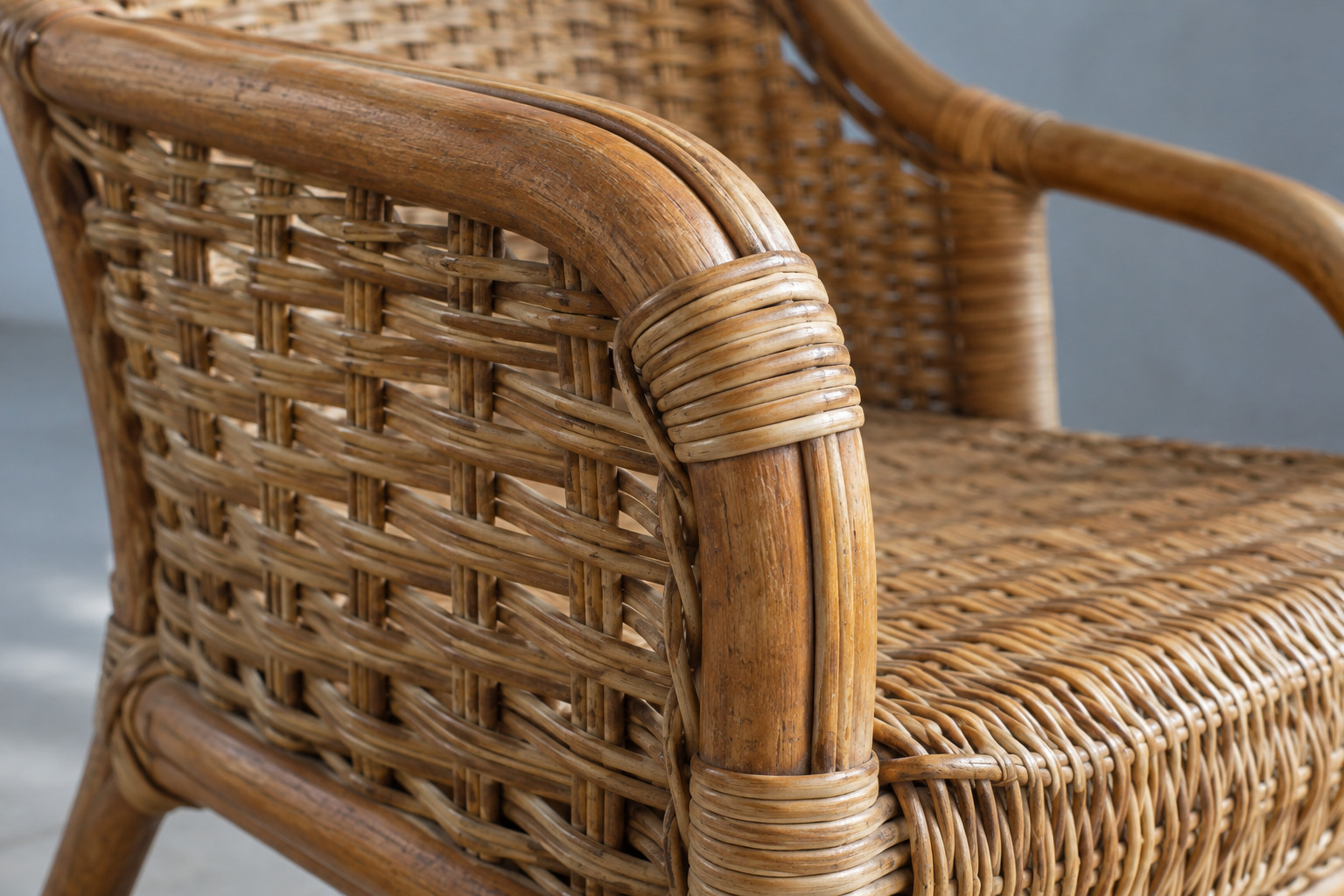
Follow the strand to the frame
Begin at the edge of a woven chair. The narrow strand passes over and under its neighbours, then meets something thicker. Around a joint, another strip may wrap repeatedly around the connection. A pattern that looked uniform from across the room separates into several kinds of work.
The frame establishes the outline. The woven field fills the space within it. Bindings draw attention to places where parts meet, even when their repeated turns make the joint look decorative. A chair is therefore a useful place to see weaving at different scales.
The Met’s armchair 1978.500 makes the material distinction concrete. Made by Heywood Brothers and Wakefield Company between 1897 and 1910, it is catalogued as rattan, maple and possibly ash. The finished object brings different plant materials together rather than being made from a single substance called wicker.3
More than a chair on the porch
Woven furniture often calls up a particular setting: a veranda, an open window, a room used in warm weather. Historical catalogues offered a broader domestic world. Cooper Hewitt’s account of The Dryad Cane Book describes chairs, tables and other furnishings in varied styles, with pieces for children as well as adults.1
The American firm W. & J. Sloane promoted the English-made range. The catalogue placed woven furniture within a household’s choices, rather than treating it as a single rustic exception to ordinary furnishing.1
The visual effect helps explain that range. A dense piece of cabinet furniture presents a continuous face. A woven one repeatedly interrupts its own surface with small openings. The room remains partly visible through it, while the strands cast a second pattern in shadow.
A showroom becomes a teaching business
Harry Peach opened Dryad’s Leicester showroom in 1907. Leicester Museums traces the later craft business to materials supplied during the First World War for occupational therapy at the 5th Northern General Hospital. Dryad subsequently developed a substantial trade in handicraft materials and instruction.2
Making and teaching were connected, but not identical. A customer could purchase a finished object, acquire materials to make something, or study a pattern made elsewhere. Each route placed the craft in a different relationship with its user.
Peach’s basketry collection, assembled between 1918 and 1936, reached far beyond England. The museum describes objects from Africa, Asia, the Pacific, Europe and the Americas, including places then governed as British colonies.2
The maker beyond the catalogue
That collection gives the neat company history a necessary complication. A showroom and a printed pattern book can make a business highly visible. The people whose knowledge shaped the collected objects may be much harder to identify.
The history of wicker therefore cannot begin and end with a European trade name. The wider record contains many materials, local practices and makers.
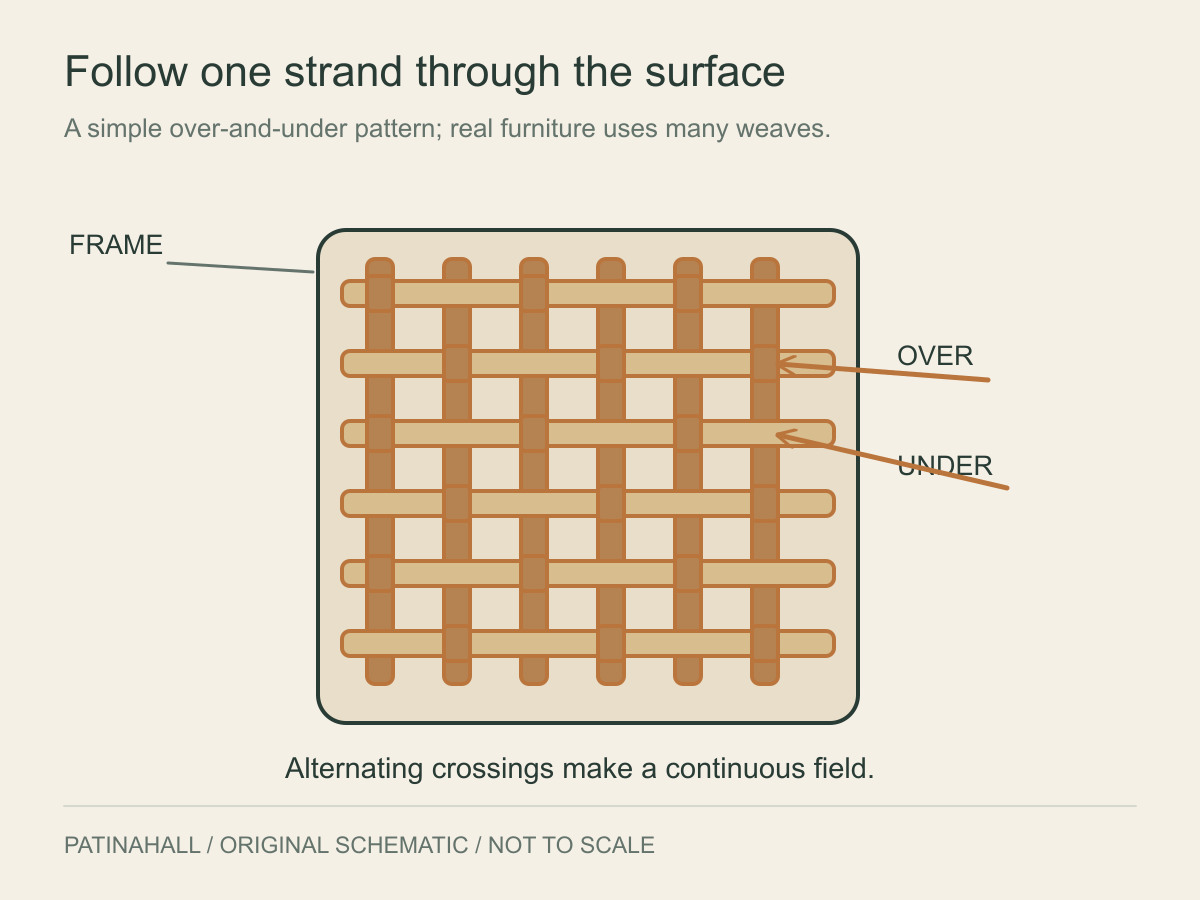
Return to the chair’s edge. Follow one strand until it turns, disappears beneath another and joins the frame. The finished surface is a pattern, but it is also the accumulated work of decisions made one crossing at a time.