The package was part of the encounter
Most furniture is recognisably itself before it reaches a room. A table may need its legs attached, but the pieces already announce what it will become.
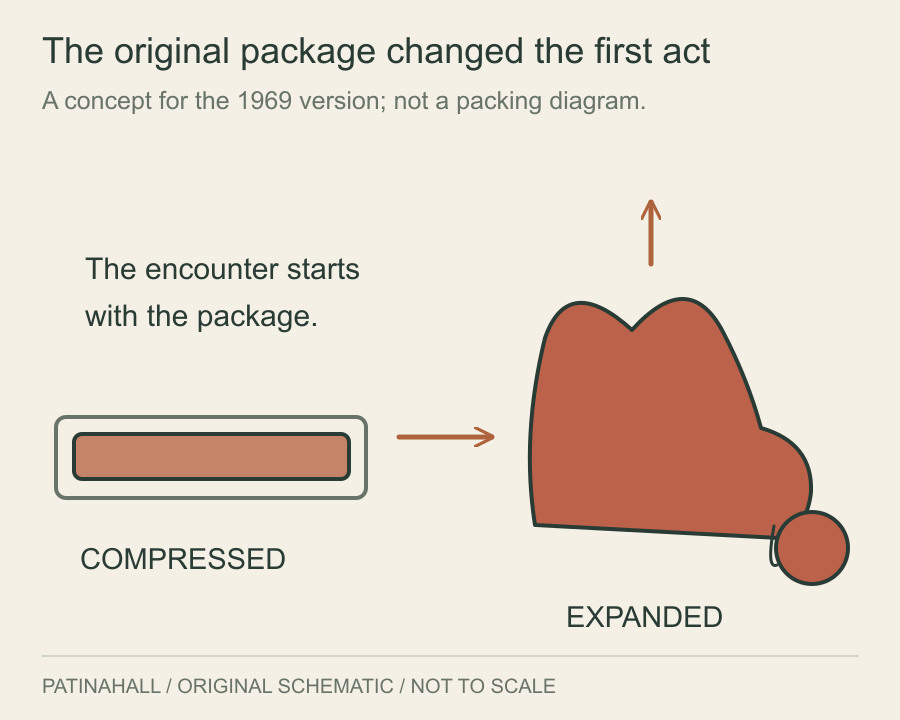
The original UP series changed that experience. B&B Italia’s history records Pesce’s 1969 design as furniture made to travel in a vacuum package. Opening the pack released a form that had occupied far less space in transit.2
The contrast was part of the fascination: a compressed object becoming a large, bodily presence. Arrival was no longer just a delivery problem to be hidden behind the finished photograph. It offered a short demonstration of what a new material system could do.
Foam gives the body its outline
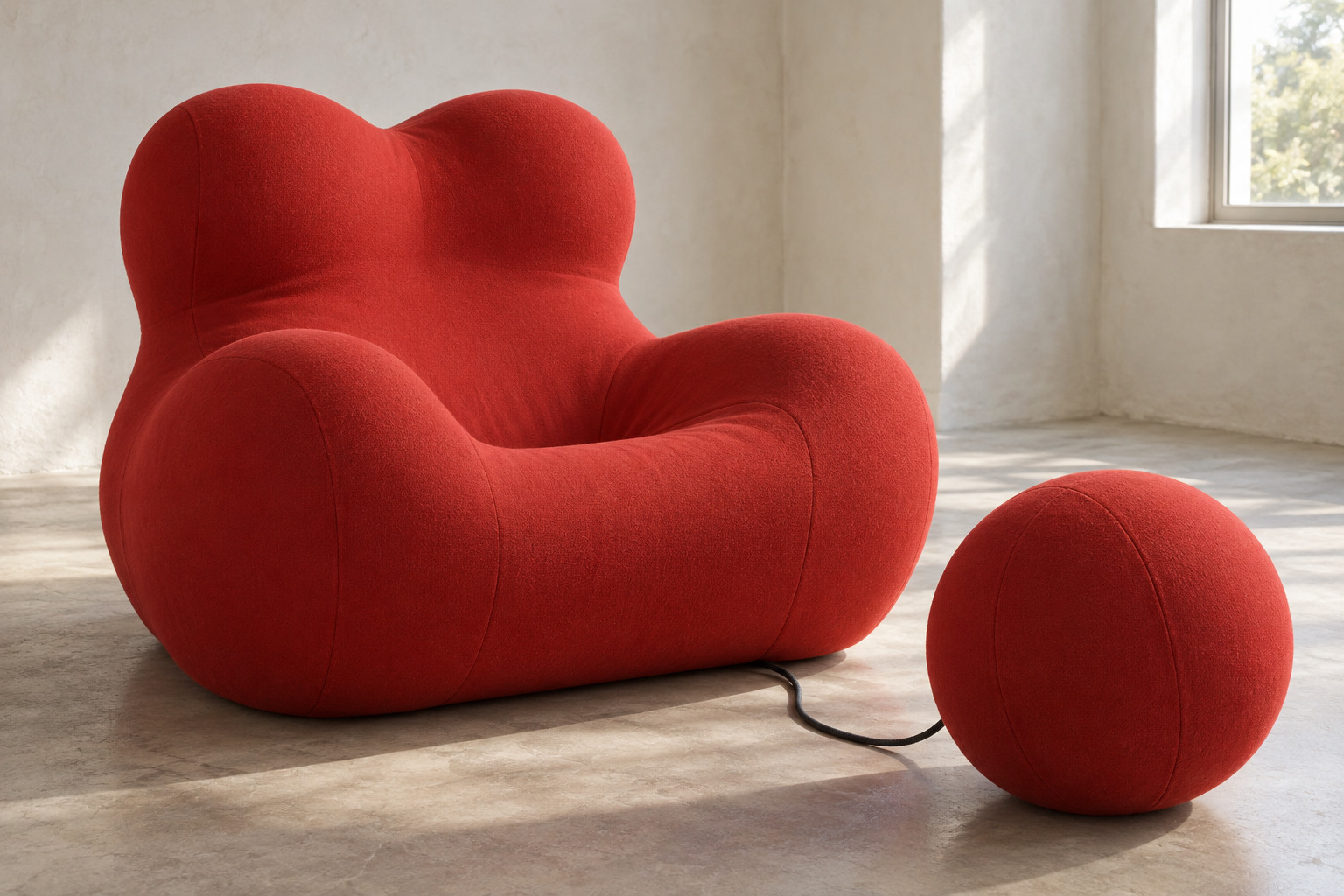
MoMA records UP5 and UP6 as polyurethane foam covered in stretch fabric, with C&B Italia as the manufacturer. The chair’s broad rounded back, deep seat and generous arms read as parts of one continuous body.1
Elastic cloth follows that volume closely. Instead of presenting a frame with separate upholstered panels, the object makes softness its principal visible form. The footrest is simpler still: a ball beside the chair, linked to it by a cord.
The pairing makes scale easy to read. One volume is shaped around the human body; the other reduces support to a near-geometric solid. Their connection turns two pieces of seating into a small scene.
The ball changes the meaning
The cord is easy to miss in a photograph filled by the red or striped chair. Once noticed, it changes the relationship between the two forms.
B&B Italia’s account describes the chair as a female figure and the attached ball as an image of captivity. This is the maker’s presentation of Pesce’s intended metaphor, rather than a meaning that every sitter is required to find.2
It places an uneasy idea inside an apparently welcoming object. The chair’s generous bodily shape and the ball’s restraint pull in different directions. Comfort and criticism share the same piece of furniture.
A recognisable form can have a different arrival
The UP series returned in 2000 using flexible cold-shaped polyurethane foam. B&B Italia states plainly that these pieces are produced in their final form and are no longer vacuum packed. The stretch-fabric covering and recognisable shapes remain.3
That difference is worth keeping in the story. The outline can survive while the way an object is made and delivered changes. A later UP chair still carries the visual argument of the original, but it does not repeat the same unpacking performance.
Look at UP5_6 with both histories in mind and the chair becomes two things at once: an unusually expressive place to sit, and a reminder that a design’s life includes the moment before it looks like the object we know.