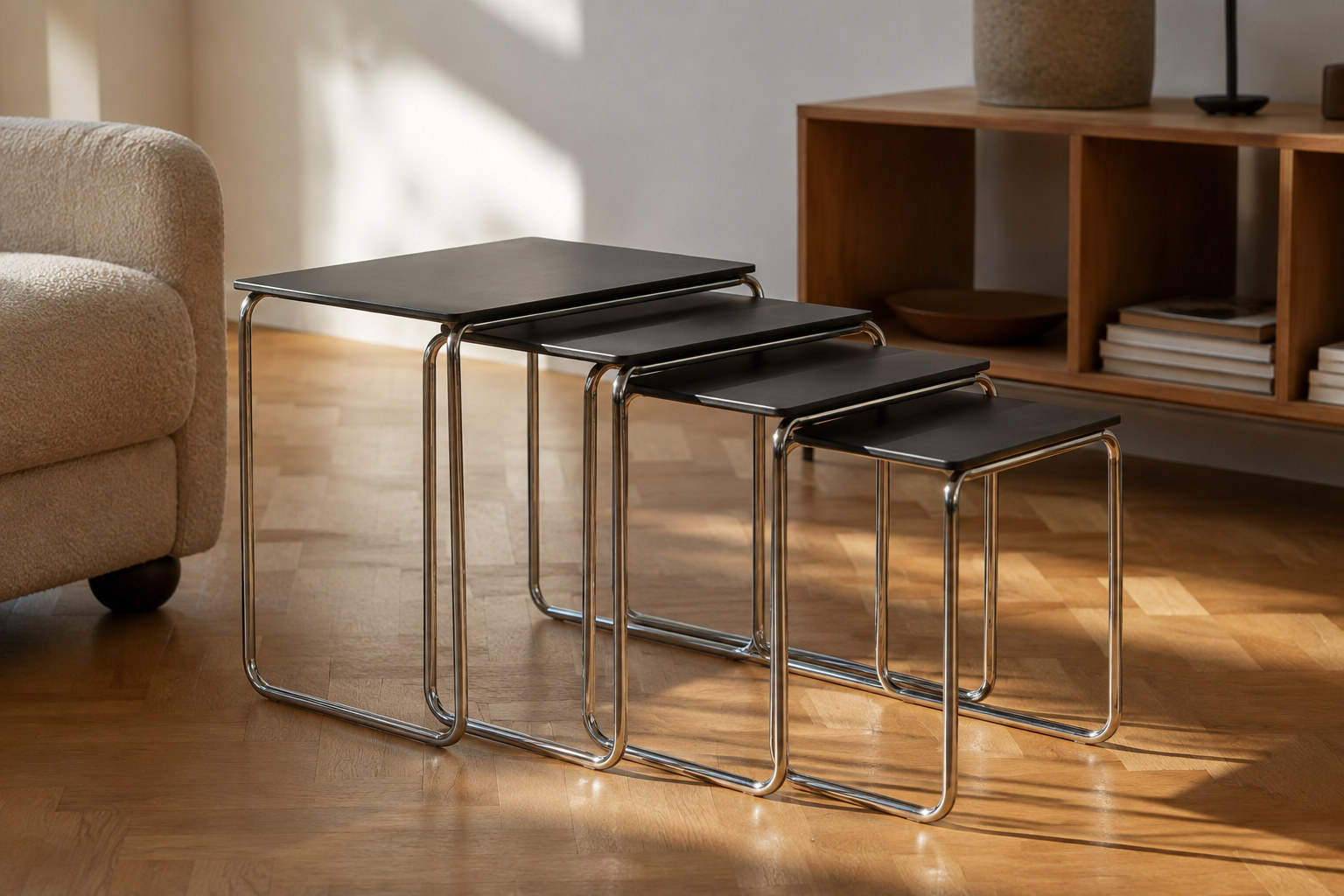
One nest, several conversations
A single coffee table keeps everyone’s cup near the middle of a room. A nest offers another arrangement. The small tables can sit beside separate chairs, leaving the centre open, then return beneath the largest when the gathering ends.
B 9 makes that change visible through four related sizes. Thonet’s product material presents the group as individual small tables that can nest together, each carrying the same relationship between a flat top and a bent tubular-steel frame.2
The attraction is not simply that four tables occupy less space when stored. Their separate identities remain clear. You can see the set as a compact stack of surfaces or as a small family distributed around the furniture.
Steel in the Bauhaus cafeteria
Thonet dates Marcel Breuer’s design to 1925/26 and describes its use in the cafeteria at the Bauhaus in Dessau. The company places it within his experiments with tubular steel, drawing a connection with the bending processes of earlier Thonet furniture.1
The same account places Breuer in contact with the aircraft manufacturer Junkers in Dessau and records the furniture in Thonet’s 1930/31 card catalogue. A small domestic surface thus sits within a wider exchange between workshops and industries.1
The material gives the table a particular kind of openness. A narrow tube can trace the path from tabletop to floor without filling the area below with a solid pedestal or broad cabinet. The gaps remain part of what a person sees.
This helps explain how a design associated with an institutional setting can feel quite natural beside a domestic chair. The small top performs a familiar job; the frame gives that ordinary surface a distinctive outline.
The smallest table determines the largest
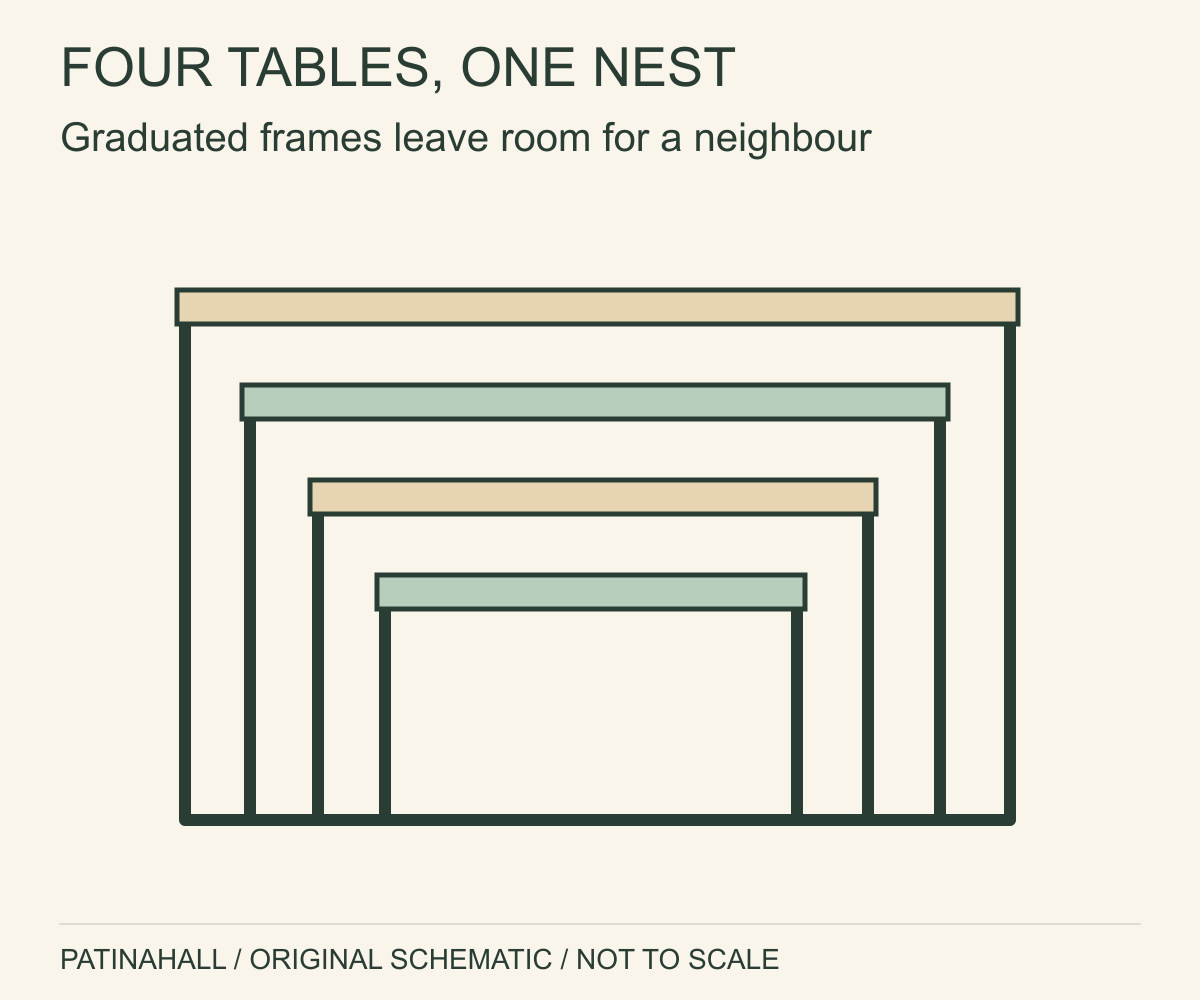
Nesting is a relationship between objects, not a feature that one table can possess alone. Each smaller frame needs a clear route beneath its neighbour. Heights, widths and the position of the supporting tubes all participate in that movement.
Look at a complete set from the side and the design becomes easier to read. The tables are close relatives, but they cannot be identical. Their graduated dimensions preserve the same idea while creating room for the next member of the set.
The diagram shows that sequence schematically. It explains why an arbitrary collection of four similar steel tables does not necessarily make a working B 9 nest.
A modest surface with a long history
Thonet still offers B 9, with finish and material choices documented for current production. That continuing availability is a different fact from the age of an individual table found second hand.12
For a reader who encounters one small table on its own, the missing neighbours are part of the story. The object was conceived within a set that could expand and contract. It brings a surprisingly flexible room arrangement out of something as ordinary as a place to put down a cup.