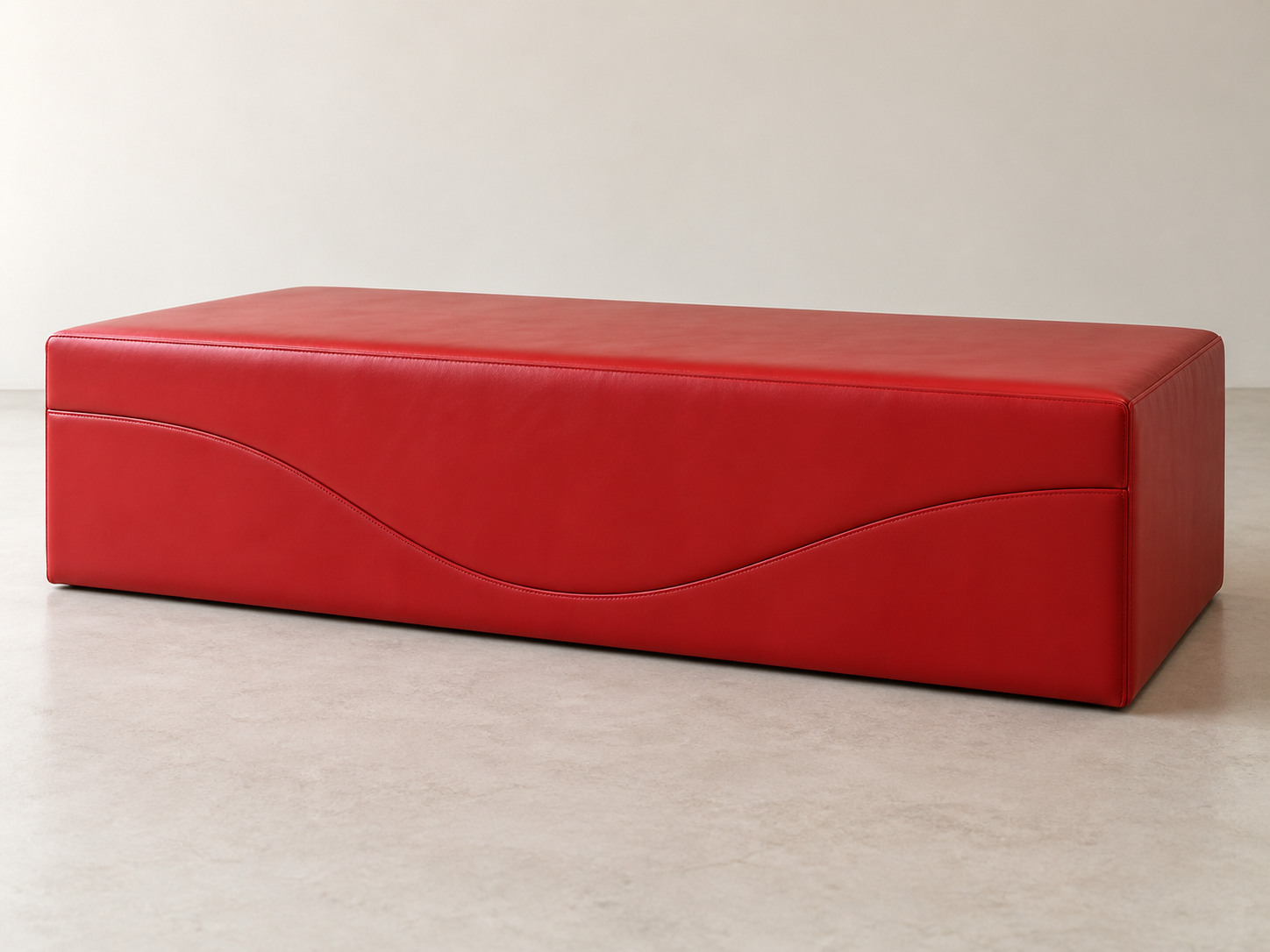
An exhibition before the catalogue
Superonda emerged from the environment around Superarchitettura, the 1966 exhibition at Pistoia associated with Archizoom and Superstudio. Drawing Matter preserves photographs and describes an early striped prototype among the show’s large, colourful objects. Poltronova’s Sergio Cammilli encountered the design there.3
That beginning helps explain why the sofa looks so unlike a polite upholstered suite. The experiment concerned behaviour and expectations as well as shape. What would happen if the furnishing of a room became less settled? What if the occupant could rearrange the object instead of simply choosing a cushion?
The production model belongs to 1967. The Indianapolis Museum of Art’s record identifies Archizoom as designer, Poltronova as manufacturer and vinyl over foam as the material construction.2
The cut supplies both halves
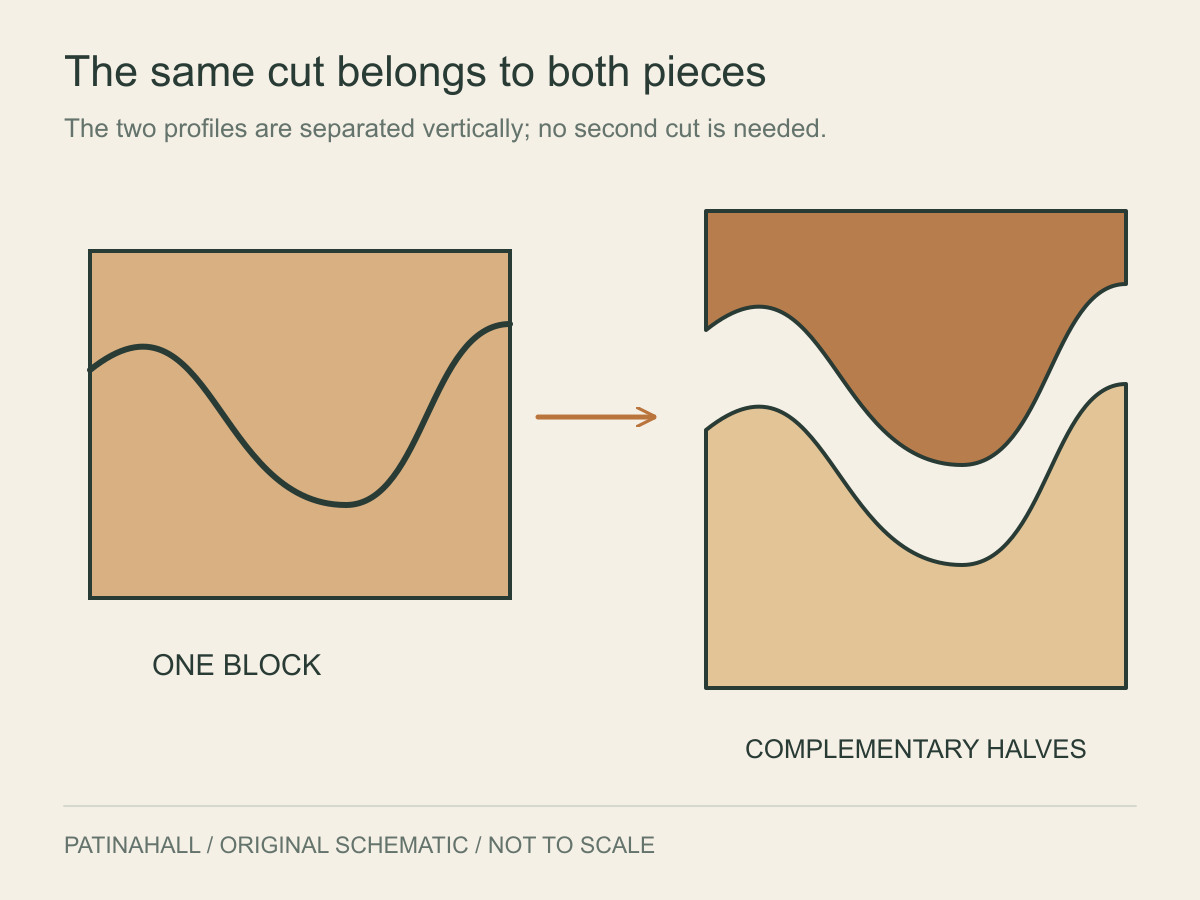
The manufacturer describes a polyurethane block divided by an S-shaped incision. The two resulting components can be related in different ways. The cut is therefore doing two jobs: making the pieces and giving them the contours that make rearrangement interesting.1
A straight division would produce two ordinary slabs. An undulating division creates changing depths and slopes. In the schematic, one edge belongs to both pieces: what one half gives up, the other receives. The pair can reconstruct a block or separate into individual forms.
This is a useful difference between adding a curve to a sofa and allowing a curve to generate the sofa. There is no need to imagine a hidden conventional wooden body beneath the wave. The shaped foam is central to the construction.
The smooth, shiny cover makes the volume read clearly. Seams and reflections follow the surface, allowing the eye to register where it rises, falls or changes direction.
A room without one prescribed posture
An ordinary sofa coordinates its parts around a fairly stable seated position. Seat below, back behind, arms at the sides. Superonda loosens those instructions. Poltronova presents it as a sofa, bed or chaise longue, depending on the relationship of its two components.1
Moving the pieces changes the places available for sitting or reclining and the space left around them. The room participates in the experiment.
The historical photographs are useful because they put people beside the idea. Drawing Matter’s account connects the design with unconventional positions of both object and user. The aim was not merely to give a familiar sofa a novel outline.3
The next arrangement is still available
Superonda’s visual force comes from a small set of decisions: two parts, a memorable cut and a surface that makes the volume conspicuous. The design does not need a complicated visible mechanism to change its role.
Once the pieces move, the empty space moves with them. A gap can appear where the sofa was continuous; a new place to recline can replace a conventional seat. The furniture keeps its material identity while the room gets another possible arrangement.