Design story

Tripp Trapp: a small floor for growing feet

Tripp Trapp looks unusual because it begins with the table rather than the chair. Peter Opsvik wanted a growing child to join the same surface as everyone else, with a seat and a little floor that could move to suit them.

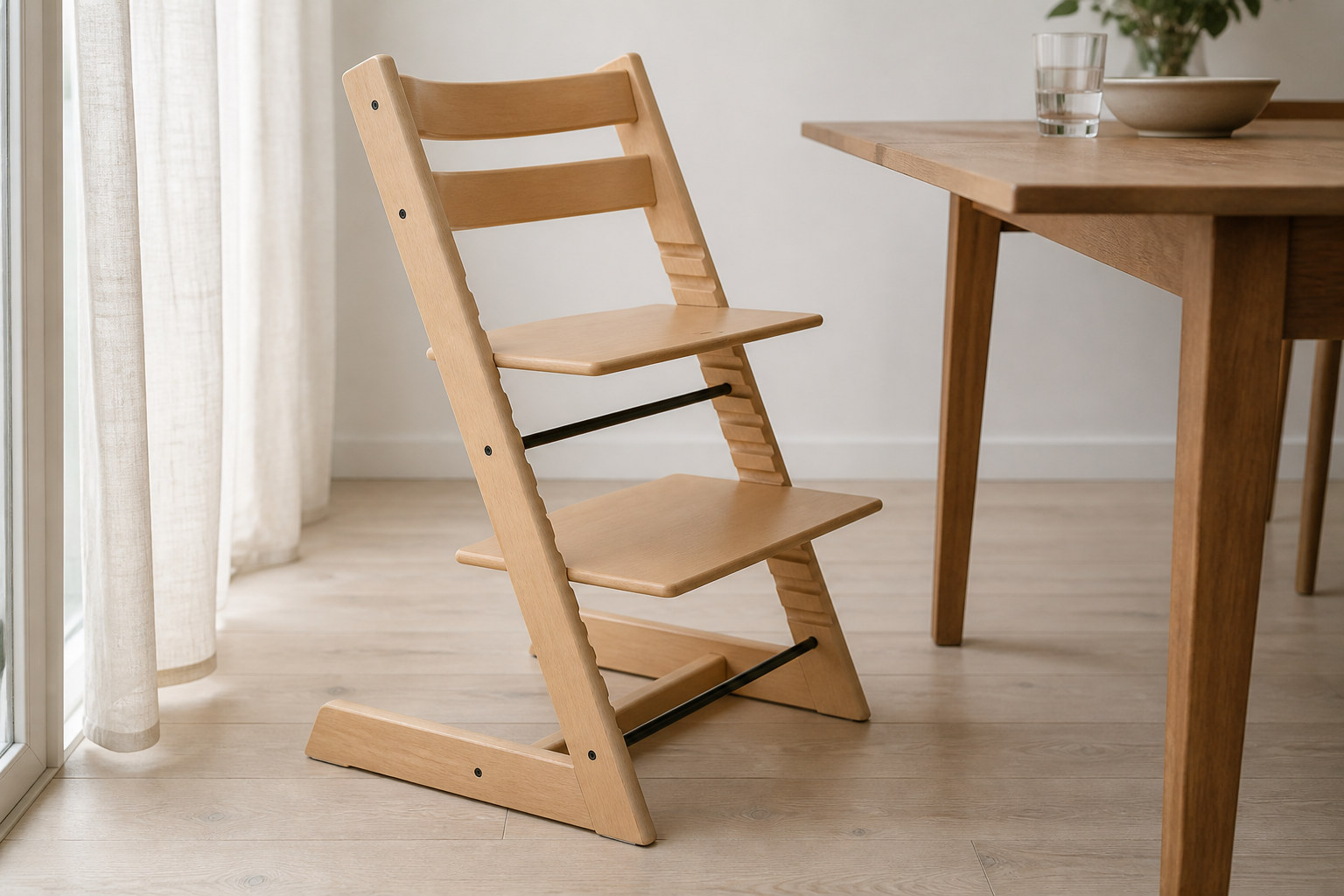
Reconstruction: An empty wooden chair with two back slats, grooved angled side supports, an upper seat and a lower foot platform.
PatinaHall editorial reconstruction. It is not a documentary photograph. Tripp Trapp’s separate seat and foot platform are visible beside a dining table. Their illustrated positions are not a setup recommendation for a child.
On this page
Key facts & takeaways

At a glance

Subject
Stokke Tripp Trapp chair
Entry
Design story
Last reviewed
7 September 2026

Three things to remember

  1. The family table was the fixed reference in Opsvik’s idea.
  2. Seat and footrest adjust as two separate surfaces.
  3. Historical design intent is distinct from current child-use instructions.

The child between two kinds of chair

Opsvik’s account begins with an ordinary family problem. His eldest son had outgrown a highchair, but the available alternatives did not give him a natural place at the adults’ table. For a designer, that awkward gap became a brief.1

A small child-sized chair solves the height of the seat by lowering it. That can work beside a small table, but it does not bring a child to the shared dining surface. An adult chair keeps the table in reach only for a larger body.

Tripp Trapp approached the relationship differently. The table could stay where it was. The chair would adapt the positions of the person’s seat and feet.

A movable floor

Opsvik describes drawing people of different sizes with their elbows at tabletop level. The back could remain around that shared height while the seat and footrest changed in height and depth. His design dates to 1972.1

The footrest is central to the idea. It gives the feet a surface at the appropriate part of the chair rather than leaving the room’s floor as the only reference. Seen from the side, the two adjustable boards explain the furniture more clearly than a product photograph full of accessories.

Our drawing separates those boards to show their roles. It does not prescribe positions for a child: settings, accessories and suitability belong to the instructions for the exact chair and current Stokke system.
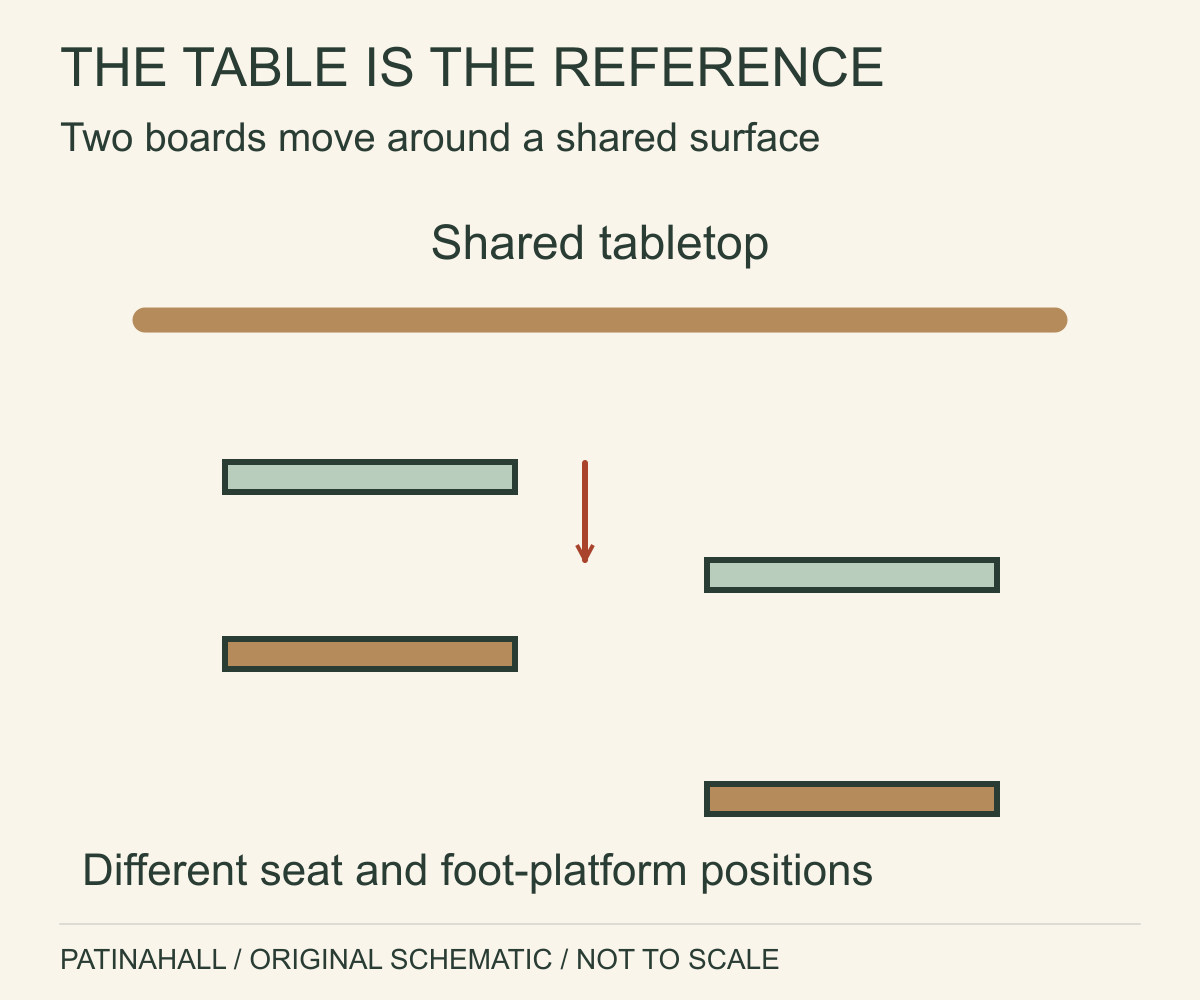
Two abstract seat-and-footrest arrangements sit beneath one continuous tabletop line.
The diagram explains Opsvik’s fixed-table, adjustable-chair idea without prescribing the distance between boards or depicting a child in use. Original PatinaHall schematic, not to scale.

The structure tells the story

The grooved side members make adjustment part of Tripp Trapp’s appearance. A conventional upholstered chair often hides its structure. Here, the repeated positions remain visible, so the object looks capable of change even when nobody is moving its boards.

The space between the seat and foot platform is particularly revealing. It represents a relationship between two parts of a person’s body. The overall outline can remain familiar while that relationship changes.

Opsvik’s own works record links the 1972 design to Stokke, whose present range continues to offer the chair in several configurations.23

A chair with a family history

A used Tripp Trapp may have moved between siblings or households. That continuity fits the design’s original concern with growth, although an individual chair’s condition and accessories need their own assessment.

Its appeal as a history subject is immediate. This is a recognisable domestic object whose unusual outline came from watching a person struggle with an everyday arrangement. The memorable feature is the lower board: a small floor brought upwards so the family table did not have to become smaller.

Research notesEvidence, connections and limits

Opsvik’s account supplies the 1972 design and adjustable-seat principle. Historical intentions and age references are not current setup or child-safety instructions; actual chair generation, accessories and Stokke guidance govern use.

Evidence map

Connected subjects and evidence

Reviewed connections

  • Stokke Tripp Trapp chairdesigned byPeter Opsvikdocumented

    Opsvik’s account supplies the 1972 design and adjustable-seat principle. Historical intentions and age references are not current setup or child-safety instructions; actual chair generation, accessories and Stokke guidance govern use.

    Reviewed 7 September 2026 by PatinaHall editorial.
  • Stokke Tripp Trapp chairmanufactured byStokkedocumented

    Opsvik’s account supplies the 1972 design and adjustable-seat principle. Historical intentions and age references are not current setup or child-safety instructions; actual chair generation, accessories and Stokke guidance govern use.

    Reviewed 7 September 2026 by PatinaHall editorial.

Research trail

Sources and further reading

  1. Chairs growing with the child: Tripp Trapp, 1972Peter OpsvikAccessed 7 September 2026
  2. Works: Tripp Trapp, HÅG Capisco and Capisco PulsPeter OpsvikAccessed 7 September 2026
  3. Tripp Trapp: chair and current configurationsStokkeAccessed 7 September 2026

Last reviewed 7 September 2026. Found an error or a stronger primary source? Contact PatinaHall.