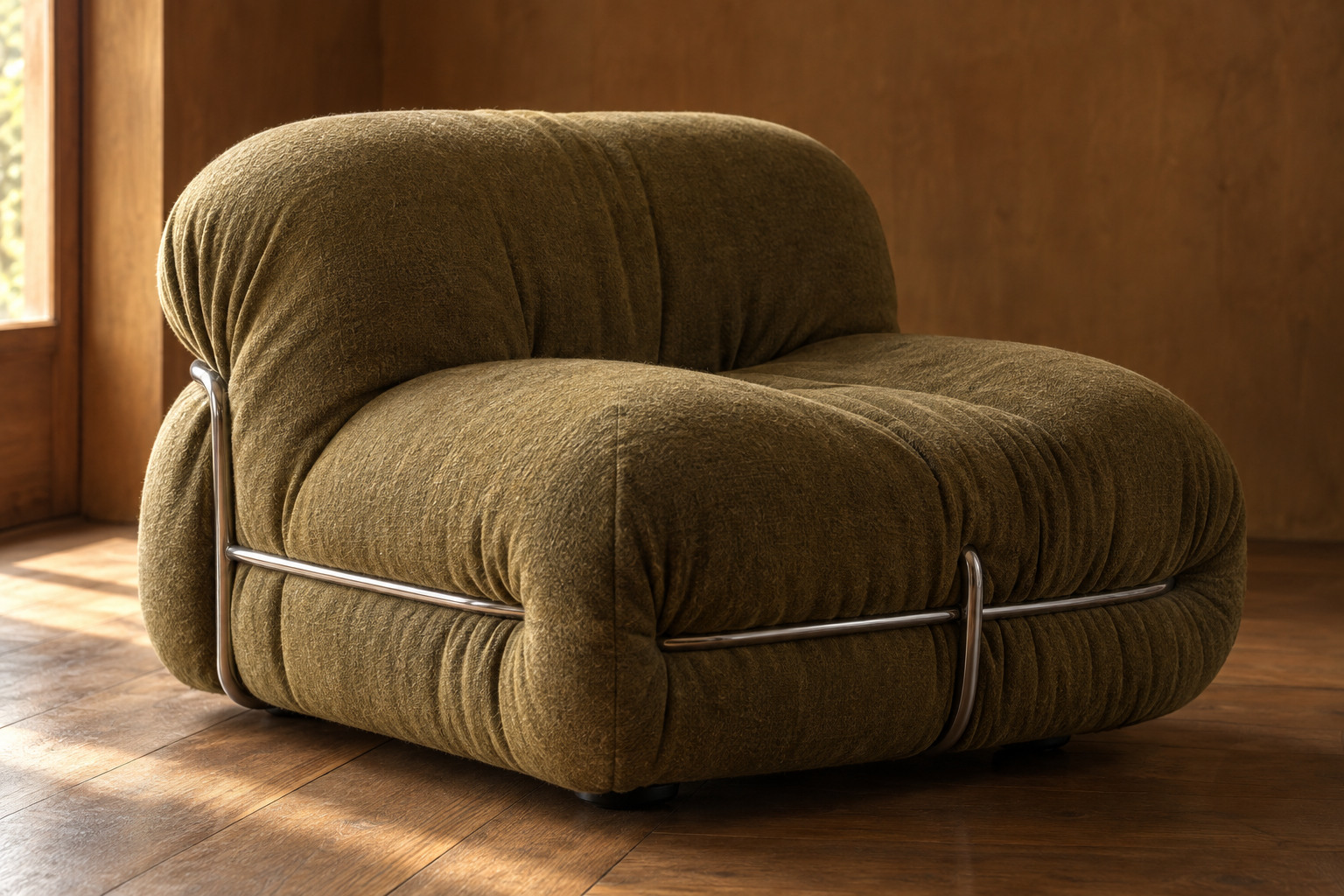
The line that gathers the volume
A conventional upholstered chair can keep its supporting structure almost entirely out of sight. You meet cloth, padding and a finished outline. Soriana lets a hard, reflective line remain visible around the soft body, making the relationship between the two materials unusually easy to read.
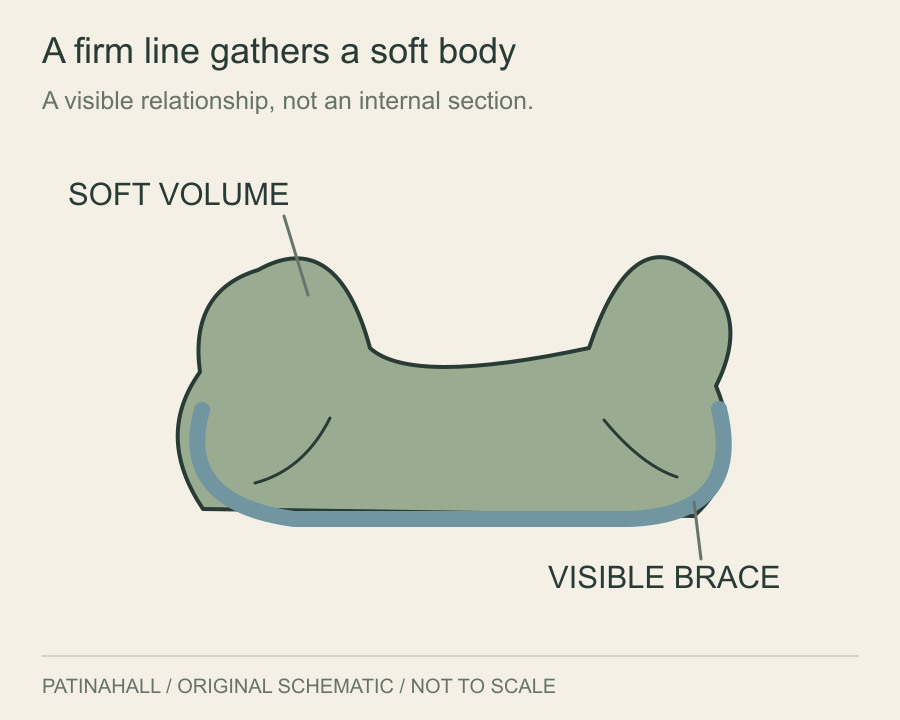
The brace gathers the upholstery at the sides and back. Above it, the padded form swells; around it, the covering creases. The metal stays relatively precise while the fabric admits folds. That difference gives the chair its character: the same curve can look firm along its boundary and yielding just beyond it.
Cassina’s account connects the original design with the possibilities of expanded polyurethane. The foam helped make a substantial upholstered volume possible without relying on the familiar outline of a wooden armchair beneath it.1
Two names belong on the label
Afra and Tobia Scarpa worked across furniture, interiors and architecture. Cassina presents their practice as a partnership, and Soriana carries both names. It is a useful correction to the habit of shortening a collaborative design to the more familiar surname or the better-known half of a couple.2
Here the collaboration can be approached through a specific problem: how do you give something generously padded a clear enough form to recognise across a room? The answer does not depend on applying a decorative pattern. It lies in the meeting of surfaces, edges and pressure.
Seen from farther away, the metal reads as a quick drawing around a larger body. Come closer and the folds break up that simple outline. The chair rewards both distances.
An award for doing a lot with a little
The 1970 Compasso d’Oro jury praised Soriana for achieving a complex image through notably simple and coherent construction. It is a more revealing observation than a list of the chair’s later admirers.3
You can test the thought by mentally removing either element. Without the upholstered mass, the brace loses the contrast that makes it legible. Without the brace, the mass loses its distinctive moment of restraint. Neither part produces quite the same effect alone.
The chair does not look simple because it is blank. It looks memorable because a few strongly differentiated elements have clear jobs.
The idea can survive a change of filling
The 2021 revision demonstrates why a design and a material specification need separate histories. Cassina’s current construction includes a wood base panel, BioFoam microspheres and recycled PET filling. Those details should not be projected backwards onto a 1969 chair.1
The visible proposition remains easy to recognise: a rounded body, a gathering line and the invitation to settle into the space between them. Soriana gives the eye a small rehearsal for sitting down.