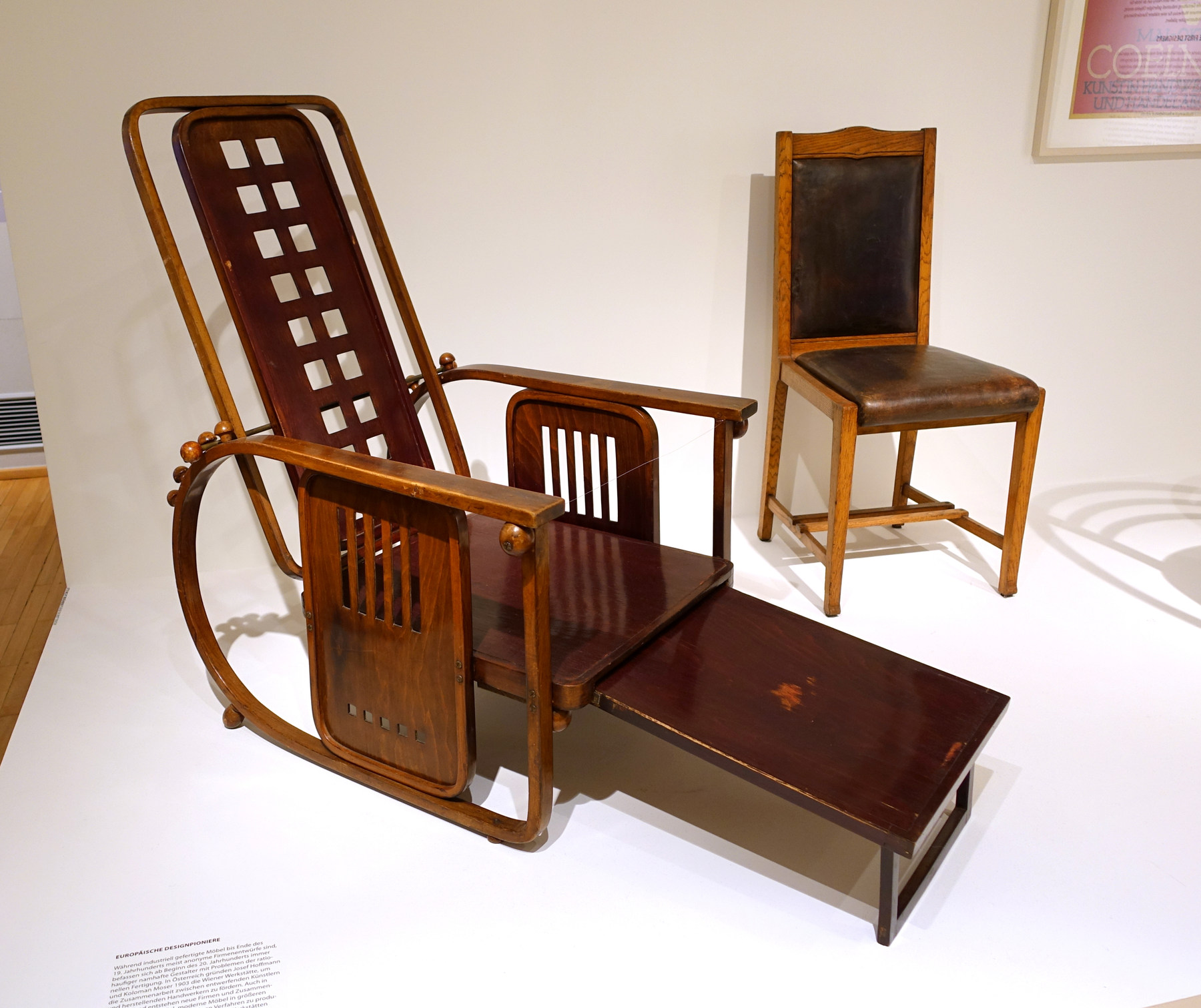
The back tells you that it can move
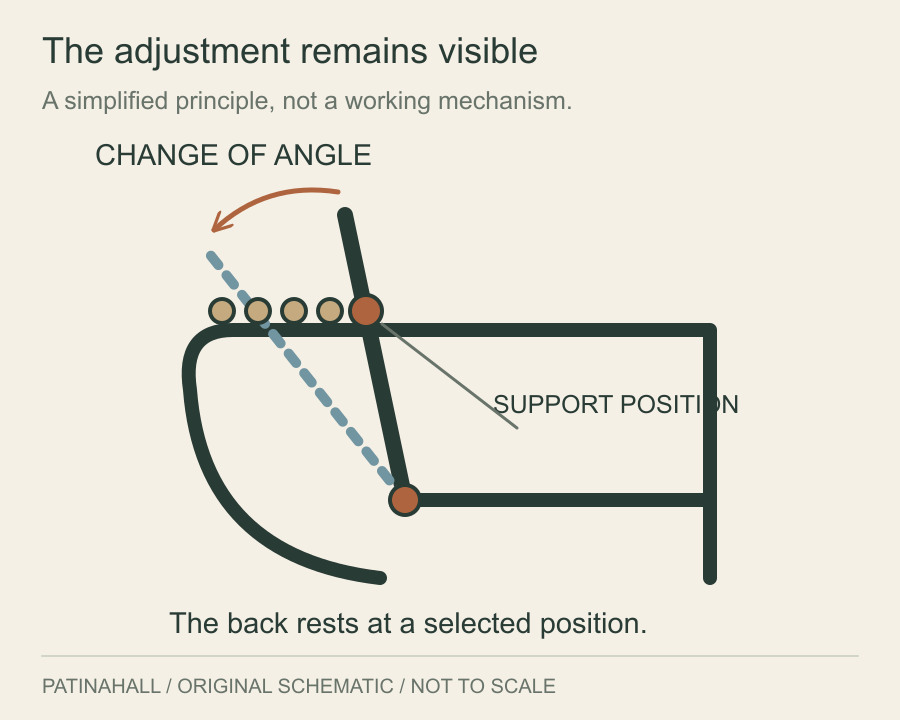
Some reclining chairs hide their adjustment inside a thick upholstered body. Sitzmaschine lets the eye find the relationship between back, support and a sequence of possible positions.
MoMA’s account identifies the rows of knobs as part of the backrest adjustment. The chair was designed around 1905 for the Purkersdorf Sanatorium, within Hoffmann’s wider effort to coordinate a building and its furnishings.1
The visible repetition is doing two things. It gives the object a recognisable rhythm, and it indicates that the back need not remain at one angle. A mechanical possibility becomes part of the way the chair is read from the side.
A curved line meets a flat panel
The frame’s loops turn the arms and lower supports into a continuous-looking route. Against those curves, the broad panels of the seat and back provide flatter surfaces. The contrast keeps the assembly legible.
The Leopold Museum records bent beech, plywood panels, a metal bar and screws in its example. Its account also describes an extending foot board and a newspaper compartment beneath the seat. Resting was imagined as an activity with equipment and small conveniences around it.2
Follow the frame from an arm towards the floor. Then look at the flatter back between the loops. The chair combines different ways of forming wood instead of asking every part to behave alike.
The machine could have cushions
The name and exposed construction can make Sitzmaschine seem committed to hardness. MoMA’s history supplies a useful correction: Jacob & Josef Kohn made several versions, most with cushions on the seat and back.1
That changes the imagined encounter. An unupholstered museum view reveals the structure clearly, but it need not represent every historical experience of sitting in the design.
The visible mechanism and the soft layer are capable of coexisting. One organises position; the other changes the contact between chair and body. The machine-like character belongs to the clarity of the arrangement, not necessarily to the absence of padding.
A small model tests a different kind of looking
The MAK collection includes a miniature Sitzmaschine model. Its dimensions belong to a small object intended to be looked at, rather than to a full-size chair intended to hold a person.3
A model makes the outline easy to grasp as a whole. The actual chair asks the viewer to consider reach, weight and the space a reclining body would occupy. Each scale reveals something the other can conceal.
Return to the row of knobs. Once their job is understood, they cease to be an odd fringe of ornament. The chair begins to describe its own movement, even while standing completely still.
