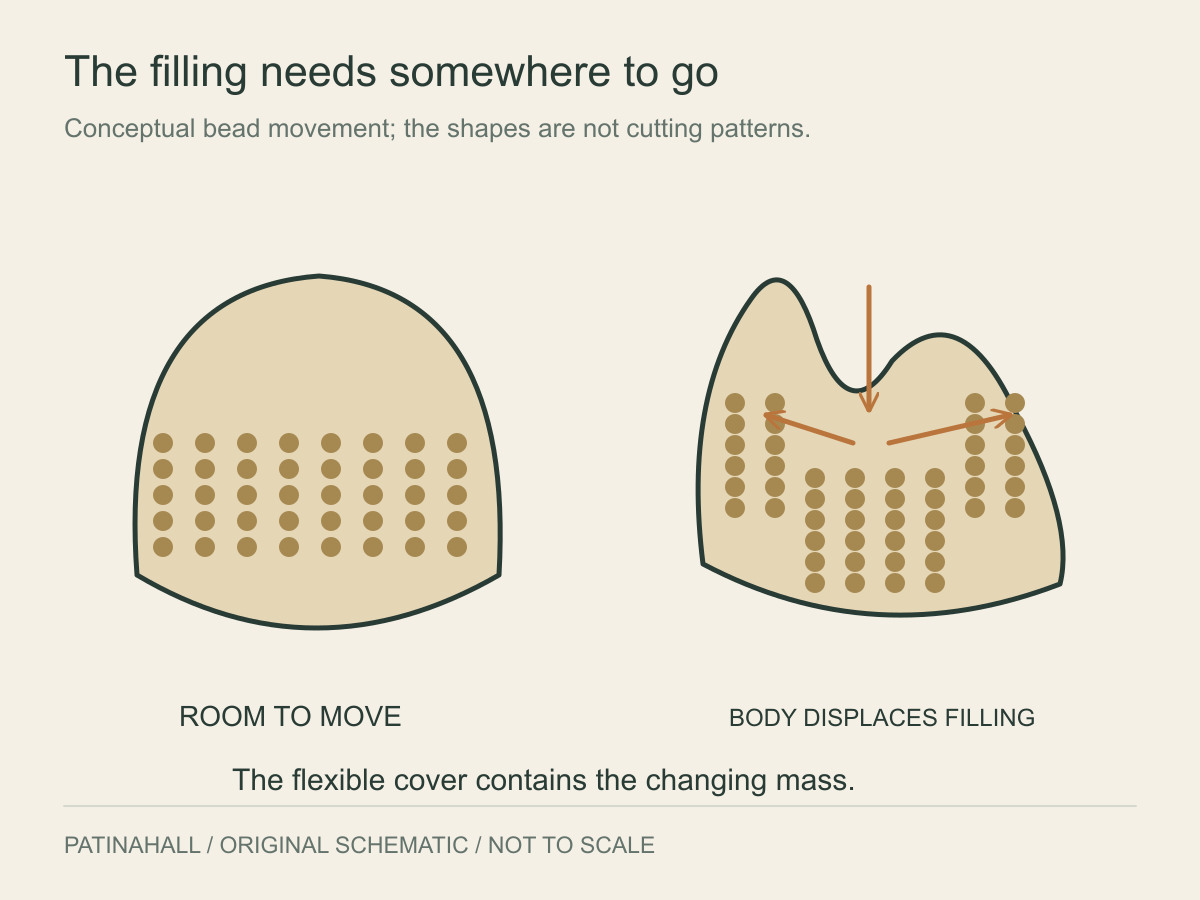
The useful part is partly empty
Fill a sack completely and its contents have little room to rearrange themselves. Sacco depends on the opposite condition. MoMA describes a cover filled to roughly two-thirds of its capacity with polystyrene beads, leaving space for them to move as the sitter settles.1
The body presses down; filling shifts into the remaining volume; the flexible cover contains it. The result acquires a seat and a back without beginning as a conventional frame with those parts fixed in position.
That makes the unoccupied chair unusually hard to separate from its use. An empty wooden chair announces a posture in advance. Sacco’s outline remains more provisional, waiting for a person to finish the arrangement.
Three designers, one shared experiment
Piero Gatti, Cesare Paolini and Franco Teodoro had worked together from 1965 across several areas of design. Zanotta’s account dates Sacco’s design to 1968 and its production to 1969.32
The experiment did not dispense with design decisions. Shape, seams, cover material and quantity of filling all affect the result. Removing a wooden frame transfers responsibility to other parts of the object.
MoMA records Gatti’s recollection of mattresses filled with chestnut leaves as a point of reference. The connection is useful because it brings the idea back to a familiar principle: a loose mass can become a supporting surface when it is held inside a flexible enclosure.1
A new chair can therefore emerge from rethinking a simple physical relationship rather than adding a more elaborate mechanism.
A designer sinks into his own proposal
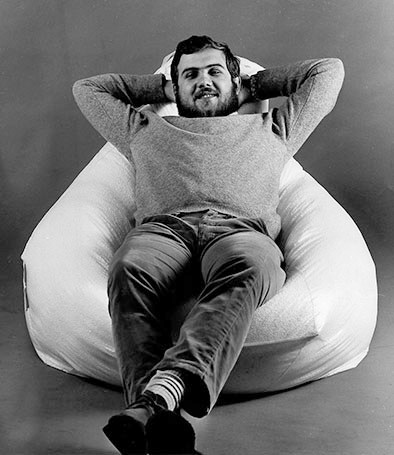
The opening photograph shows Franco Teodoro reclining in Sacco. The family-archive record dates the image to 16 April 1969 and credits Mario Sarotto.4
It is a particularly helpful view because the person explains the furniture. The cover rises around parts of the body and flattens elsewhere. The chair’s irregular outline no longer looks like an incomplete object; it looks like the trace of a particular occupation.
The photograph also leaves something unresolved. Another sitter, or the same sitter shifting position, would produce a different arrangement. One image can document a moment without supplying a definitive silhouette for the design.
Zanotta’s history records later versions with changed materials, including developments associated with the design’s fiftieth anniversary. Those updates belong to particular editions rather than to the original 1960s filling.2
The underlying question remains easy to recognise: how much of a chair’s shape can be left to the person who uses it?
Sacco offers an unusually visible answer. The occupant sits down and the furniture rearranges its own outline. Stand up again and the empty bag retains a temporary memory of the body that was there.
