Design story

Robin Day 675: one plywood curve for back and arms

The 675 chair’s wooden back does not stop where the arms begin. One broad plywood curve travels around the sitter, giving Robin Day’s compact chair a continuous gesture above its thin steel frame.

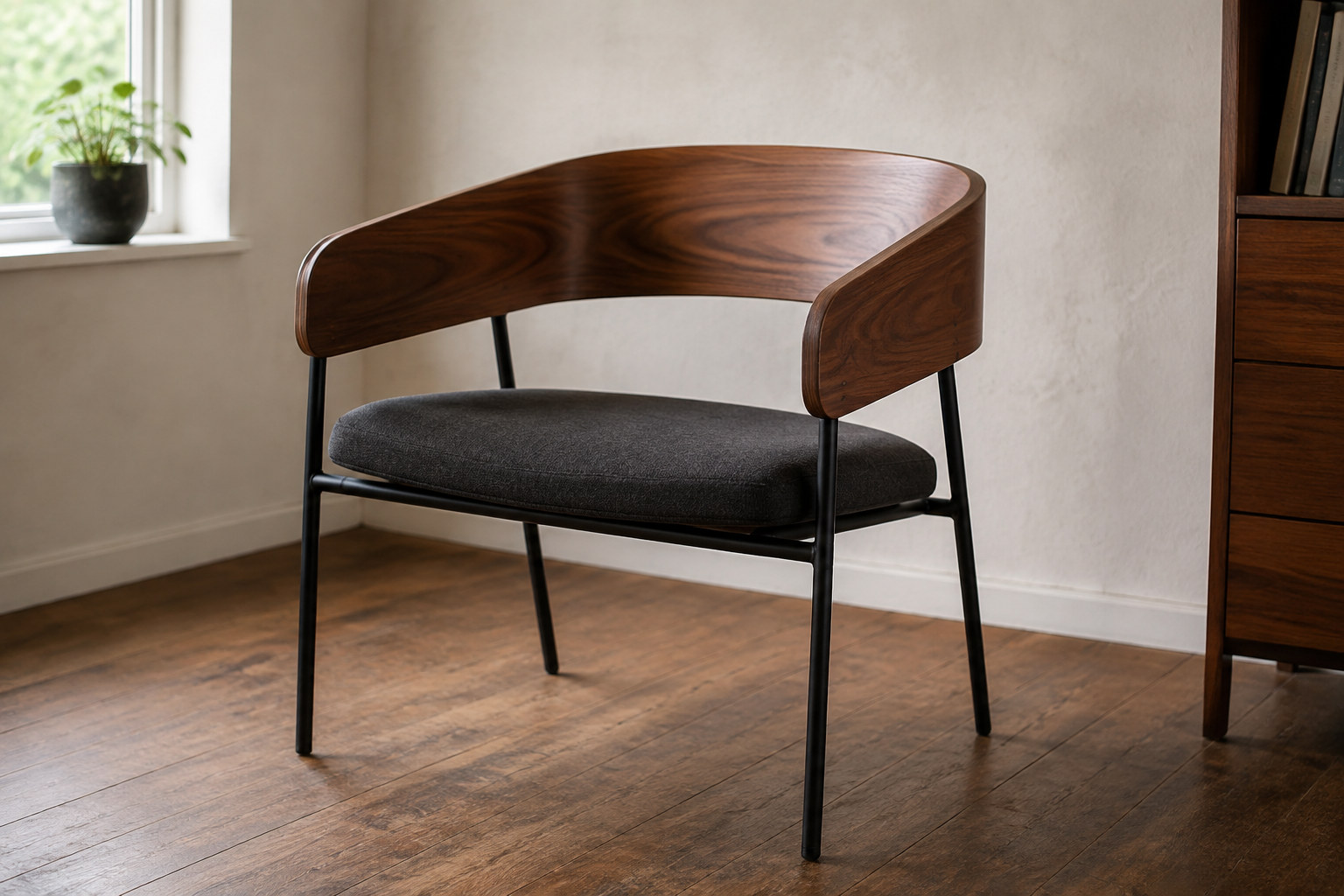
Reconstruction: A walnut-coloured plywood band curving from a chair’s back into its arms above a separate grey seat and thin black steel legs.
PatinaHall editorial reconstruction. It is not a documentary photograph. This 675 interpretation follows the wood around the corner from back to arm. Veneer, upholstery and shell proportions do not document a specific Hille or Case chair.
On this page
Key facts & takeaways

At a glance

Subject
Robin Day 675 chair
Entry
Design story
Last reviewed
7 September 2026

Three things to remember

  1. One plywood component forms the back and arms.
  2. The 675 followed Day’s Festival Hall work.
  3. A Hille example and a later Case chair share a design history, not a production date.

Follow the wood around the corner

Most armchairs make a visible distinction between back and arm. The 675 softens that boundary. Its plywood piece curves around the sitter, with the ends continuing forward as arm supports.

The Frederick Parker Collection records a Hille-made example with a walnut-faced laminated back and arms, an upholstered plywood seat and a black steel frame. The description makes the chair’s three-part organisation clear: a shaped upper piece, a padded sitting surface and a narrow supporting structure.2

Each part looks different because each has a different task. The wood offers a broad, warm surface; the seat supplies softness; the steel leaves the area underneath visually open.

After the Festival Hall

The Day Foundation dates the 675 to 1952 and describes it as a simplified development of the dining chair designed for the Royal Festival Hall. The relationship places an ordinary dining or desk chair within the work surrounding the 1951 Festival of Britain.1

The important story is the move towards a simpler object. A design made for a prominent public building can generate an idea that becomes useful elsewhere. Here, the continuity of back and arms could survive in a chair suited to less ceremonial surroundings.

That gives the curved plywood a human scale. It is not only a sculptural flourish to admire across a gallery. It is the piece a seated person meets when leaning back or resting an arm.

A broad surface on a thin frame

The contrast between upper shell and lower support is worth a second look. The back has enough width to carry a visible sweep of veneer; the frame reads as a set of lines. The two kinds of form keep the chair from becoming a solid upholstered volume.

The front opening matters too. The plywood ends leave a route into the seat, while the curve behind gives a sense of enclosure. The chair can look light from outside and still define a personal place at the table.

These are observations about the form, rather than measurements of comfort. Different bodies and upholstered versions meet the same outline differently.
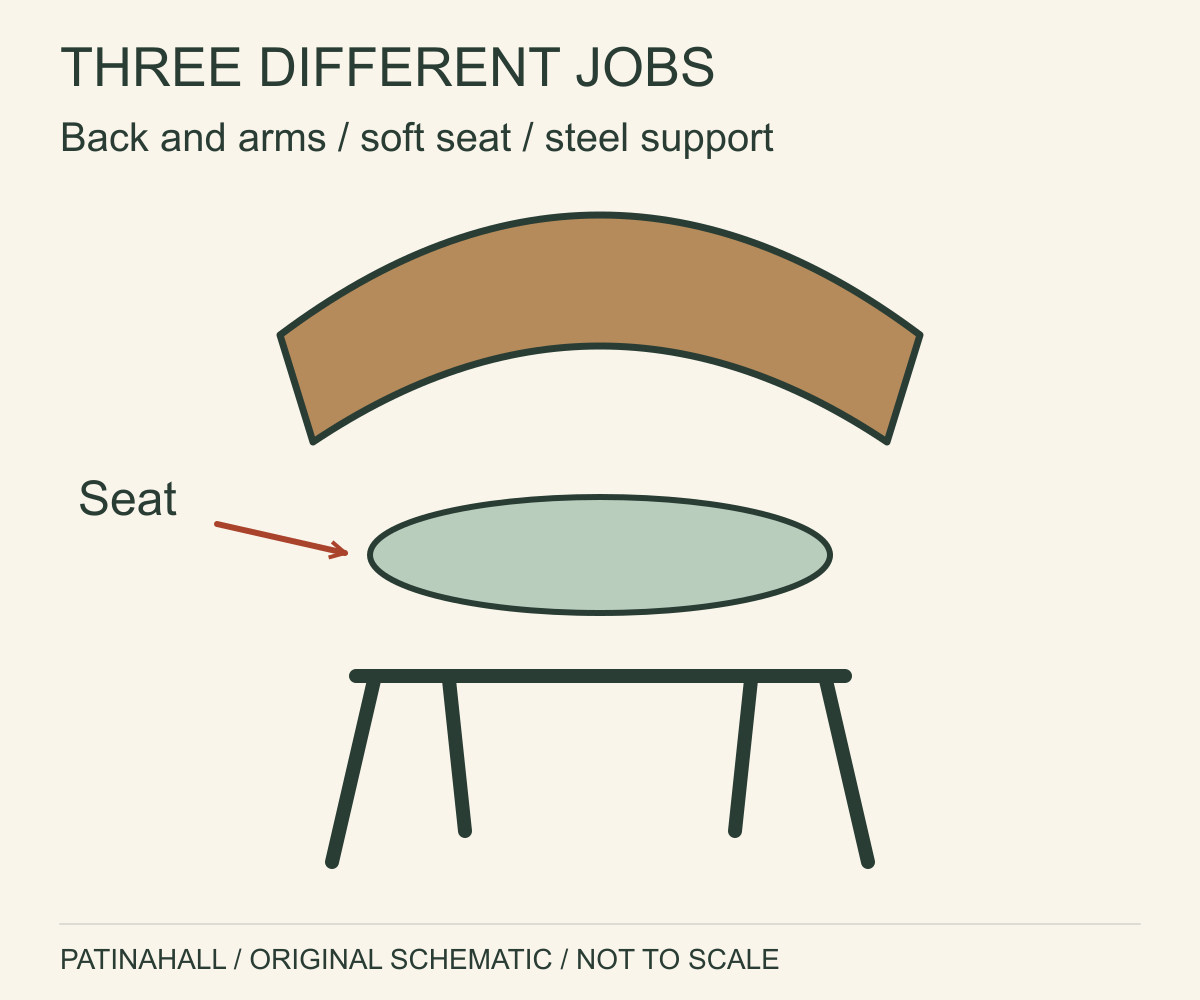
An exploded schematic separates a continuous curved plywood component, an upholstered seat and a thin steel frame.
Different materials perform distinct roles in the 675 chair. The exploded spacing is explanatory, not an assembly sequence or parts-compatibility claim. Original PatinaHall schematic, not to scale.

Hille, then Case

The Foundation identifies Case as the current licensed producer, and Case documents its own materials and finish choices. Those records sit alongside the collection’s older Hille chair rather than replacing its specification.13

For someone encountering a second-hand 675, the useful first distinction is therefore between the design and the particular production example. The curve can connect an old chair to a current one without making them the same object.

The detail to remember remains remarkably simple: one piece of plywood crosses a boundary that furniture usually draws between the back and the arms.

Research notesEvidence, connections and limits

The foundation dates the 675 to 1952. The Frederick Parker Collection records one Hille example; Case describes licensed later production. Neither the current finish list nor the museum specimen dates every used chair.

Evidence map

Connected subjects and evidence

Reviewed connections

  • Robin Day 675 chairdesigned byRobin Daydocumented

    The foundation dates the 675 to 1952. The Frederick Parker Collection records one Hille example; Case describes licensed later production. Neither the current finish list nor the museum specimen dates every used chair.

    Reviewed 7 September 2026 by PatinaHall editorial.
  • Robin Day 675 chairmanufactured byHilledocumented

    The foundation dates the 675 to 1952. The Frederick Parker Collection records one Hille example; Case describes licensed later production. Neither the current finish list nor the museum specimen dates every used chair.

    Reviewed 7 September 2026 by PatinaHall editorial.
  • Robin Day 675 chairmanufactured byCase Furnituredocumented

    The foundation dates the 675 to 1952. The Frederick Parker Collection records one Hille example; Case describes licensed later production. Neither the current finish list nor the museum specimen dates every used chair.

    Reviewed 7 September 2026 by PatinaHall editorial.

Research trail

Sources and further reading

  1. 675 Chair, Robin Day, 1952Robin and Lucienne Day FoundationAccessed 7 September 2026
  2. Robin Day 675 chair: FPF486Frederick Parker CollectionAccessed 7 September 2026
  3. 675 Chair: contemporary licensed productionCase FurnitureAccessed 7 September 2026

Last reviewed 7 September 2026. Found an error or a stronger primary source? Contact PatinaHall.