Design story

Pratone: finding somewhere to sit in a patch of grass

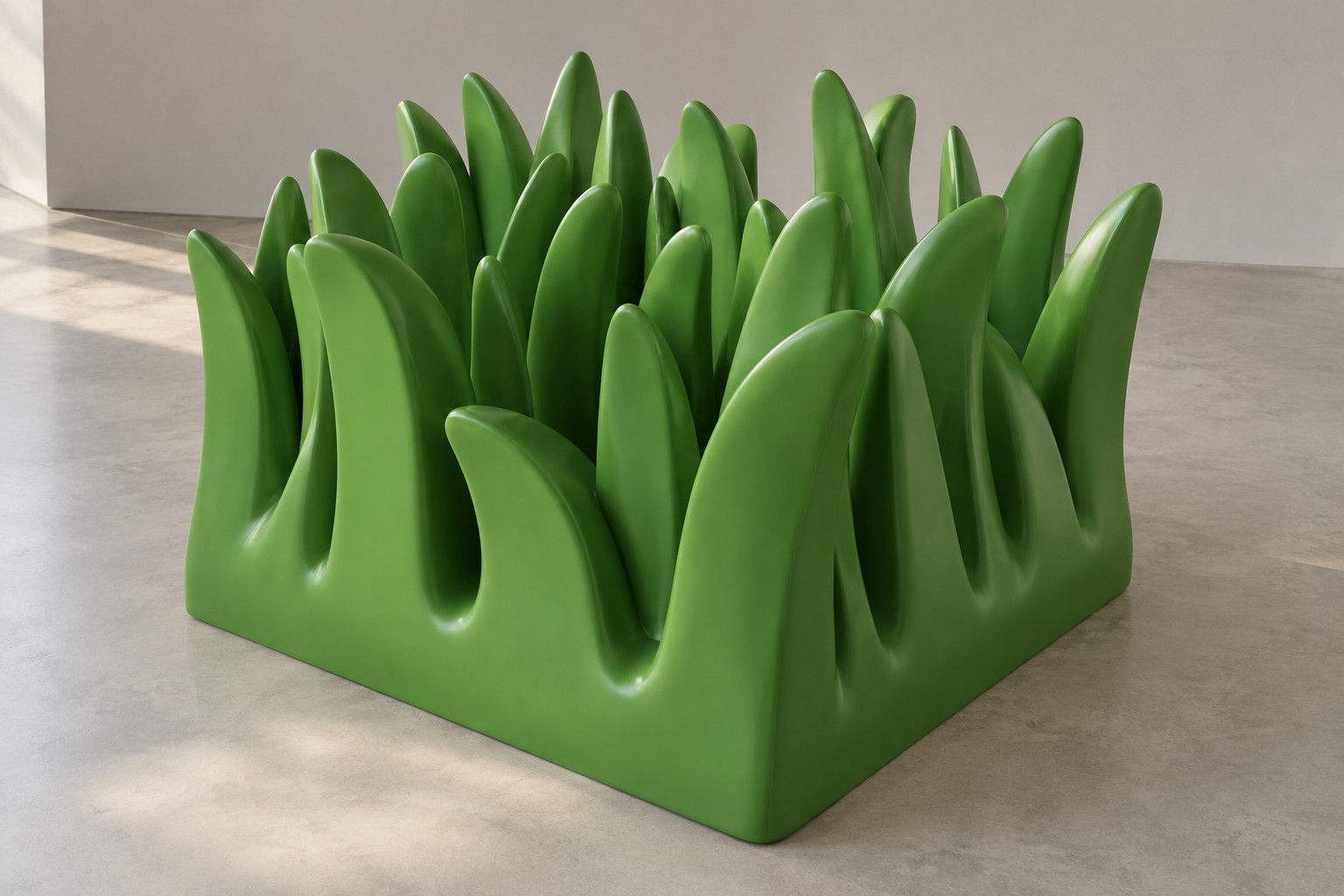
Pratone makes a sitter look small. Its oversized grass rises around the body, while soft foam gives way where a conventional chair would offer a clearly marked seat.

An interpretive human-scale green seating sculpture has thick tapering blades rising from a common low base with a smooth coated surface.
PatinaHall editorial reconstruction. It is not a documentary photograph. A study of soft coated blades and the spaces between them; their arrangement is approximate.
On this page
Key facts & takeaways

At a glance

Subject
Pratone
Entry
Design story
Last reviewed
10 September 2026

Three things to remember

  1. The large blades surround the body; their tips do not mark the sitting height.
  2. Soft polyurethane is essential to the design’s invitation to settle between the blades.
  3. The absence of allotted places changes how shared seating can be read.

Grass at the wrong scale

Pratone looks like a small patch of grass until you put a person beside it. The blades become large enough to sit among. Giorgio Ceretti, Piero Derossi and Riccardo Rosso turned a familiar outdoor surface into something that surrounds the body.1

For a sense of scale, the Museum of Fine Arts, Houston’s 1986 example is roughly 1.4 metres wide and almost a metre high. That height is the top of the grass, rather than a conventional seat height.4 The body belongs down between the blades. A photograph without a sitter can disguise just how much of the furniture rises around you.

The material makes room

Gufram makes the forty-two blades from soft polyurethane, finished with its Guflac coating. Their ability to yield is essential: replace them with rigid spikes and the invitation disappears.1

On a conventional armchair, the seat, back and arms tell you where to settle before you touch it. Pratone leaves that arrangement open. The spaces between the blades and the softness of the foam have to work together as a body sinks into the patch.

That is the more interesting surprise after the grass joke. The exaggerated blades are both the obstacle you see and the material that gives way. Finding a position becomes part of encountering the design.
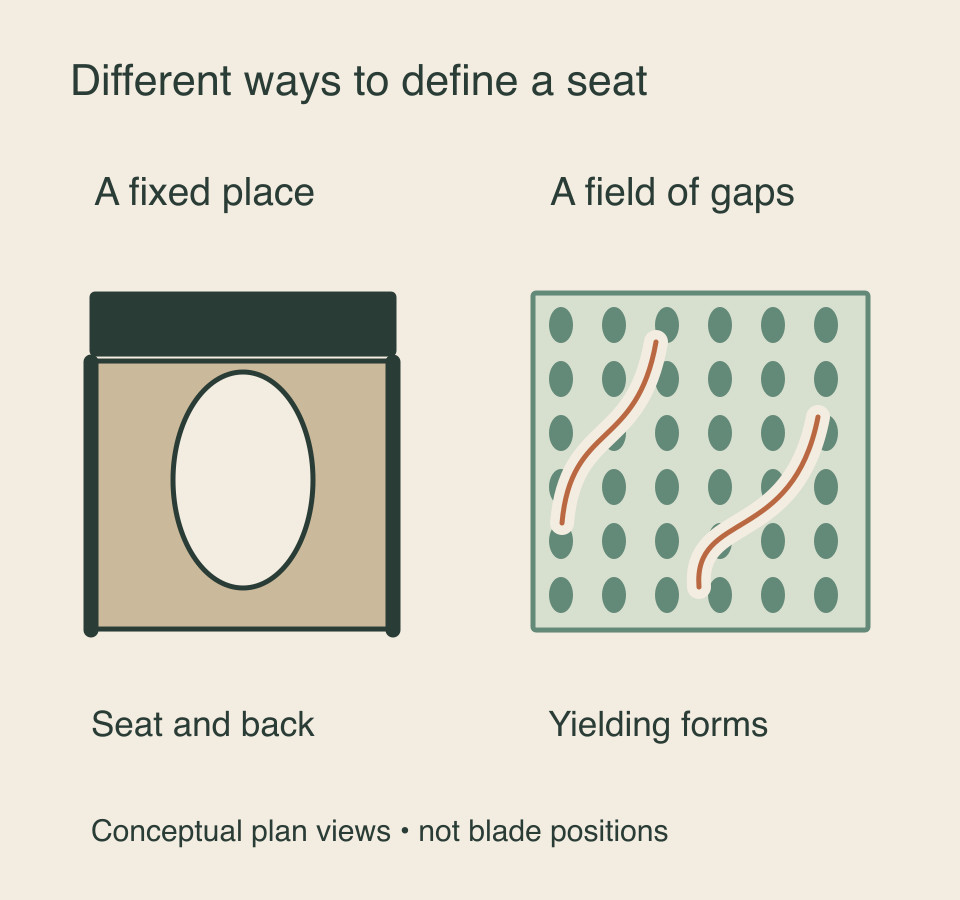
Two conceptual plan views compare a fixed seat-and-back arrangement with gaps between yielding forms in a bounded field.
A conventional seat marks out a place; Pratone leaves the body’s position open. Original PatinaHall schematic, not to scale or a prescribed posture.

A sofa without allotted places

There are no cushion seams marking a place for each sitter, and no single upholstered back facing the room. Read as shared seating, Pratone makes people negotiate their positions within one small territory. This interpretation follows its form; individual experiences of comfort will differ.

Its appearance in MoMA’s 1972 exhibition catalogue, Italy: The New Domestic Landscape, puts that experiment in context. The subject was the home and how people might live in it. The designers’ experimental work also fed into Gruppo Strum, formed in 1971.23

Pratone gives that large architectural question a bodily scale. A seat can quietly direct us to sit upright, face forwards and keep to one cushion. Here those familiar instructions dissolve into soft green blades. The sitter has some arranging to do.

Research notesEvidence, connections and limits

Gufram uses 1971, Vitra 1970, and MoMA’s 1972 catalogue prints 1970 (1971). The scale example is MFAH’s object 2018.493, made in 1986; its dimensions are not assigned to every version. The reconstruction does not establish exact blade positions.

Evidence map

Connected subjects and evidence

Reviewed connections

  • Pratonedesigned byGiorgio Cerettidocumented

    Gufram jointly credits Ceretti, Derossi and Rosso for Pratone.

    Reviewed 10 September 2026 by PatinaHall editorial.
    • Source 1Object description and historical account
  • Pratonedesigned byPiero Derossidocumented

    Gufram jointly credits Ceretti, Derossi and Rosso for Pratone.

    Reviewed 10 September 2026 by PatinaHall editorial.
    • Source 1Object description and historical account
  • Pratonedesigned byRiccardo Rossodocumented

    Gufram jointly credits Ceretti, Derossi and Rosso for Pratone.

    Reviewed 10 September 2026 by PatinaHall editorial.
    • Source 1Object description and historical account
  • Pratonemanufactured byGuframdocumented

    Gufram documents production of Pratone.

    Reviewed 10 September 2026 by PatinaHall editorial.
    • Source 1Object description and historical account
  • Pratoneuses materialPolyurethane foamdocumented

    The maker specifies flexible polyurethane with a Guflac finish.

    Reviewed 10 September 2026 by PatinaHall editorial.
    • Source 1Object description and historical account

Research trail

Sources and further reading

  1. PRATONE: Ceretti, Derossi, Rosso, 1971GuframAccessed 10 September 2026
  2. Italy: The New Domestic Landscape, 1972 catalogue, Pratone entryThe Museum of Modern ArtAccessed 10 September 2026
  3. Designers of Pratone: Gruppo Strum chronologyVitra Design MuseumAccessed 10 September 2026
  4. Pratone: designed 1971, made 1986, object 2018.493; dimensions and materialsThe Museum of Fine Arts, HoustonAccessed 10 September 2026

Last reviewed 10 September 2026. Found an error or a stronger primary source? Contact PatinaHall.