Paper behind the black shine
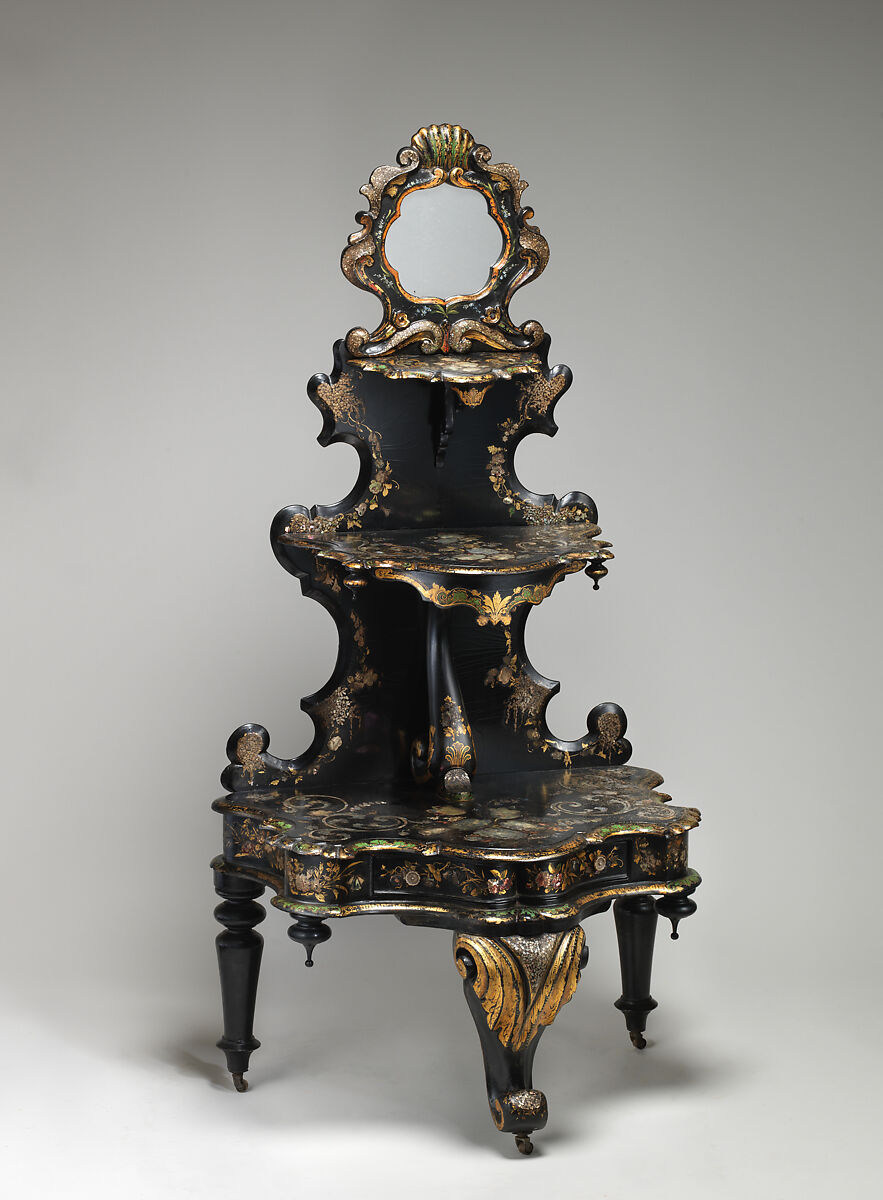
The display stand looks richly dressed: dark glossy surfaces, gold ornament, a mirror and flashes of pale shell. Three tiers give it places for objects, while its own decoration competes for attention. Small castors sit beneath the elaborate base.
The unexpected material appears in the Met’s catalogue. This British étagère, dated to the middle of the nineteenth century, combines wood with papier-mâché. Both carry black lacquer, paint, gilding and mother-of-pearl decoration. It is furniture made partly from paper, with the exact maker unrecorded.1
That qualification matters to the pleasure of discovery. The catalogue does not say every leg and shelf is paper, and the polished photograph cannot map the concealed construction for us. What it does establish is a mixed object whose luxurious finish crosses material boundaries.
Paper could become a workable board
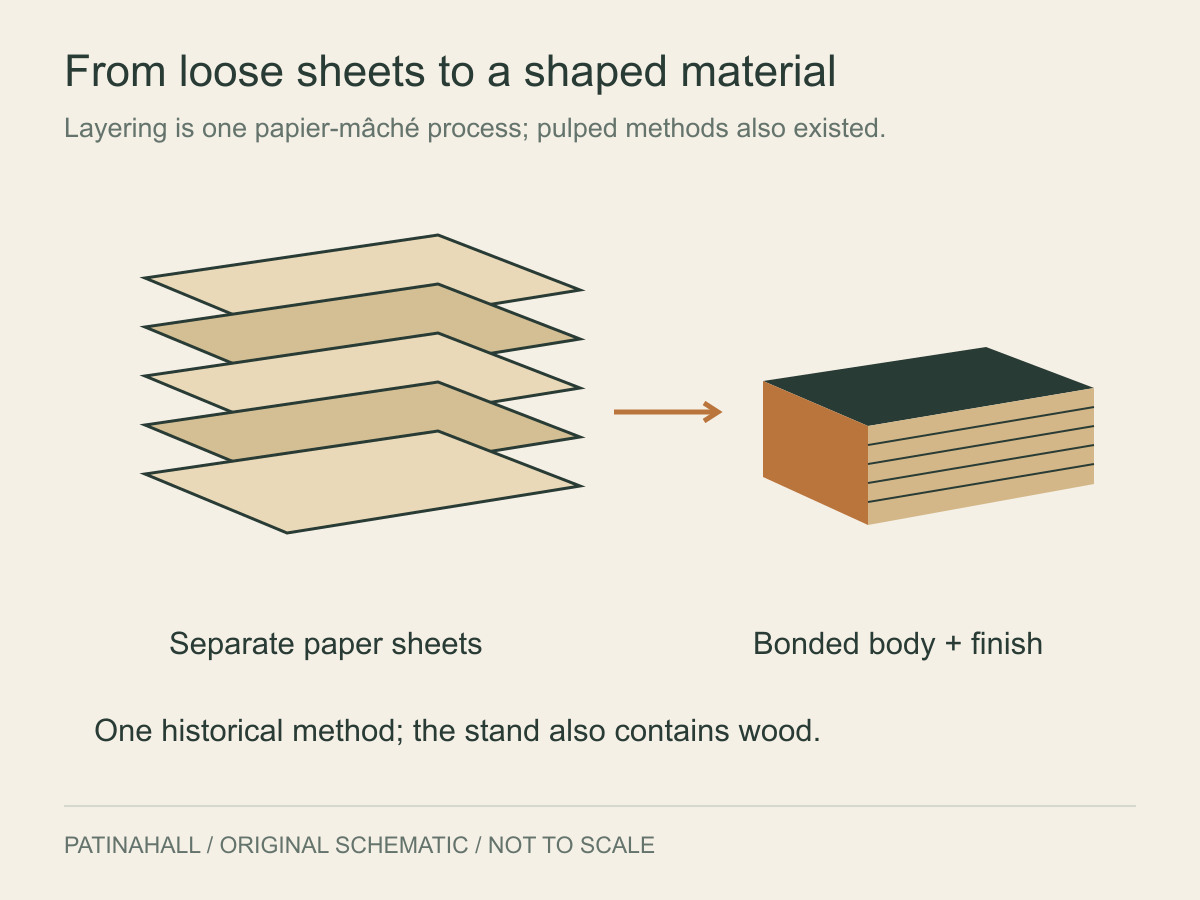
Papier-mâché covered more than one manufacturing process. The Georgian Group’s technical history distinguishes pulped material from methods that build up layers of paper. Henry Clay’s 1772 patent described sheets pasted around a form, treated and heated, producing a shaped material that could subsequently be worked and finished.4
The useful surprise is the change of state. A loose sheet bends readily. A built-up body of bonded sheets can become a component with a thickness and a shape of its own. The schematic below explains this layered principle; it does not claim that a particular part of the étagère was made by that exact method.
The Met’s tray attributed to the firm of Henry Clay offers a simpler comparison. Dated to the first half of the nineteenth century, it brings the paper-based material into a broad, shallow household form. Seen beside an elaborate stand, a tray makes the movement from shaped surface to more ambitious furniture easier to imagine.3
A desk helps explain the shell
A separate object at Winterthur provides a closer technical story. Jena Gilbert-Merrill’s study examines a papier-mâché writing desk associated with Jennens & Bettridge, made around the middle of the nineteenth century. It discusses the firm’s steam-moulding developments and the layered work involved in creating a highly decorated piece.2
The study also explains mother-of-pearl decoration in which thin pieces of shell were attached to the surface and incorporated into the finish. That is a useful corrective to the assumption that every gleaming shell shape must occupy a carved recess.2
Winterthur’s desk has its own maker, date range and construction evidence. It supplies a comparison for understanding this material world, rather than an attribution for the Met’s stand. On the étagère itself, the photograph lets us follow the contrast between dark lacquer, gold lines and bright shell without pretending to see underneath them.
The ornament had its critics
The flexibility of paper-based manufacture also made it contentious. As the Winterthur study describes, elaborate moulded decoration could attract admiration for its technical accomplishment and criticism for the abundance or character of its ornament.2
This stand makes the disagreement easy to understand. A curl leads into another curl; the mirror doubles part of the visual activity; pale details interrupt the black ground. Someone seeking a quiet background for a few possessions might find it exhausting. Someone enjoying a surface that keeps offering another detail could find exactly what they wanted.
The material surprise gives both responses more to consider. Paper was participating in a display of finish, labour and ambition. The humble starting material had become one of the reasons such furniture could look so extravagantly unlike a sheet of paper.