Artefact story

Oeben’s mechanical table: a room inside a drawer

Oeben’s table hides a workspace beneath its flowers. The top slides back as a fitted drawer comes forward; closing it stores the energy for the next opening.

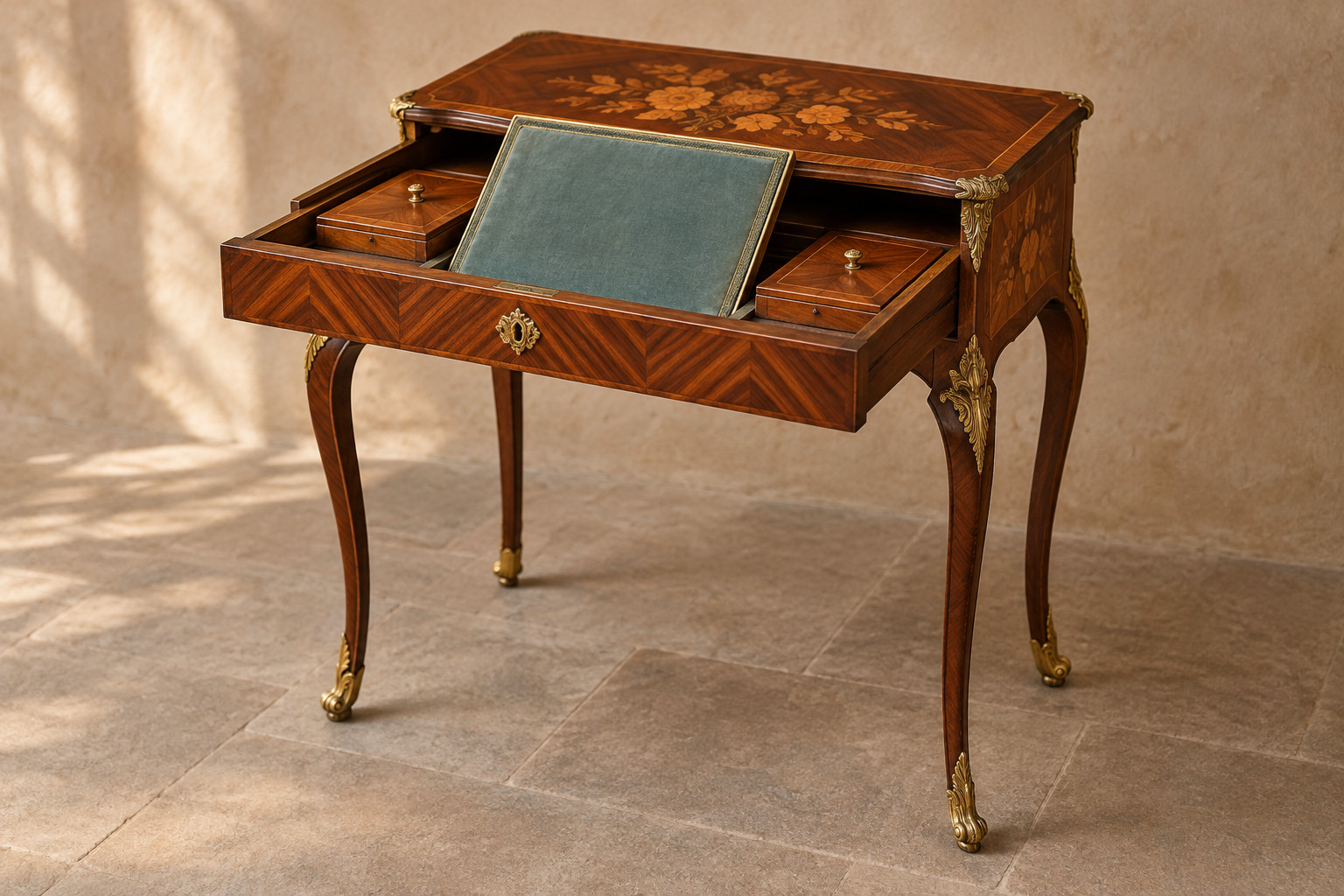
A reconstructed small veneered table has four curved legs, a top moved back and an open fitted drawer with a tilted reading panel.
PatinaHall editorial reconstruction. It is not a documentary photograph. The top recedes and the drawer opens a workspace. Ornament, fittings and setting are approximate.
On this page
Key facts & takeaways

At a glance

Subject
Oeben mechanical table 70.DA.84
Entry
Artefact story
Last reviewed
10 September 2026

Three things to remember

  1. The top and fitted drawer travel in opposite directions.
  2. Closing the table rewinds the springs for another opening.
  3. The nearly black leaves were made from pale holly dyed green.

The tabletop gets out of the way

Release the mechanism and the decorated top slides backwards while a fitted drawer moves towards the sitter. One part withdraws as the other approaches, bringing the hidden working space within reach.1

The movement changes what the top is for. Closed, it is the surface you see and use. Open, it becomes the cover that has moved aside. Within the drawer, a central panel can be tilted by hand for reading, with compartments to either side.2

Oeben made the table in Paris; it is now Getty object 70.DA.84.3 Only about seventy-four centimetres wide, it manages to offer several positions for things and for the person using them. The ingenuity is in making those positions appear when needed.2

Closing it stores the next opening

Two spring barrels, one at each end of the case, drive the present mechanism. Toothed rails coordinate the top and drawer as they move in opposite directions. Pushing the table closed rewinds the springs.2

The closed position is therefore part of the action. It prepares the energy for another opening. The case stays fixed on its legs while the working parts travel within and above it.

This makes the return movement as interesting as the reveal. What looks like tidying away is also preparing the furniture for its next use.
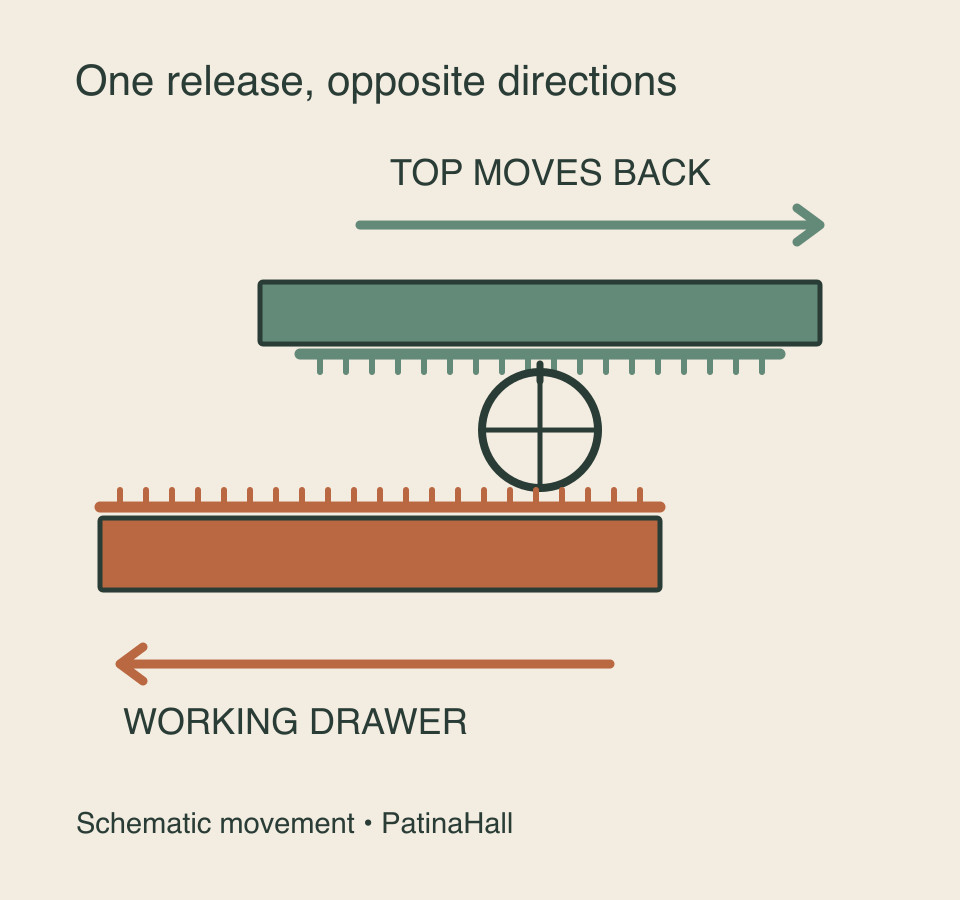
A schematic shows the tabletop moving backwards and the working drawer moving forwards on opposite sides of a simplified gear.
The top and drawer travel in opposite directions. Original PatinaHall schematic, not to scale; the complete paired springs and guides are omitted.

The leaves used to be green

Even the surface has changed more than a first glance suggests. Getty’s technical study identified the nearly black leaves and stems as holly, a naturally pale wood that had been dyed olive green. The dye darkened with age.2

The flowers are assembled from cut wood, but their colours were never limited to the natural shades of timber. A bright bouquet once accompanied the opening trick. Today’s darker tabletop records another kind of transformation, happening far more slowly than the movement of the drawer.

Keeping the trick working

Unused screw holes and other traces show that the mechanism has been altered.2 Such evidence adds the work of later hands to the springs and veneers. Keeping a complicated table usable was a continuing task.

The pleasure of the object lies in the two movements meeting: the top gets out of the way just as the drawer arrives. Behind that brief, graceful action is a long history of making, adjustment and repair.

Research notesEvidence, connections and limits

Getty 70.DA.84 is dated about 1760 in the current catalogue and about 1750 in CONA. The mechanism shows alteration. The reconstruction approximates the open arrangement; the diagram simplifies the paired spring and rail system.

Evidence map

Connected subjects and evidence

Reviewed connections

  • Oeben mechanical table 70.DA.84made byJean-François Oebendocumented

    Getty identifies Oeben as maker of exact object 70.DA.84.

    Reviewed 10 September 2026 by PatinaHall editorial.
    • Source 2Object description and historical account
  • Oeben mechanical table 70.DA.84uses techniqueOpposed spring-driven table movementdocumented

    The technical description records spring barrels and opposed toothed rails moving top and drawer case in opposite directions.

    Reviewed 10 September 2026 by PatinaHall editorial.
    • Source 2Object description and historical account

Research trail

Sources and further reading

  1. The Unfolding of an Exquisite Mechanical TableJ. Paul Getty MuseumAccessed 10 September 2026
  2. Mechanical reading, writing, and toilette table, catalogue 18: 70.DA.84J. Paul Getty MuseumAccessed 10 September 2026
  3. Mechanical reading, writing, and toilette table: CONA 700006403Getty Research InstituteAccessed 10 September 2026

Last reviewed 10 September 2026. Found an error or a stronger primary source? Contact PatinaHall.