Design story

Rex: the wooden chair that makes room for something else

Rex offers a shaped wooden seat and a useful way to put it away. Niko Kralj combined curved, slotted plywood with folding, so a chair generous enough for sitting could make room for the rest of life.

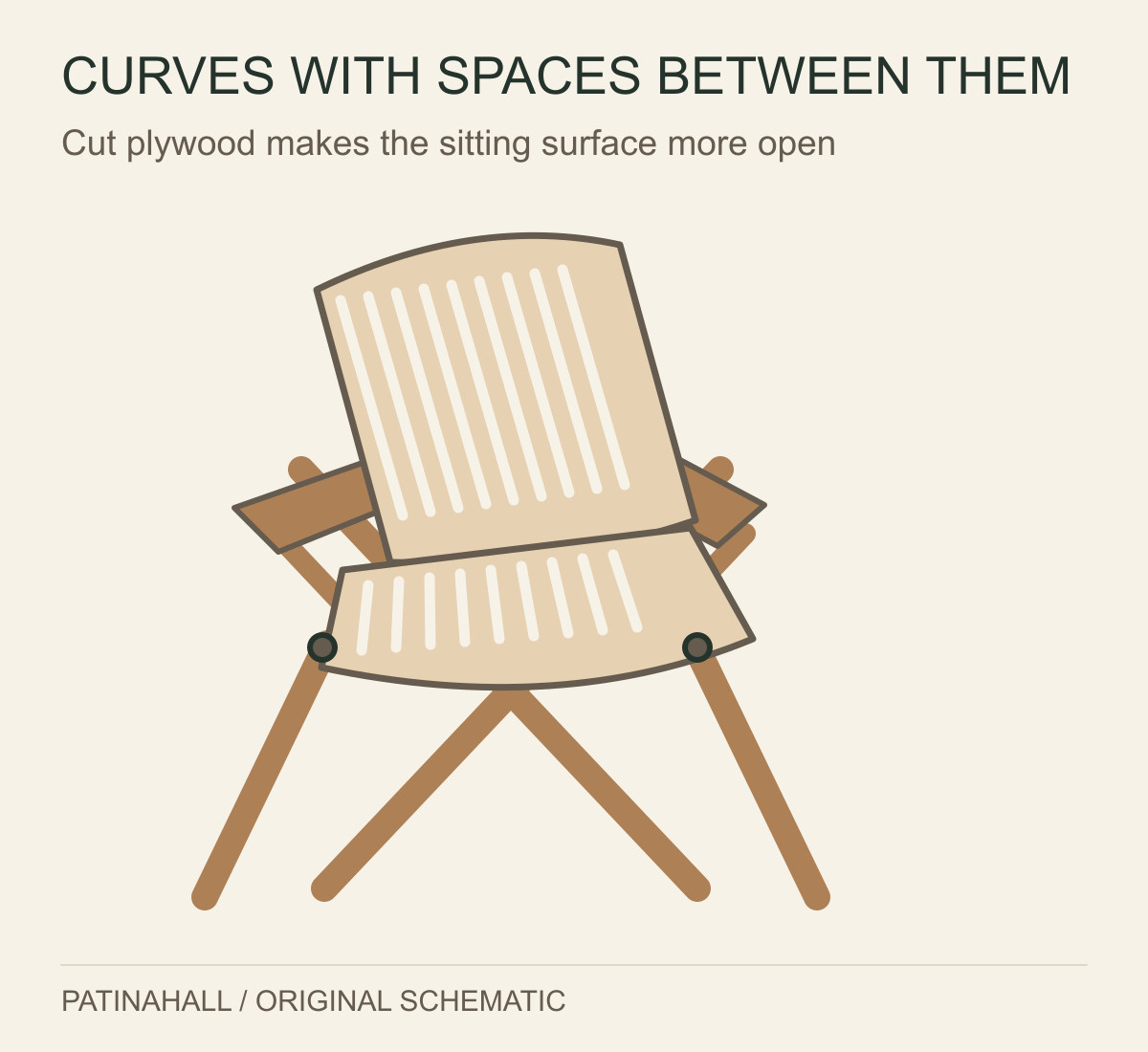
An illustrative wooden lounge chair has slotted curved plywood seat and back panels above crossed folding supports and wooden arms.
The parallel slots open Rex’s curved plywood surfaces to light. The drawing simplifies its supports and joints. Original PatinaHall schematic, not to scale.
On this page
Key facts & takeaways

At a glance

Subject
Niko Kralj Rex folding lounge chair
Entry
Design story
Last reviewed
6 September 2026

Three things to remember

  1. The broader Rex history and the folding lounge model have different date contexts.
  2. The slots are cut into shaped plywood, rather than applied decoration.
  3. A chair’s stored shape is part of its usefulness.

A chair with a useful disappearing act

A comfortable chair is welcome until the room needs to do something else. Rex addresses both moments. Its shaped wooden seat and back offer a generous sitting form; its folding structure lets the chair become a much thinner object when it is put away.

MoMA records Niko Kralj’s REX Lounge Chairs as a 1956 design. The museum’s examples measure nine centimetres deep when folded, a striking indication of the change in form rather than a universal dimension for every Rex.2

Here, the stored shape deserves as much attention as the chair opened for use.

The spaces cut into the wood

The seat and back gain their airy appearance from parallel slots in shaped plywood. MAO, Ljubljana’s Museum of Architecture and Design, explains the perforations as both a visual feature and a way to reduce the amount of material.3

These are useful spaces. They let light pass through what might otherwise read as a broad wooden surface. The eye follows the remaining strips and the curve they share, so the chair can look open while retaining a coherent sitting shape.

Rex Kralj’s current lounge-chair description connects the cut plywood to its curves, low weight and folding behaviour. The material treatment and the overall structure belong to the same design problem.4
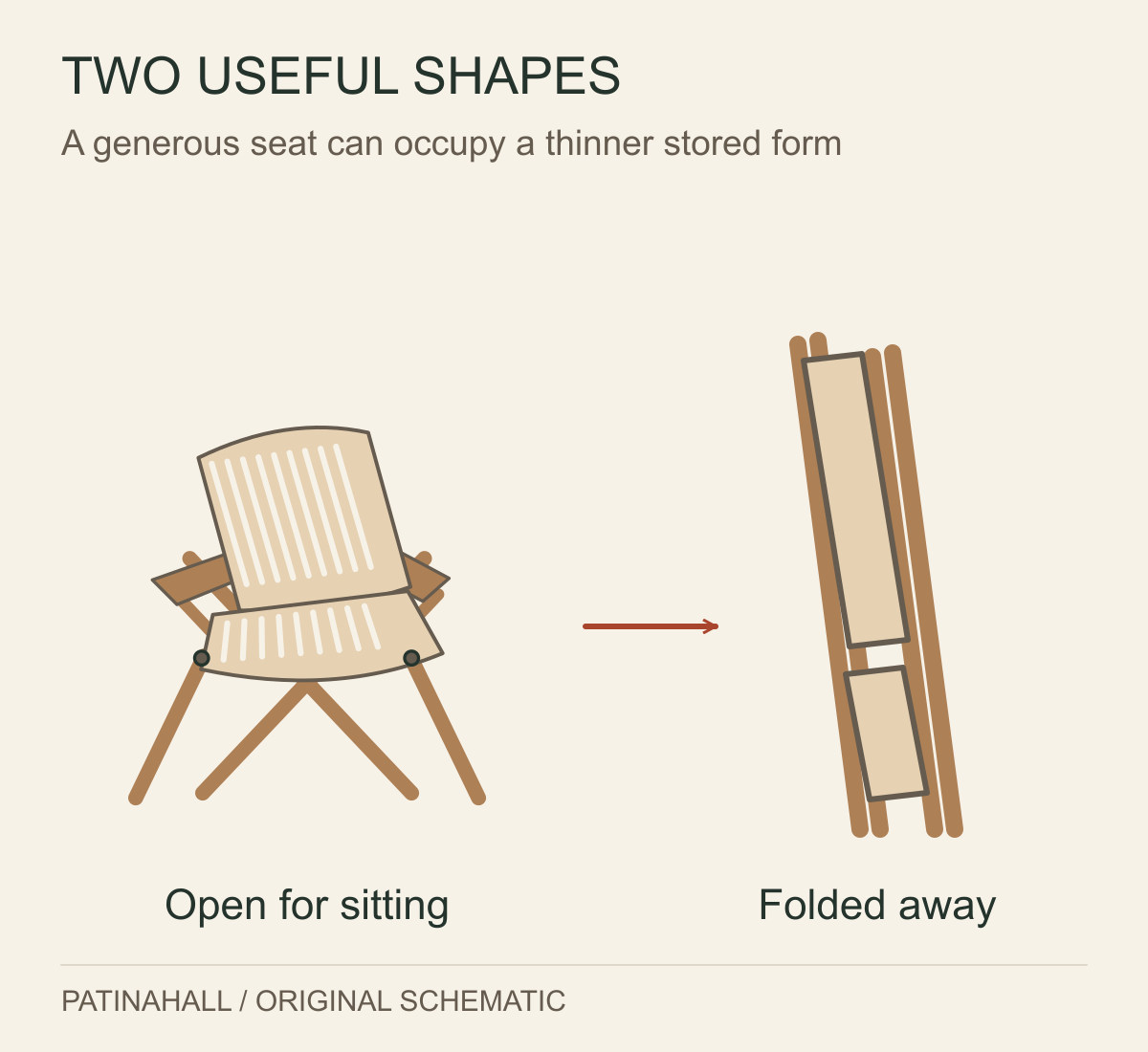
An open slotted wooden lounge chair is compared with a narrow folded silhouette, linked by an arrow.
Rex’s open and stored forms serve different moments in a room. The silhouettes are illustrative rather than a folding sequence. Original PatinaHall schematic, not to scale.

An industrial chair from Slovenia

MAO places the broader Rex story in 1952, naming Kralj and Stol Kamnik. Its account describes an early Slovenian experiment in mass-producing an affordable everyday chair through pressed and perforated plywood.1

That earlier family history and the more specific 1956 folding lounge record answer different questions. One introduces the wider project; the other anchors the particular chair examined here.

The industrial context matters because a wooden chair can easily be read as an object shaped entirely by hand. Rex’s curves also belong to a story about repeatable production. The useful form had to make sense for manufacturing as well as for someone sitting down.

Making room without becoming disposable

The current Rex range continues the folding lounge chair in wood finishes including beech and oak. Its maker still presents folding as a central part of the product.4

A chair that folds can be substantial during use and temporary in its claim on the room. Those qualities are often treated as opposites. Rex brings them into one object by giving the opened and closed forms equal attention.

Look again at the slots and the joints. One set of decisions opens the surface to light; another allows the structure to close. Together they explain a chair that can take its place comfortably, then make room for the next thing a household needs to do.

Research notesEvidence, connections and limits

MAO supplies the early Rex context; MoMA’s 1956 lounge-chair record and the current maker concern more specific examples and versions. Recorded dimensions are not universal, and seller descriptions do not establish exact dates, model numbers or condition.

Evidence map

Connected subjects and evidence

Reviewed connections

  • Niko Kralj Rex folding lounge chairdesigned byNiko Kraljdocumented

    MAO’s broad Rex history uses 1952; MoMA and the current maker date the folding lounge model 1956. Keep those scopes distinct and apply MoMA’s folded dimensions only to its recorded examples.

    Reviewed 6 September 2026 by PatinaHall editorial.
  • Niko Kralj Rex folding lounge chairmanufactured byRex Kraljdocumented

    MAO’s broad Rex history uses 1952; MoMA and the current maker date the folding lounge model 1956. Keep those scopes distinct and apply MoMA’s folded dimensions only to its recorded examples.

    Reviewed 6 September 2026 by PatinaHall editorial.
    • Source 4Rex Lounge Chair current production

Research trail

Sources and further reading

  1. Silent Revolutions: Rex Chair, Niko Kralj for Stol Kamnik, 1952Museum of Architecture and Design, LjubljanaAccessed 6 September 2026
  2. Niko Kralj, REX Lounge Chairs, 1956, 77.2018.1-2The Museum of Modern ArtAccessed 6 September 2026
  3. Stol Rex: educational worksheet on perforated plywoodMuseum of Architecture and Design, LjubljanaAccessed 6 September 2026
  4. Rex Lounge Chair: Niko Kralj, 1956Rex KraljAccessed 6 September 2026

Last reviewed 6 September 2026. Found an error or a stronger primary source? Contact PatinaHall.