Artefact story

A New York cradle: the nursery borrows formal furniture

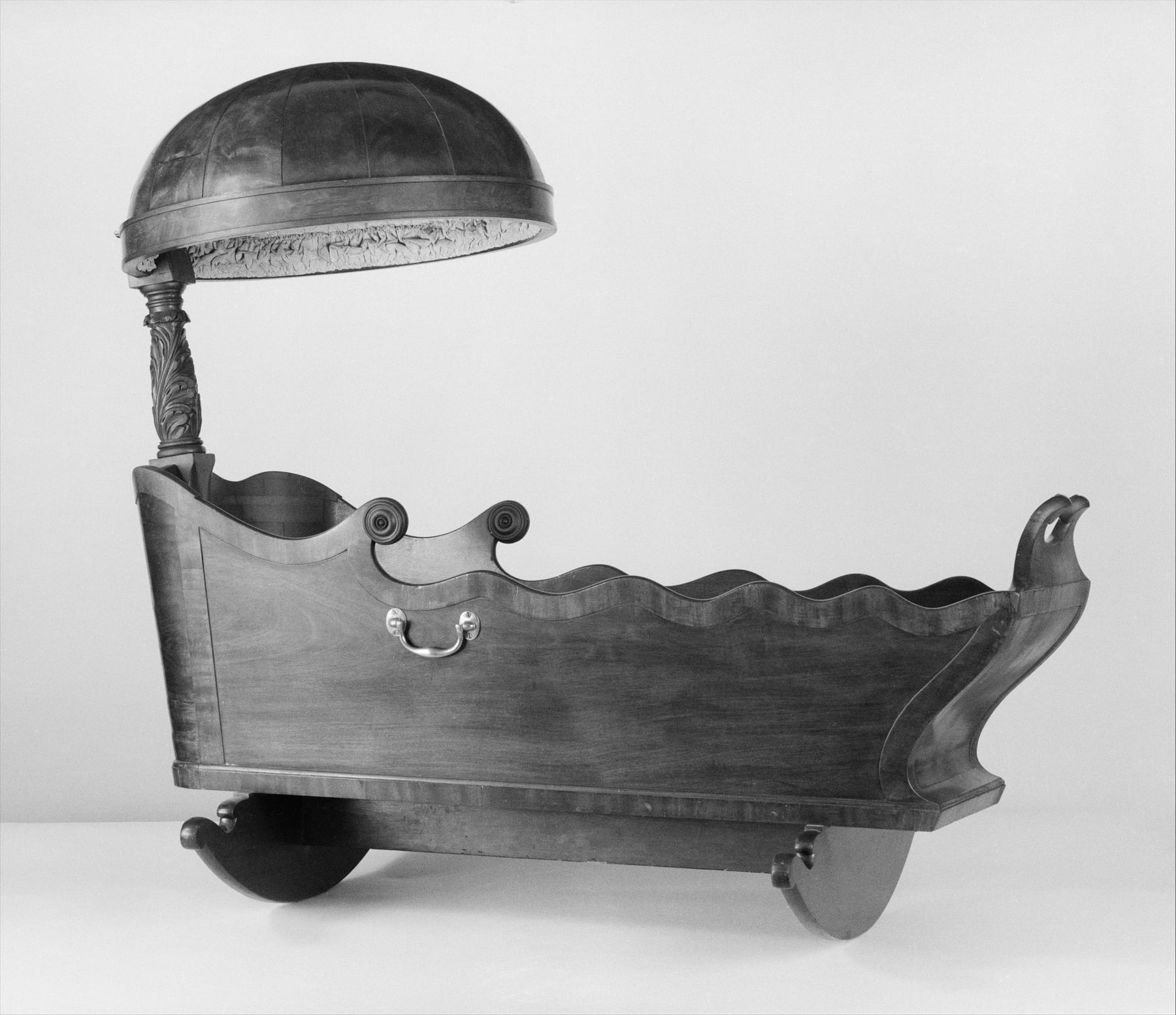
This New York cradle brings the visual language of formal furniture into the nursery. A broad hood rises above a shaped wooden body, while curved rockers sit beneath it. Even in an archival black-and-white photograph, the contrast between the commanding canopy and the small sleeping enclosure is striking.

Archival monochrome view of the New York cradle, with a broad hood above a shaped body and curved rockers.
Archival monochrome view of the New York cradle, with a broad hood above a shaped body and curved rockers. Accession 1971.217. The Metropolitan Museum of Art. Public domain (CC0).
On this page
Key facts & takeaways

At a glance

Subject
Cradle 1971.217
Entry
Artefact story
Last reviewed
6 September 2026

Three things to remember

  1. The hood, enclosure and rockers form three distinct but related shapes.
  2. The Met relates the unadorned wood and substantial curves to late Federal taste.
  3. George Smith’s remarks offer period context, not a design attribution for this cradle.

The nursery gets a commanding silhouette

The broad hood gives this small bed an unexpectedly imposing presence. Raised on a post above the enclosure, it creates a second large shape in the air. Below it, the curved ends and rockers give the body a similarly emphatic outline.

The Met dates the cradle to 1815–20 and places its manufacture in New York. Its catalogue describes late Federal furniture through unadorned mahogany and substantial rounded forms. The cradle brings those qualities into a room associated with an infant, rather than reserving them for a parlour.1

Curves continue down to the floor

Start at the hood and trace the object downwards. The upper curve is held above the sleeping space; the wooden enclosure has its own shaped ends; the rockers carry the movement down to floor level. These are separate parts, but their repeated curves make the cradle feel composed as a whole.

The museum records mahogany, rosewood, brass and white pine. That list adds information that the monochrome photograph cannot provide on its own. The broad dark areas and small highlights in the image show contrasts of tone, while the catalogue identifies the materials.1

The closer view helps separate the enclosure from the supports beneath it. A shape that looks almost monumental in the full photograph is still a set of joined components organised around a small sleeping space.
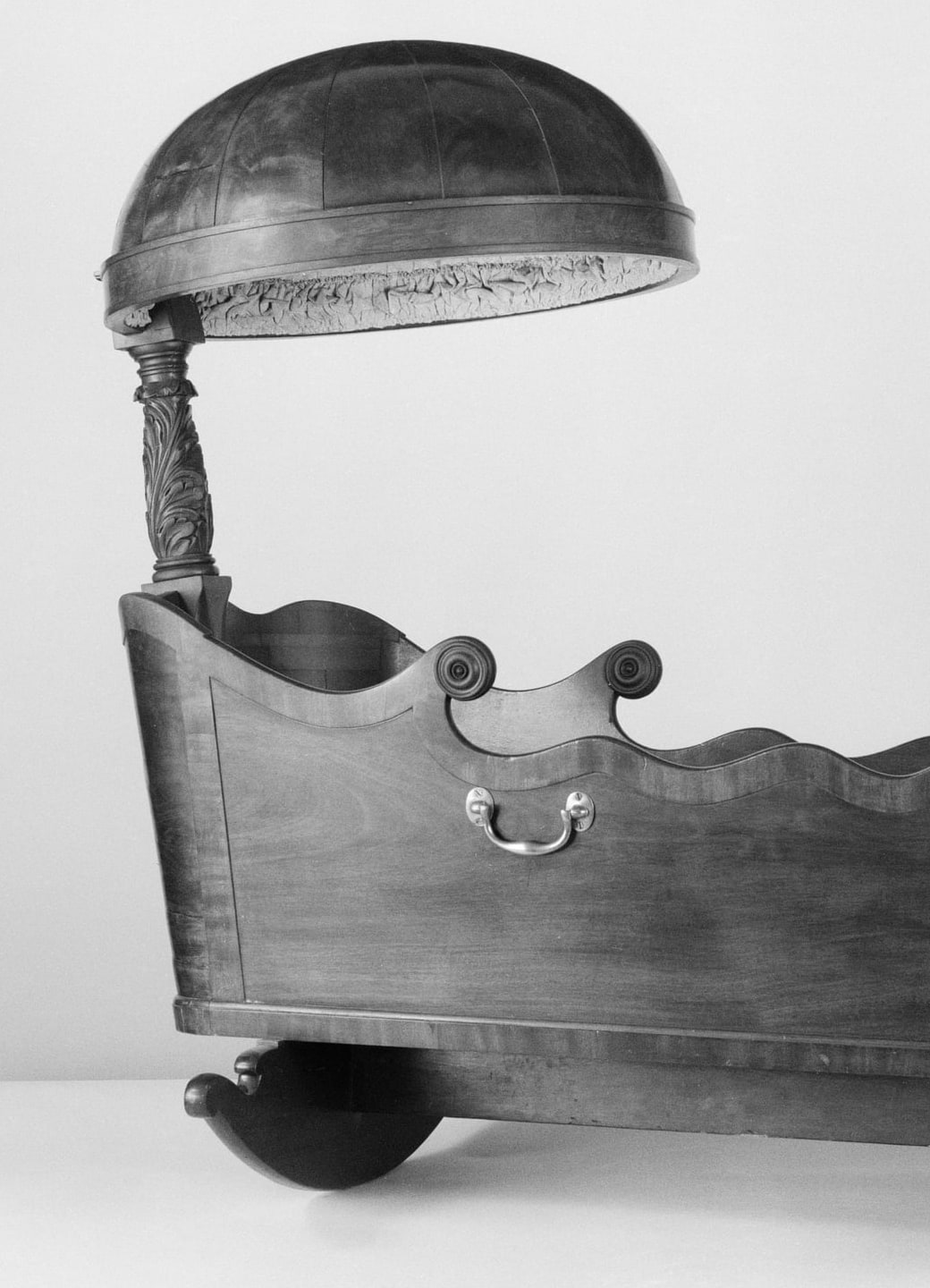
Cropped archival detail showing the cradle’s hood support, shaped rim and one rocker; the monochrome image does not record original colour.
Cropped archival detail showing the cradle’s hood support, shaped rim and one rocker; the monochrome image does not record original colour. Accession 1971.217. The Metropolitan Museum of Art. Public domain (CC0).

An outline with very little fuss

The cradle’s forceful shapes belong to a wider taste for clear outlines. Discussing an American klismos chair, the Met cites the British furniture designer George Smith’s 1812 admiration for Greek designs: he valued flowing contours and parts arranged in distinct masses, without a clutter of small details.2

That contemporary idea offers a useful lens for this cradle, without making Smith its designer. The large hood, enclosure and rockers can each be grasped at a glance. Their relationship supplies the drama that elaborate surface carving might provide on another object.

No maker or original family is identified in the museum’s record. The surviving form nevertheless tells a specific story about domestic scale: a piece made for the smallest member of a household could borrow the visual confidence of its grander furniture. The broad curves do that work before any ornament is needed.

Research notesEvidence, connections and limits

The museum identifies a New York origin and an 1815–20 date range, but no maker or original family. The monochrome photograph does not establish original colour. This historical account does not assess suitability for present-day infant use.

Evidence map

Connected subjects and evidence

Reviewed connections

  • Cradle 1971.217uses materialMahogany, rosewood, brass and white pinedocumented

    The primary record lists these materials for this subject. The full material list and object dating remain in the cited accession record; listed replacement or uncertain materials retain their qualifiers.

    Reviewed 6 September 2026 by PatinaHall editorial.
  • Cradle 1971.217associated with placeNew York Citydocumented

    The Met records this geographic association for the exact artefact.

    Reviewed 6 September 2026 by PatinaHall editorial.

Research trail

Sources and further reading

  1. Cradle — 1971.217The Metropolitan Museum of ArtAccessed 6 September 2026
  2. Side Chair 1984.126: George Smith on outline and massThe Metropolitan Museum of ArtAccessed 6 September 2026

Last reviewed 6 September 2026. Found an error or a stronger primary source? Contact PatinaHall.