The promised shortcut did not arrive
A proposal for producing upholstered discs quickly and cheaply helped prompt the sofa’s development. The production method did not become the economical solution its advocates expected, but the design was compelling enough to continue. Herman Miller introduced Marshmallow in 1956.2
This is a better story than a simple celebration of efficient manufacture. Sometimes a process suggests a form, then fails to deliver its promised advantage. The form can remain interesting for reasons that become clearer after the original practical justification has weakened.
Here, the repetition itself became the argument. A sofa usually gathers its supporting and cushioning parts into a continuous body. Marshmallow lets the individual elements remain separate and visible.
Count the spaces as well as the circles
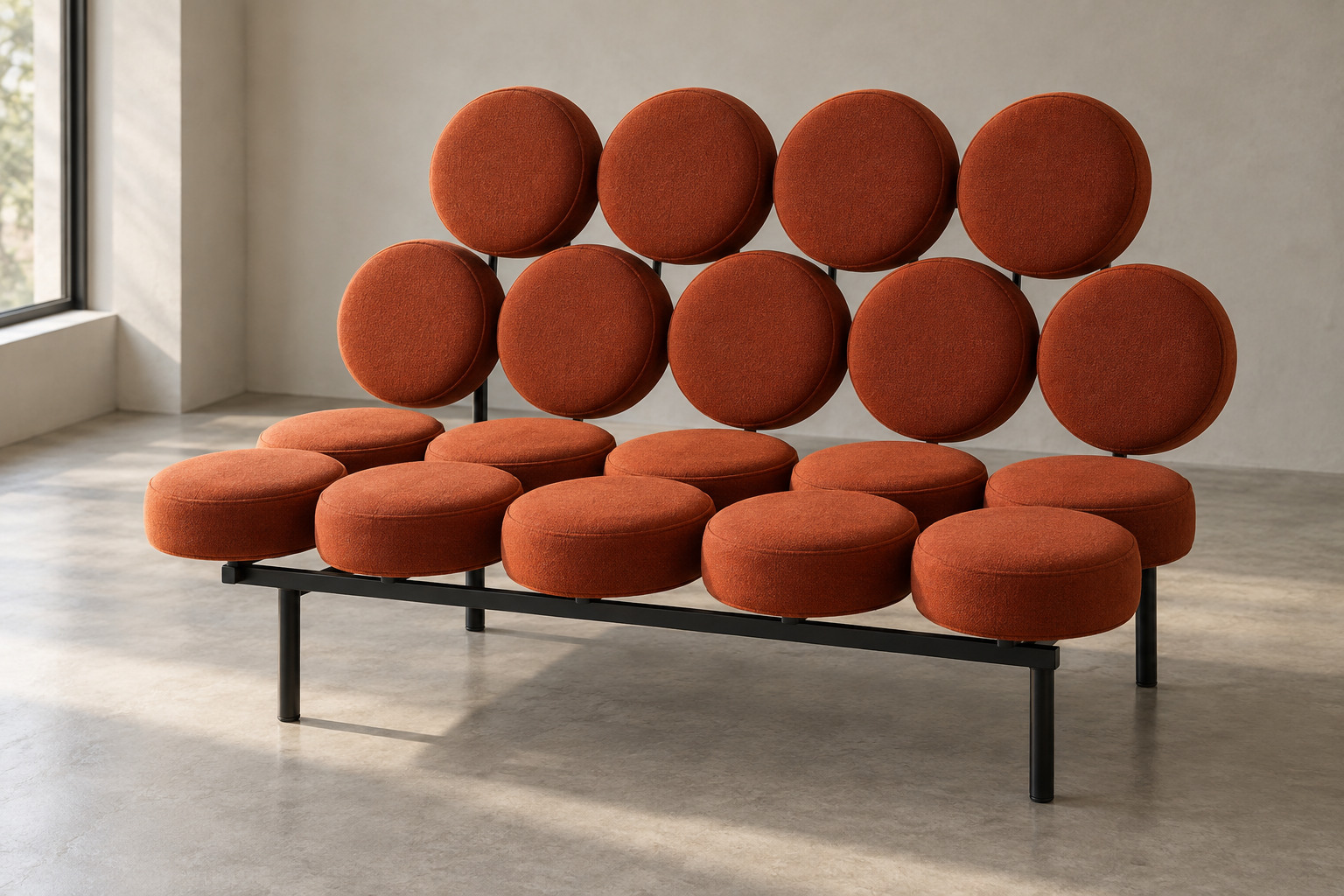
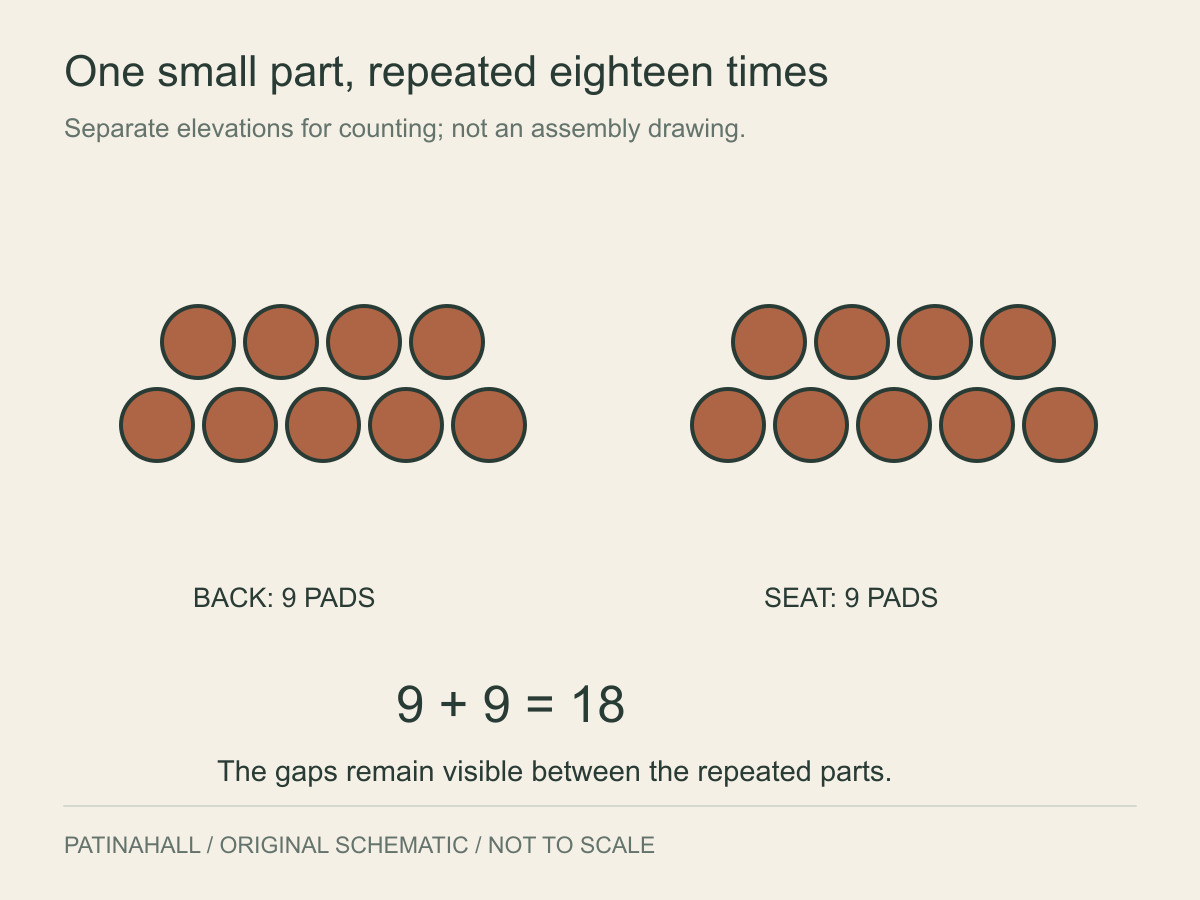
There are eighteen upholstered discs. Nine form the back and nine the seat, with gaps between neighbouring pads. The metal structure carries these separate surfaces without filling the spaces around them.3
The gaps do a surprising amount of visual work. They interrupt the usual impression of a solid upholstered block. Light passes through; the wall and floor remain visible; the cushions appear to occupy positions in a framework rather than merge into a single volume.
Repetition also makes variation conspicuous. Change the colour of a few pads and the arrangement becomes a pattern. Keep them alike and the circular rhythm carries the composition by itself.
Vitra’s catalogue describes a six-pad connecting unit that could extend an arrangement between two sofas. The same small element could therefore contribute to a larger system, rather than remaining tied to one isolated piece.3
The person inside the office credit
Irving Harper worked as design director in the George Nelson office. Herman Miller’s account of his career, drawing on interviews, identifies his role in Marshmallow alongside work in graphics and other products.1
An office name can make a collaborative practice look like the work of one pair of hands. Recovering Harper’s contribution makes the sofa’s authorship more precise and the surrounding practice more interesting.
His later paper sculptures offer another view of an ability to build expressive forms from repeated elements. They are separate works, not evidence that the sofa was conceived as a paper model. The connection is a way of looking across his practice, rather than a claim about a hidden development sequence.
The sofa remains slightly unresolved
Marshmallow never becomes an entirely ordinary sofa, even in a single muted colour. Its divisions stay visible. The eye keeps moving between the circular pads and the frame that gathers them.
That slight resistance is part of its appeal. It lets us recognise a familiar object while continuing to see the assembly that makes it possible.
The failed shortcut has left a useful question behind: how much of a sofa needs to be one continuous thing? Eighteen circles offer a memorable answer.