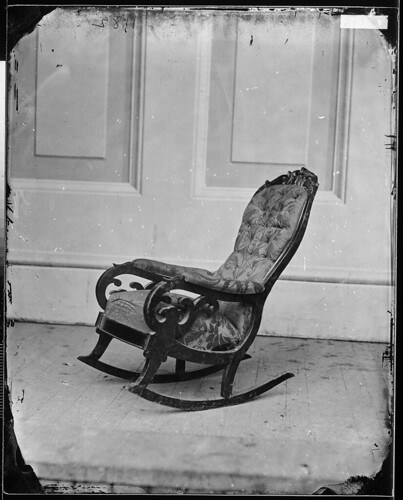
Furniture borrowed for an important visitor
The rocker belonged to Harry Clay Ford, one of the theatre’s owners. Bought as part of a reception-room suite, it later moved to his apartment before being brought back for President Lincoln’s visit on 14 April 1865. The Henry Ford dates its manufacture to 1855–65 and identifies walnut and silk damask among its materials.1
This earlier life is easy to lose once an object acquires a famous name. In the theatre box, the chair became a place associated with a single terrible event. In the years before it, people had simply sat, leaned back and worn its upholstery.
The two histories occupy the same material. One is nationally remembered; the other survives through ordinary use and the museum’s research.
The photograph removes the sitter
The National Archives photograph shows the empty rocker as a subject in its own right. Its caption identifies the chair through Lincoln, while the object fills the image without a reconstruction of the theatre scene. The record places the photograph in the Mathew Brady collection.2
An empty chair can be unusually forceful. It retains the shape of an absent body without showing one. Here, the framing encourages the viewer to connect the vacancy with a person whose name is already supplied.
That transformation began early. The Henry Ford also holds a stereograph dated 1865–66 depicting the chair. Such a small, reproducible image made the object available to viewers who would never stand beside it.3
The chair was becoming something that could circulate as a picture while the physical object remained elsewhere.
Three different kinds of evidence
A stain offers a tempting shortcut from surface to story. Yet the museum records hair-oil wear from earlier users and later investigation of the upholstery. Conservation analysis found that the material history of the stains was more complicated than the popular assumption that every dark area was blood.1
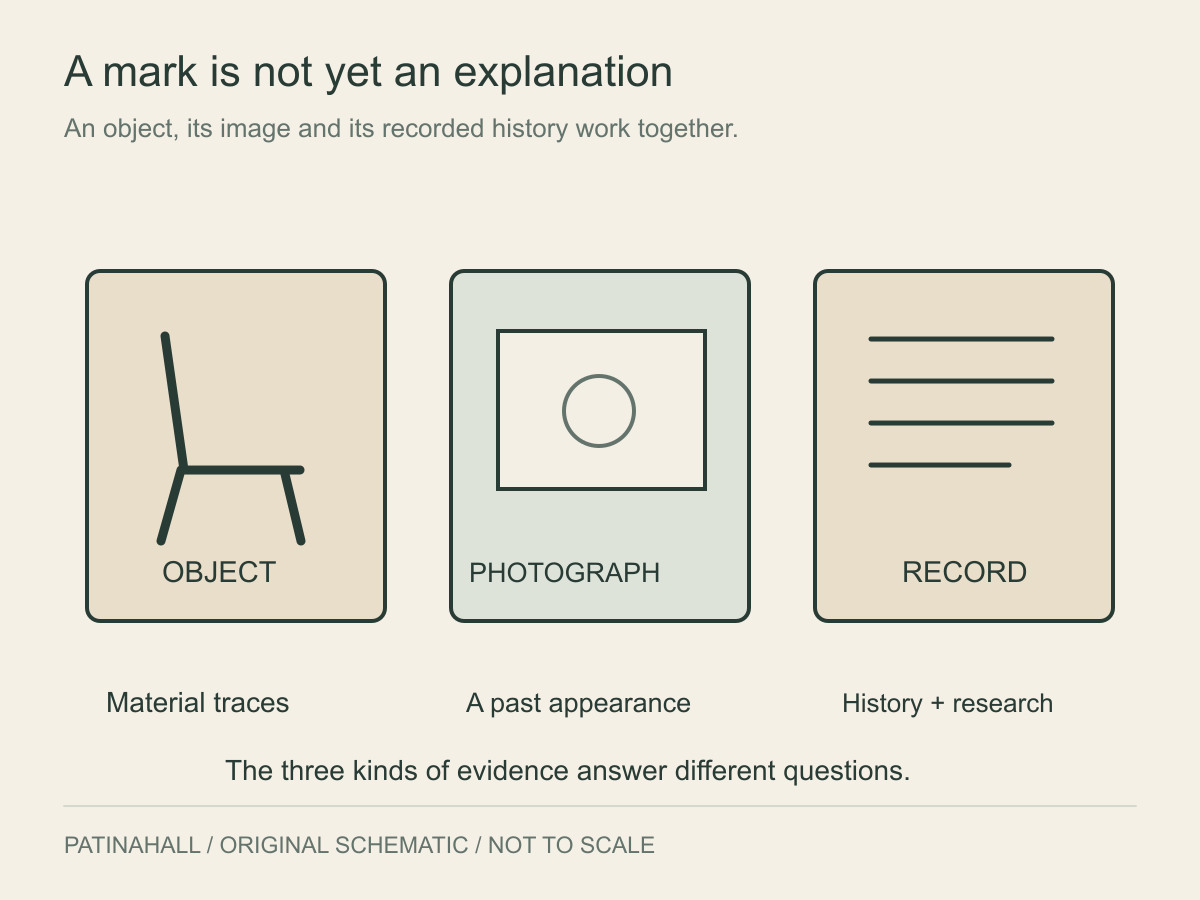
The object, the photograph and the collection record therefore do different jobs. The object carries material traces. The photograph records an appearance at a particular moment. The written account connects ownership, movement and research.
They are most useful together. A photograph cannot identify every substance in a fabric. A laboratory result cannot tell the whole story of how a chair reached a theatre. Provenance cannot prevent us from overlooking a repair that is visible in the object itself.
The ordinary life remains inside it
The rocker eventually entered Henry Ford’s collection following its return to the theatre owner’s family and sale in 1929. It now has a public identity that its maker and first occupants could not have anticipated.1
Its quieter history still matters. A piece of furniture can become evidence without surrendering the years of use that came before. Looking at the chair responsibly means allowing those years to remain visible, even when the famous event is the first thing we think of.