Artefact story

Light Shade Shade: the chandelier inside the mirror

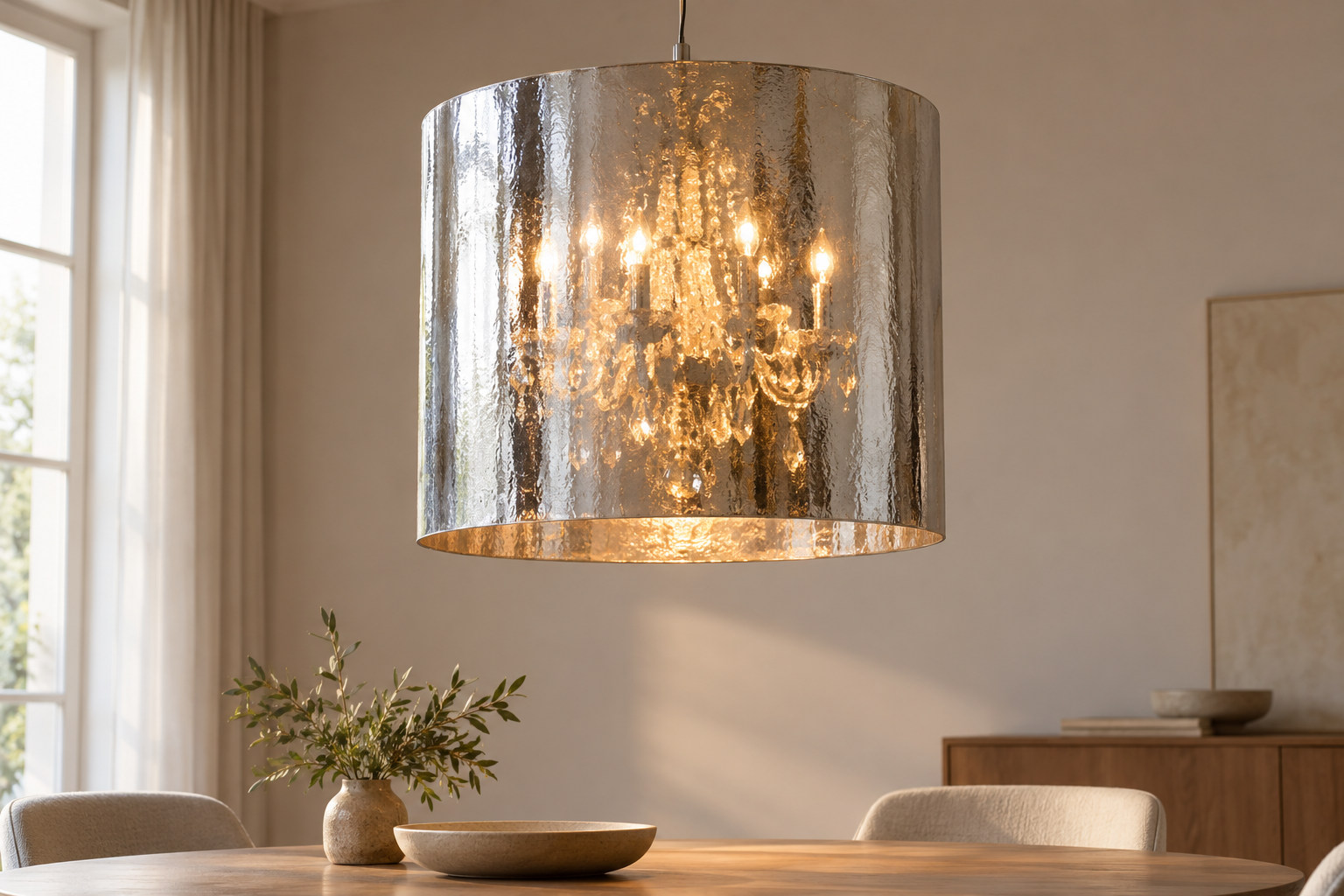
An unlit silver cylinder can look like the whole lamp. Turn attention towards its illuminated state and a chandelier appears inside. Jurgen Bey’s Light Shade Shade makes concealment and revelation two readings of the same closed object.

An illuminated chandelier can be seen within a closed reflective cylindrical outer shade.
PatinaHall editorial reconstruction. It is not a documentary photograph. A closed reflective outer form lets the inner chandelier become visible through light.
On this page
Key facts & takeaways

At a glance

Subject
Lightshade-shade chandelier, Centraal Museum28654
Entry
Artefact story
Last reviewed
26 October 2026
Object dated
1999documented

Three things to remember

  1. The outer mirrored foil remains around the chandelier.
  2. Illumination changes what can be seen through that surface.
  3. The museum’s 1999 object is separate from later Moooi product variants.

A chandelier gets another outline

A traditional chandelier usually introduces itself through its arms, suspended details and lights. In Light Shade Shade, a cylinder gives that existing object a new outer boundary. The first impression can be much simpler than the thing held inside.

Centraal Museum identifies its example as 28654, dates it to 1999 and credits Jurgen Bey. It names Droog Design as promoter and records an acquisition in 2000. The materials include a chandelier and mirrored foil.1

The existing object remains important. The new design does not need to erase the chandelier’s decorative character to give it a different place in the room. It changes the conditions under which that character becomes visible.

The room appears on the outside

When the light is off, the museum explains, the mirrored exterior reflects its surroundings. The cylinder borrows fragments of the room and becomes a comparatively continuous silver presence.1

That reflection offers a different kind of detail from the chandelier. Instead of following the old object’s arms and ornaments, the viewer notices a surface that responds to the space around it.

The outer shade therefore does two jobs in the visual reading. It provides a clear new outline and supplies a changing image of the surrounding room. The object can seem restrained while carrying quite a busy inner history.
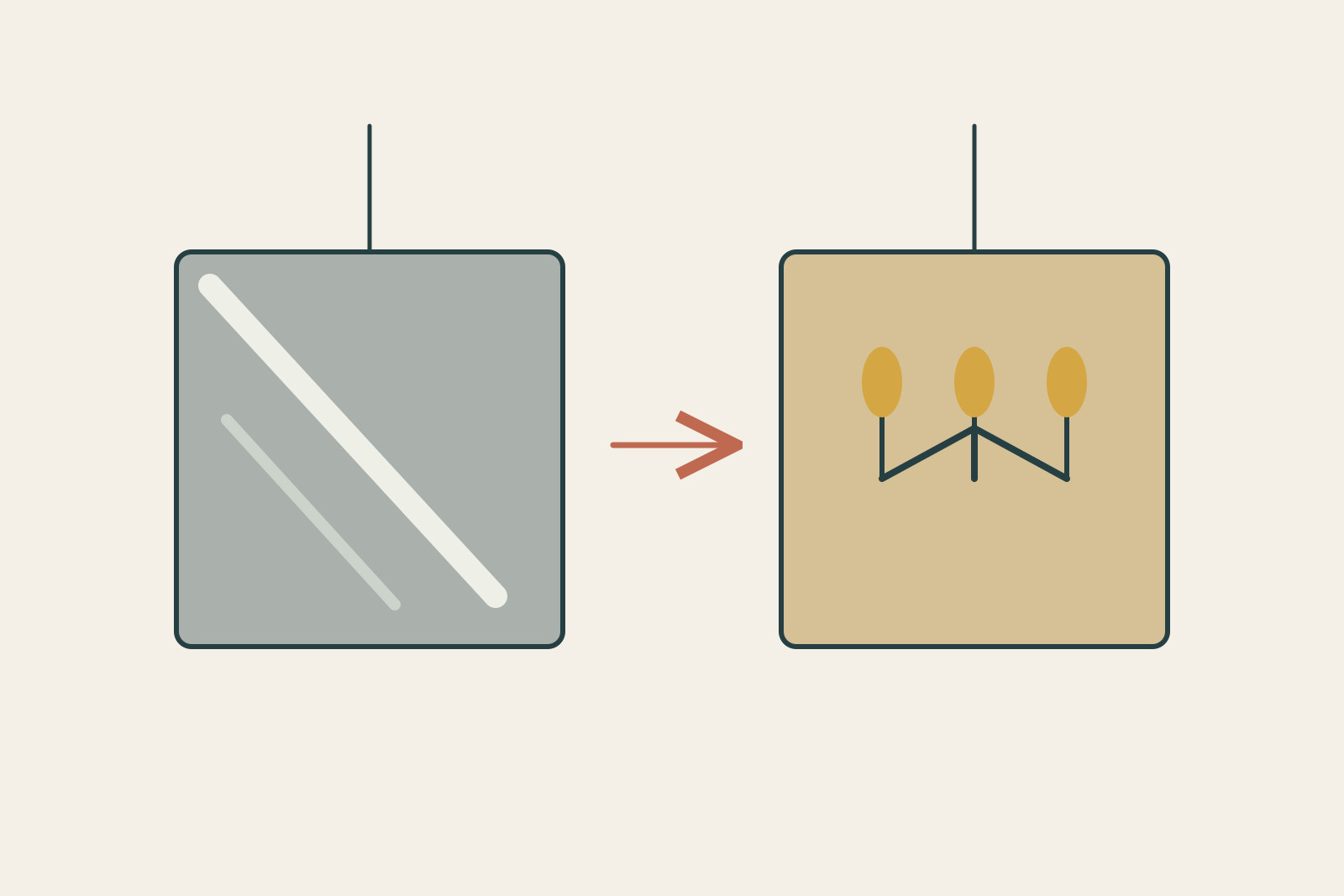
The same closed reflective cylinder conceals or reveals the chandelier as light balance changes.
The same closed reflective cylinder conceals or reveals the chandelier as light balance changes. Original PatinaHall schematic, not to scale.

Light lets the older form return

With the chandelier illuminated, its shape becomes visible through the foil. Both Centraal Museum and TENT’s Dutch Design Port exhibition account describe this reveal. The outer cylinder stays in place; a change in light alters which form can be read most clearly.12

It is a small spatial drama without a moving curtain. The same enclosure that seemed to simplify the lamp can show the more elaborate object within. Two visual languages share one location.

The effect also changes the relationship with time. The existing chandelier is not merely a source for a newly drawn outline. Its own form remains present and can return to view.

One object keeps its own measurements

Moooi’s contemporary product sheet describes later Light Shade Shade variants, including a model 95 with its own measurements and specification. Those details help identify that product, but they are not a substitute for the Centraal Museum record.3

The lasting idea is easy to see without mixing the versions. An outer surface can introduce a new object while leaving an earlier one inside it. Here light supplies the moment when the two become visible together.
Research notesEvidence, connections and limits

Centraal Museum 28654 anchors this object story. Dimensions and electrical specifications from a later Moooi model are not transferred to it, and the illustrations do not document hidden construction or wiring.

Evidence map

Connected subjects and evidence

Reviewed facts

  • Object dated 1999documented

    Centraal Museum dates its Lightshade-shade chandelier 28654 to 1999 and records acquisition in 2000. Those dates concern this museum object. They are not inferred from the dimensions or electrical specification of a later Moooi model.

    Reviewed 26 October 2026 by PatinaHall editorial.
    • Source 1Work or object record and accompanying maker account: Lightshade-shade chandelier, Centraal Museum 28654. Kroonluchter Lightshade-shade, 28654

Reviewed connections

  • Lightshade-shade chandelier, Centraal Museum28654attributed toJurgen Beyattributed

    Centraal Museum credits Jurgen Bey as designer and Droog Design as promoter of object 28654. The promoter credit is not converted into a manufacturing attribution. The museum describes an existing chandelier within reflective foil.

    Reviewed 26 October 2026 by PatinaHall editorial.
    • Source 1Work or object record and accompanying maker account: Lightshade-shade chandelier, Centraal Museum 28654. Kroonluchter Lightshade-shade, 28654
  • Lightshade-shade chandelier, Centraal Museum28654uses techniqueReflective foil concealment and reveal in Light Shade Shadedocumented

    Centraal Museum describes the chandelier becoming visible through its outer foil when illuminated, and the reflective exterior dominating when unlit. TENT’s exhibition account supports that contrast. The effect depends on light balance, not a mechanical opening of the shade.

    Reviewed 26 October 2026 by PatinaHall editorial.
    • Source 1Work or object record and accompanying maker account: Lightshade-shade chandelier, Centraal Museum 28654. Kroonluchter Lightshade-shade, 28654
    • Source 2Dutch Design Port exhibition text: Jurgen Bey chandelier enclosed in semi-transparent mirrored foil, revealed when illuminated

Research trail

Sources and further reading

  1. Kroonluchter Lightshade-shade, object 28654Centraal Museum UtrechtAccessed 26 October 2026
  2. Dutch Design PortTENT RotterdamAccessed 26 October 2026
  3. Light Shade Shade: contemporary product sheetMoooiAccessed 26 October 2026

Last reviewed 26 October 2026. Found an error or a stronger primary source? Contact PatinaHall.