People within the curves
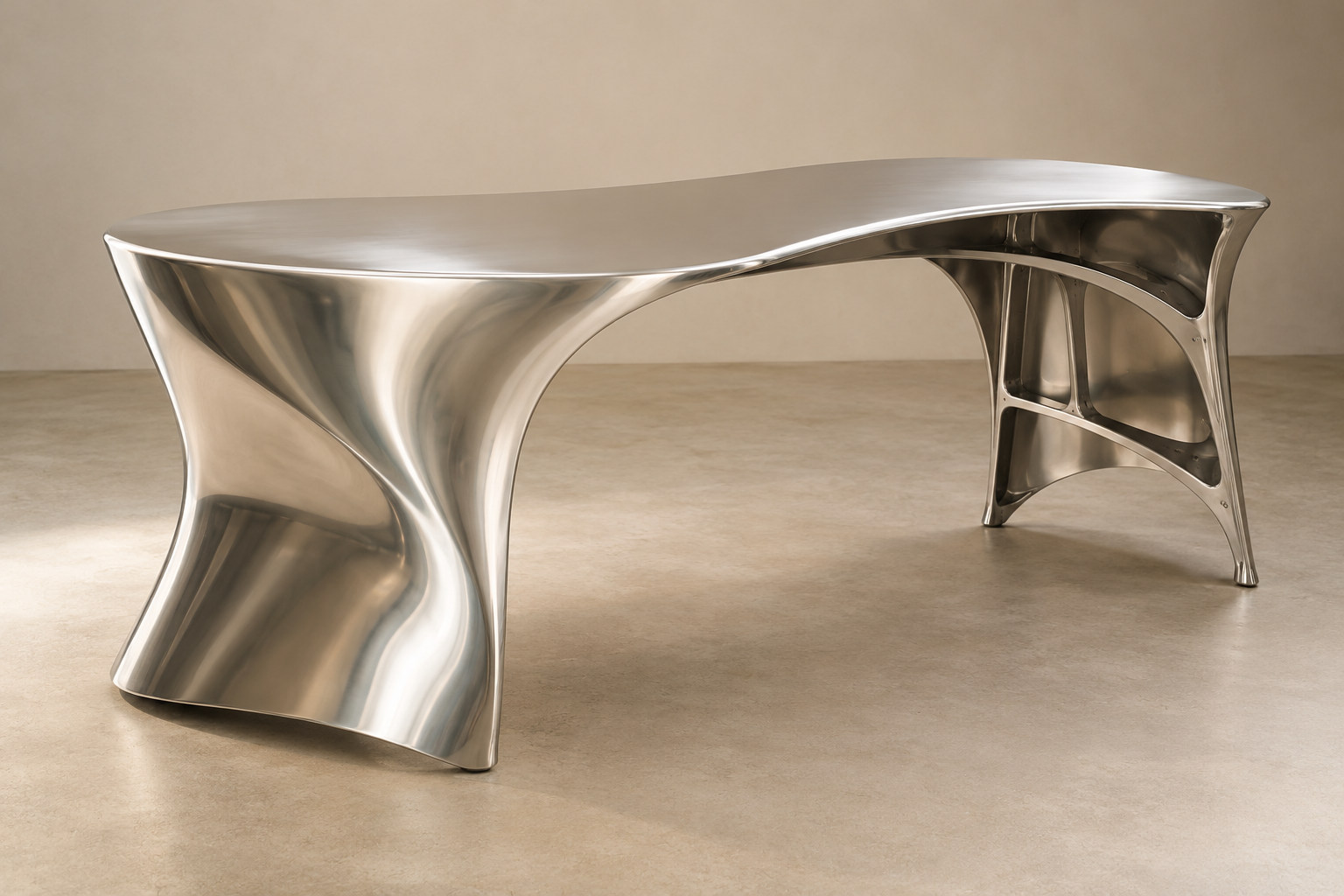
Lectori Salutem brings people into the outline of a desk. Its project accounts identify the profiles of Joep Verhoeven and Judith de Graauw, Jeroen Verhoeven's creative partners, within the flowing form. A contour can therefore be read both as furniture and as a reference to a person.12
That makes recognition part of looking. The desk does not need to carry a separate portrait frame: the reference belongs to the line through which the object takes shape.
A work surface is a particularly apt place for that gesture. It is where someone makes things, organises ideas and spends time. Here, the people associated with creative work become part of the object around which such activity can happen.
A smooth outside, an open end
The desk also changes character when viewed from its open end. A flowing exterior gives way to a visible supporting frame. The same object offers the eye a continuous surface and then an account of its construction.2
DeMakersVan's project account describes metal parts shaped using a six-axis industrial robot. It connects a tool associated with industrial production to a personal, elaborate piece of furniture.1
The contrast between exterior and frame gives that process a place in the finished work. Looking around the desk brings the viewer from a broad curve to the parts involved in realising it.
A project with more than one expression
A later gallery record describes a bronze-coated stainless-steel variant dated 2018 under the name Verhoeven Twins. Its warm-coloured surface is a particular expression of the project, with its own credit and edition record.3
The underlying story remains the relationship between flowing form, complicated making and named collaborators. The profiles bring the desk close to a human circle; the open end brings it close to the workshop.
Follow the curves once more, then look into the exposed structure. Lectori Salutem makes room for both kinds of presence: the people a designer works alongside, and the parts through which an idea becomes a desk.