Begin with the edge of the cloth
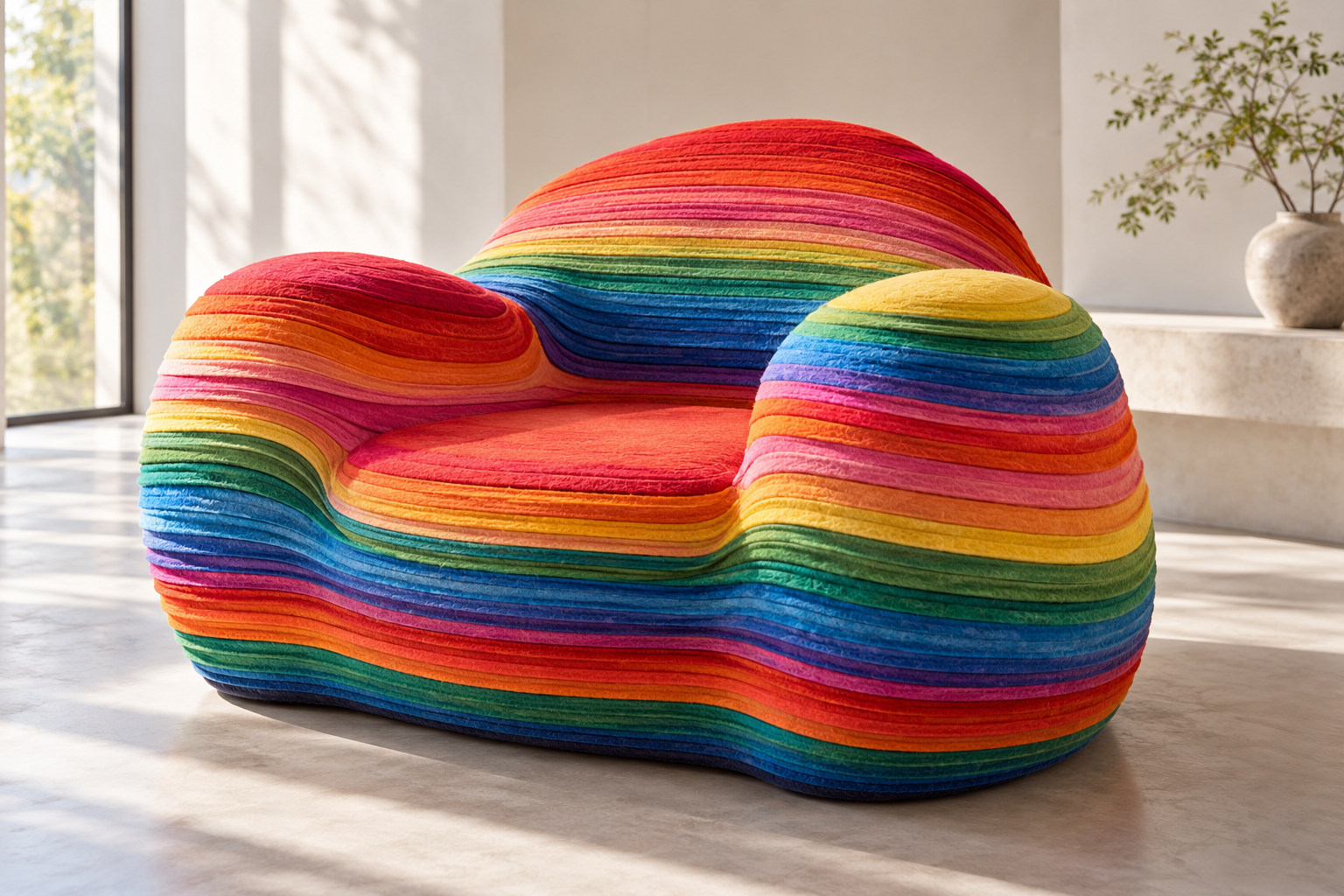
A fabric surface usually asks us to feel its face. Layers Cloud Chair asks us to look at its edge. Repeated cut layers create fine horizontal bands that follow a rounded seating form, making colour visible across the depth of the object.
Kvadrat describes 545 layers and nearly 100 colours in Hutten’s Divina project.2 These quantities explain this particular experiment’s intensity. They are not a recipe for every chair that shares a cloud-like outline.
Give the material the whole volume
The change is more than unusual upholstery. Instead of wrapping an existing chair with textile, the layers become the visible body. The relationship between one contour and the next gives rounded parts a stepped, almost topographical rhythm.
Hutten’s archive connects the project with his earlier aluminium Cloud Chair while describing a different material exploration.1 Keeping the two apart makes the transformation more interesting: a familiar formal idea can be reconsidered when another material takes responsibility for the volume.
Colour becomes something to move around
The designer archive gives 2013, while Kvadrat places the work in its 2014 Milan Divina presentation.12 Those dates record different moments in the project’s life.
The finished encounter is unusually generous. At a distance the chair reads as a colourful rounded body; closer attention finds layer after layer. Textile becomes simultaneously a material, a record of repetition and a way to draw a soft-looking volume in space.