
The workspace comes along
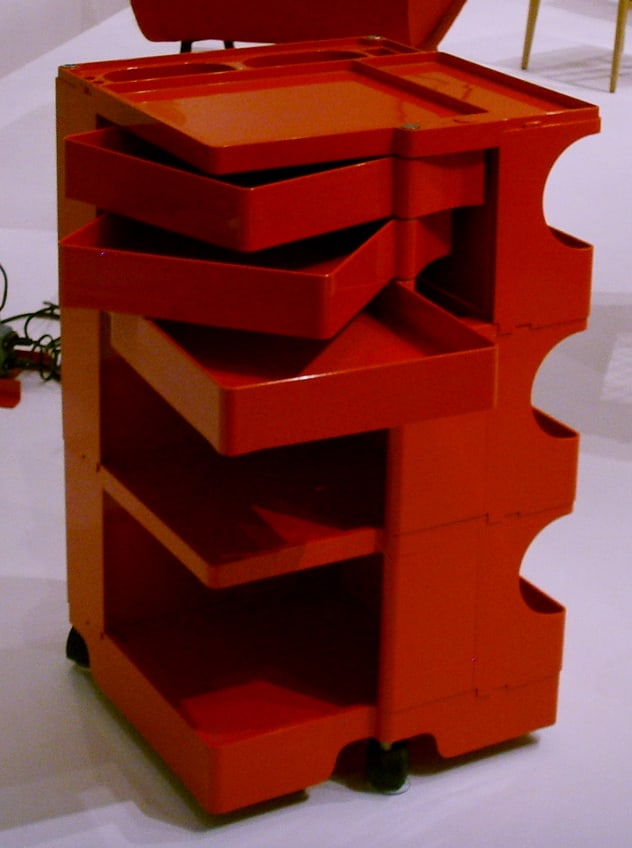
A desk can be clear while everything needed for the next task remains close by. Boby occupies that useful middle ground. The trolley collects small tools and materials beside a work surface, then rolls the whole arrangement elsewhere.
MoMA records Joe Colombo’s Boby 3 Portable Storage System as a 1969 design in ABS plastic, made by Bieffeplast. Its interpretation connects the trolley to Colombo’s interest in adaptable domestic equipment and movable elements.1
That larger ambition becomes very approachable in this small object. Instead of rebuilding a room around each activity, part of the room can travel with the activity.
The drawer that turns a corner
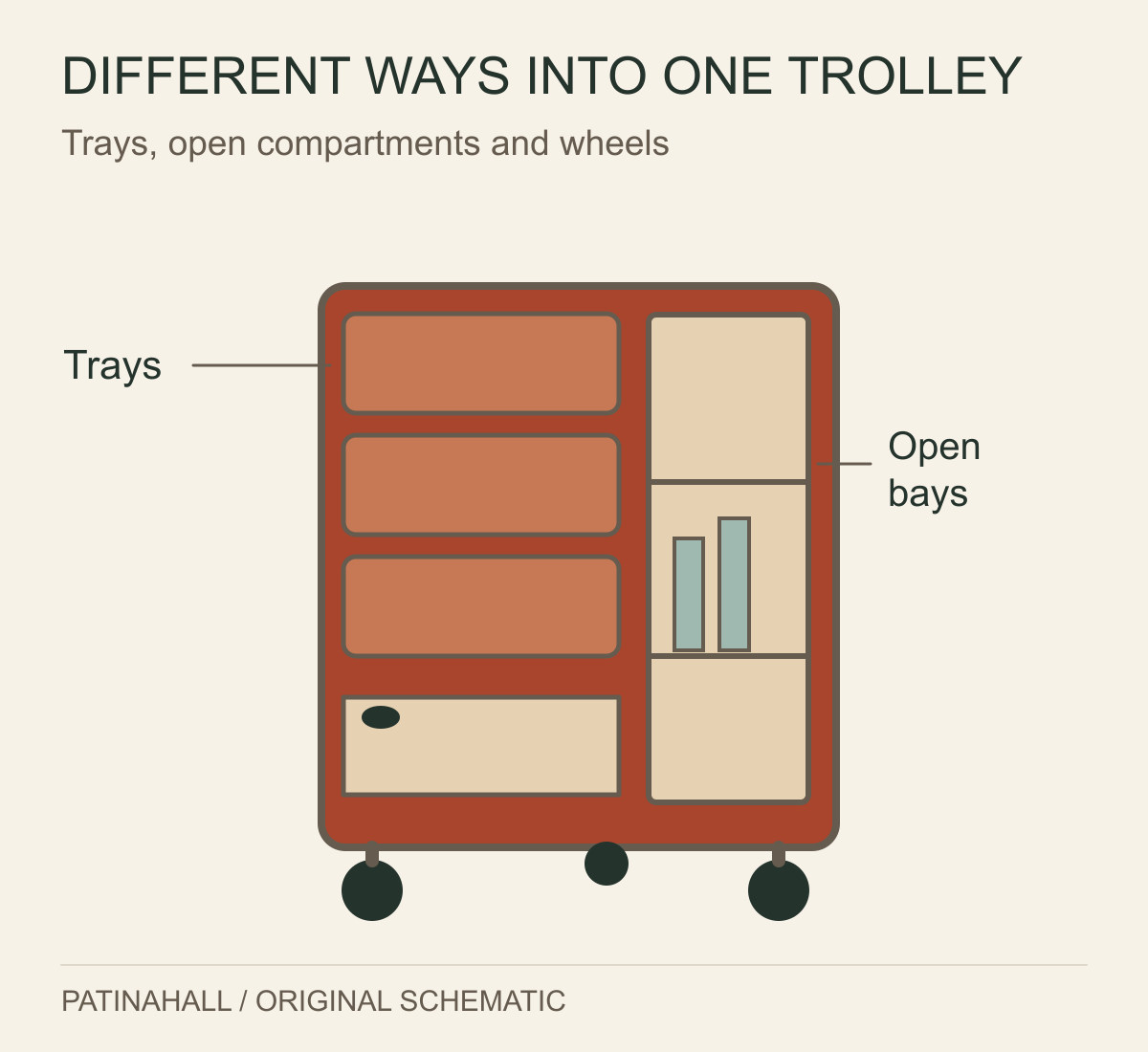
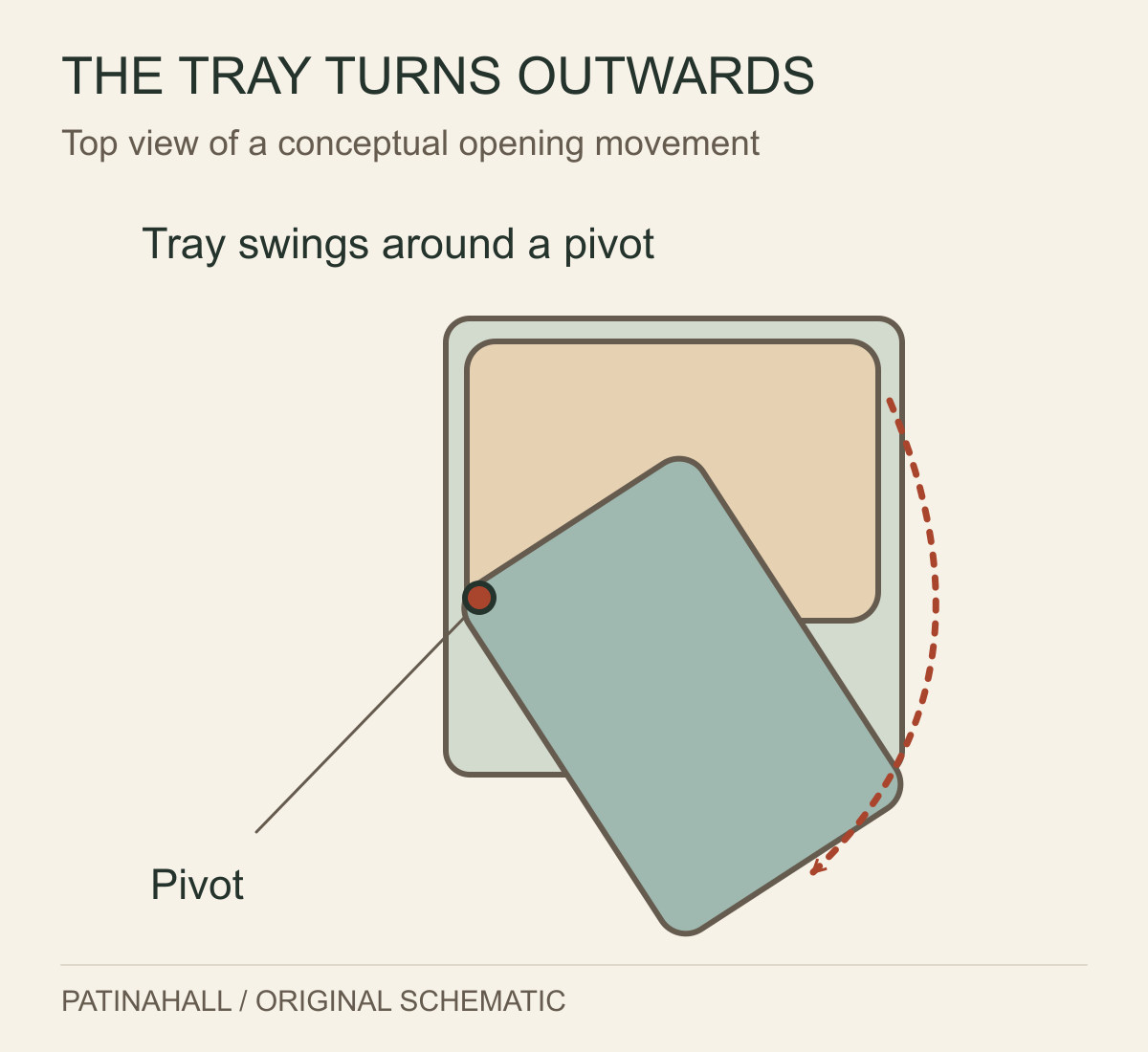
Boby’s most engaging movement happens above its wheels. Shallow trays swing out around a pivot, opening like a fan. B—Line’s catalogue shows this arrangement alongside open compartments and shelves.3
A conventional drawer travels in a straight line. A pivoting tray sweeps sideways, presenting its contents next to the body of the cabinet. That makes the direction of access part of the trolley’s character: front, side and top can each offer a different way in.
The distinction is visible even when the trolley is empty. An open shelf welcomes something you want to reach directly; an upright compartment gathers taller things; a shallow tray spreads smaller ones out. The storage is already making suggestions about how to work.
Small furniture, industrial thinking
Colombo’s interest in plastics was grounded in manufacturing experience. MoMA’s account connects his experiments to taking over his family’s electrical-conductor business in 1958. ABS and modular construction offered ways to give domestic objects several linked functions.1
B—Line describes the continuing Boby through injection-moulded ABS drawers and compartments, with polypropylene castors. It offers a range of configurations under the same name.2
Rounded edges and repeated sections give the trolley a coherent body despite its many openings. It can hold a varied collection without looking like several unrelated boxes strapped to a set of wheels. That visual unity is part of the design work too.
A working companion with a long life
The museum’s 1969 Boby 3 and B—Line’s model dated 1970 document different points in the design’s history. The current maker’s catalogue illustrates several heights and arrangements, showing how the working idea continues through variations.13
For someone encountering a vintage or recent Boby, the most useful historical clue is its organisation. Follow the route of a hand: into an open bay, over the top, around a swinging tray. Then imagine moving all those stored things together.
The trolley turns storage into a companion to an activity. Its pleasure lies in the moment when several useful things arrive together, already arranged, and the work can begin.