Artefact story

An ivory-and-cane chair: three materials, one open outline

A pale decorated frame surrounds a fine woven seat. The Met’s eighteenth-century chair combines fruitwood, ivory and cane, using solid edges and open surfaces to give an intricately worked object a surprisingly light outline.

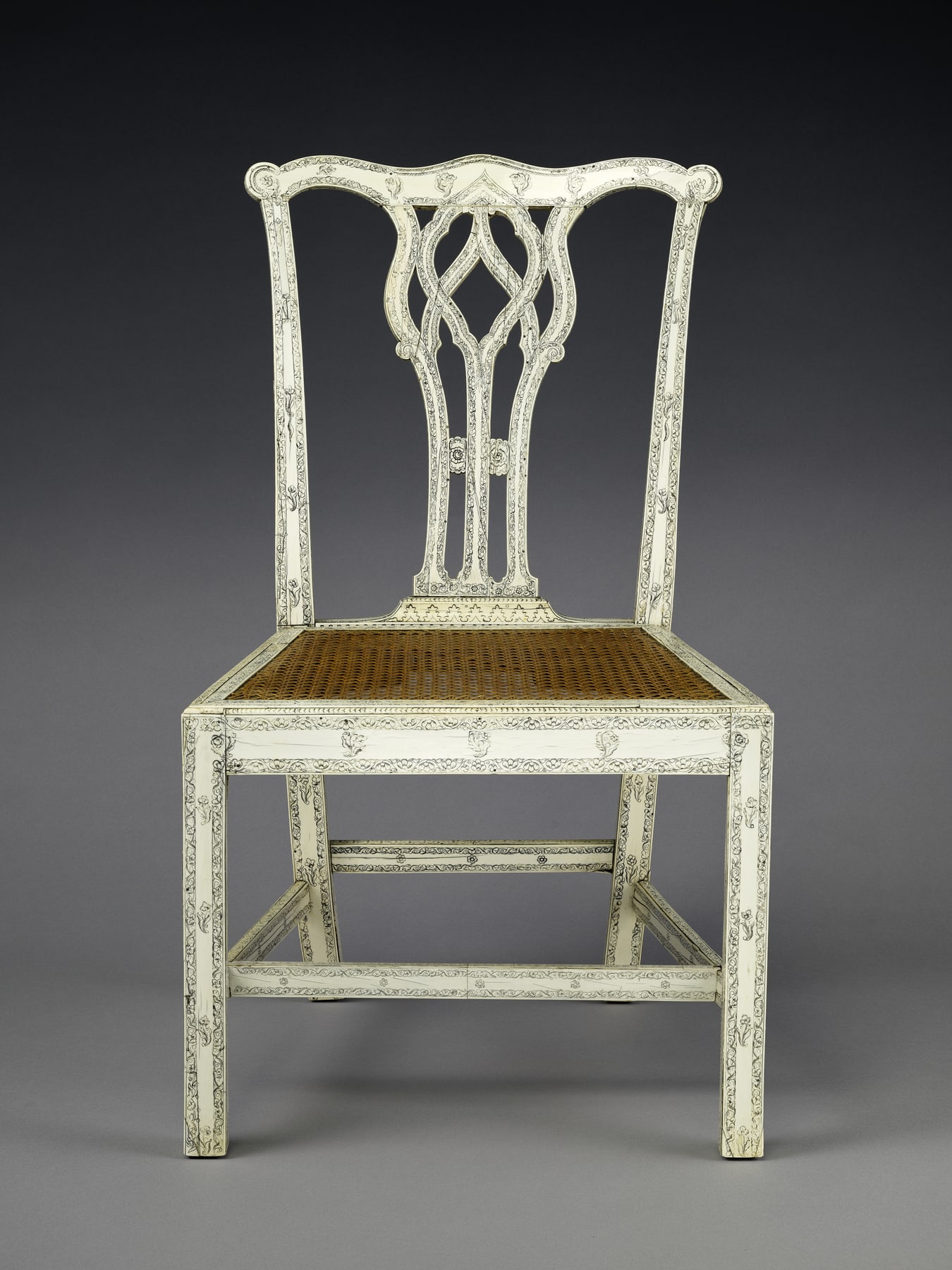
Pale eighteenth-century chair attributed to India, with a pierced back, decorated frame and woven cane seat.
Pale eighteenth-century chair attributed to India, with a pierced back, decorated frame and woven cane seat. Accession 1984.47.2. The Metropolitan Museum of Art. Public domain (CC0).
On this page
Key facts & takeaways

At a glance

Subject
Chair (One of Set of Four) 1984.47.2
Entry
Artefact story
Last reviewed
6 September 2026

Three things to remember

  1. The Met records fruitwood, ivory and cane for this chair.
  2. India is a geographical attribution, not a named workshop in the record.
  3. The Soane comparison concerns a different chair with a different construction and provenance.

A pale frame around an open seat

This chair brings three materials into one light-looking outline. The Met records fruitwood, ivory and cane, with a date in the second half of the eighteenth century and a geographical attribution to India. Its frame carries a dense pattern of pale detail, while the seat is a mesh of narrow strands.1

Look at the difference between those surfaces. Light catches the decorated frame as a solid edge. It passes through the small openings in the seat. The pierced back introduces larger gaps, so the chair alternates between worked material and open space rather than presenting a continuous pale block.

Three materials make one silhouette

The photograph invites the eye to follow the decoration, but the material list matters too. Fruitwood remains part of the object even where the pale surfaces dominate the view. Calling it simply an ivory chair would hide that combination.

The woven seat works differently from the surrounding frame. It spans an opening as a closely repeated mesh; the frame defines the perimeter and carries the larger outline. In the detail view, these two kinds of making sit immediately beside one another.

The Met identifies the chair as one of four. Repeated around a room, their open backs and narrow legs would produce a very different visual effect from four heavy upholstered seats. That comparison concerns the surviving shapes: the original room and arrangement are not recorded.1
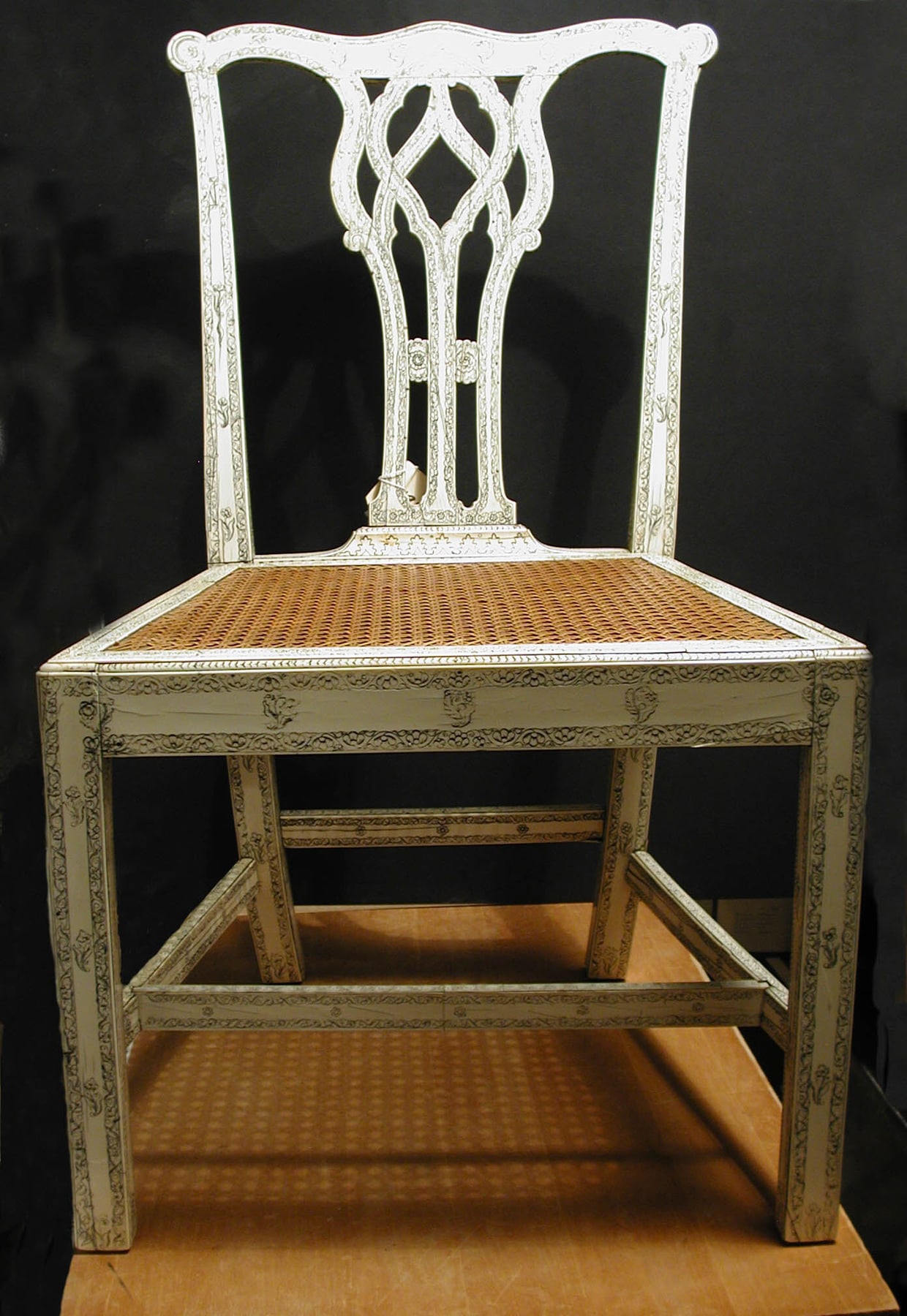
Closer museum view of the Indian-attributed chair, showing the cane seat and the open structure of rails below it.
Closer museum view of the Indian-attributed chair, showing the cane seat and the open structure of rails below it. Accession 1984.47.2. The Metropolitan Museum of Art. Public domain (CC0).

Ivory furniture could be built another way

A late eighteenth-century armchair at Sir John Soane’s Museum offers a physical comparison. Its catalogue identifies solid carved ivory, partly gilded, with a rattan seat. It has a wheel-shaped back, outward-curving arms and five legs. The museum places its manufacture in Murshidabad, an important ivory-carving centre where British influence encouraged western-style furniture after 1757.2

That context shows how an Indian craft material and a recognisable chair form could meet in quite elaborate objects. It does not assign the Met’s chair to the same workshop or city. The contrast is useful precisely because the two chairs use ivory within different structures.

Return to the Met example’s restrained outer shape and busy inner detail. The woven seat leaves it visually open; the pale frame gives the eye something intricate to follow. Its interest lies in that close meeting of materials, visible without an invented patron or palace.

Research notesEvidence, connections and limits

The Met record identifies materials, a broad date and an attribution to India, but no city, maker or original patron. Murshidabad and the solid-ivory construction belong to the separate Soane comparison; they are not transferred to this chair.

Evidence map

Connected subjects and evidence

Reviewed connections

  • Chair (One of Set of Four) 1984.47.2uses materialFruitwood, ivory and canedocumented

    The primary record lists these materials for this subject. The full material list and object dating remain in the cited accession record; listed replacement or uncertain materials retain their qualifiers.

    Reviewed 6 September 2026 by PatinaHall editorial.
  • Chair (One of Set of Four) 1984.47.2associated with placeIndiaattributed

    The Met records this geographic association for the exact artefact. India is an attribution, not a securely established workshop or city.

    Reviewed 6 September 2026 by PatinaHall editorial.

Research trail

Sources and further reading

  1. Chair (One of Set of Four) — 1984.47.2The Metropolitan Museum of ArtAccessed 6 September 2026
  2. Ivory armchair XF170: Murshidabad and the Tipu Sultan provenance storySir John Soane’s MuseumAccessed 6 September 2026

Last reviewed 6 September 2026. Found an error or a stronger primary source? Contact PatinaHall.