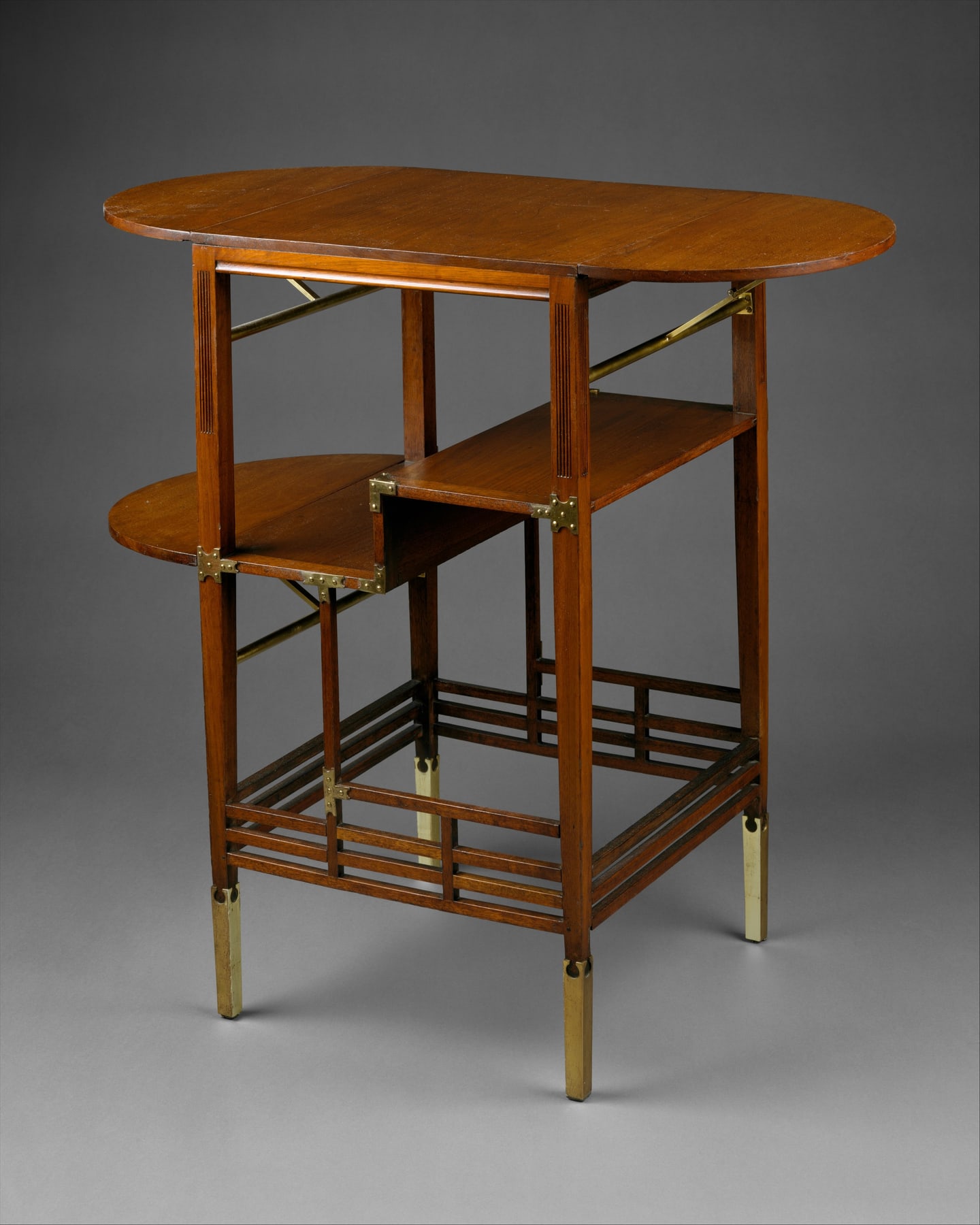
Empty space has an outline
Look through the table before looking at its top. Small rectangles and longer open passages appear between the posts, shelves and stretchers. Their sizes differ, so the eye does not settle into a simple repeated grid.
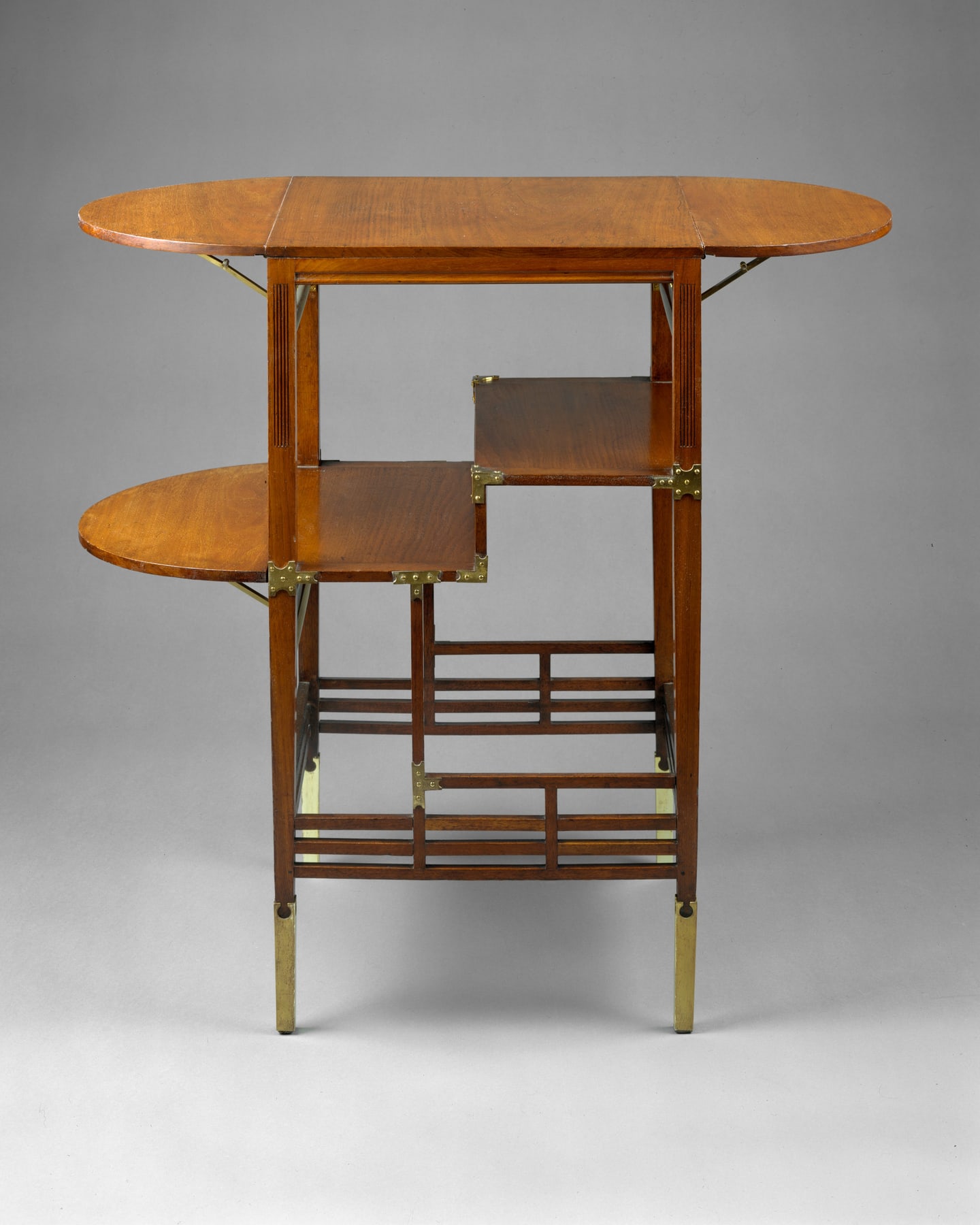
The front and angled photographs make that asymmetry easier to understand. A shelf that appears to line up with a rail in one view separates from it in the other. The composition is three-dimensional, even though its narrow members can resemble lines in a drawing.
Brass marks the connections
The Met records walnut and gilt brass and dates the table to about 1872. Its discussion points to the small metal braces as elements with both structural and decorative roles.1
The braces make selected connections conspicuous. Instead of covering the frame with continuous carving, the design concentrates bright details at places where pieces meet. Their scale suits the thin wooden members: the ornament does not overwhelm the construction it accompanies.
Japanese influence met an English vocabulary
The museum identifies influences from Japanese design and eighteenth-century English furniture. The table should therefore be read as Godwin’s particular combination, rather than as a direct copy of an unnamed Japanese object.1
That mixture is visible as a tension between familiar domestic furniture and an unexpected arrangement. It is still a small table with a usable upper surface. Below, the offset shelves and irregular spacing prevent its base from becoming a conventional symmetrical stand.
Light furniture could support a full interior
The V&A’s account of the Aesthetic home describes an interest in lighter furniture, flat decoration and the arrangement of objects. Such furniture could serve as a platform for a considered display, rather than leaving the room empty.2
This table makes that role easy to imagine. Its open frame allows an object placed on a shelf to have a visible outline, while the shelf itself becomes one element in a larger arrangement. The empty spaces are available for relationships, not merely evidence that decoration has been removed.
The V&A discusses other Godwin furniture, including an ebonised sideboard. The Met table is walnut; sharing a designer does not require all his work to share a black finish.
Return to the small brass braces and the offset lower shelves. Their interest is quiet but specific. They show how a designer can make the way a table is held together become the way it is looked at.