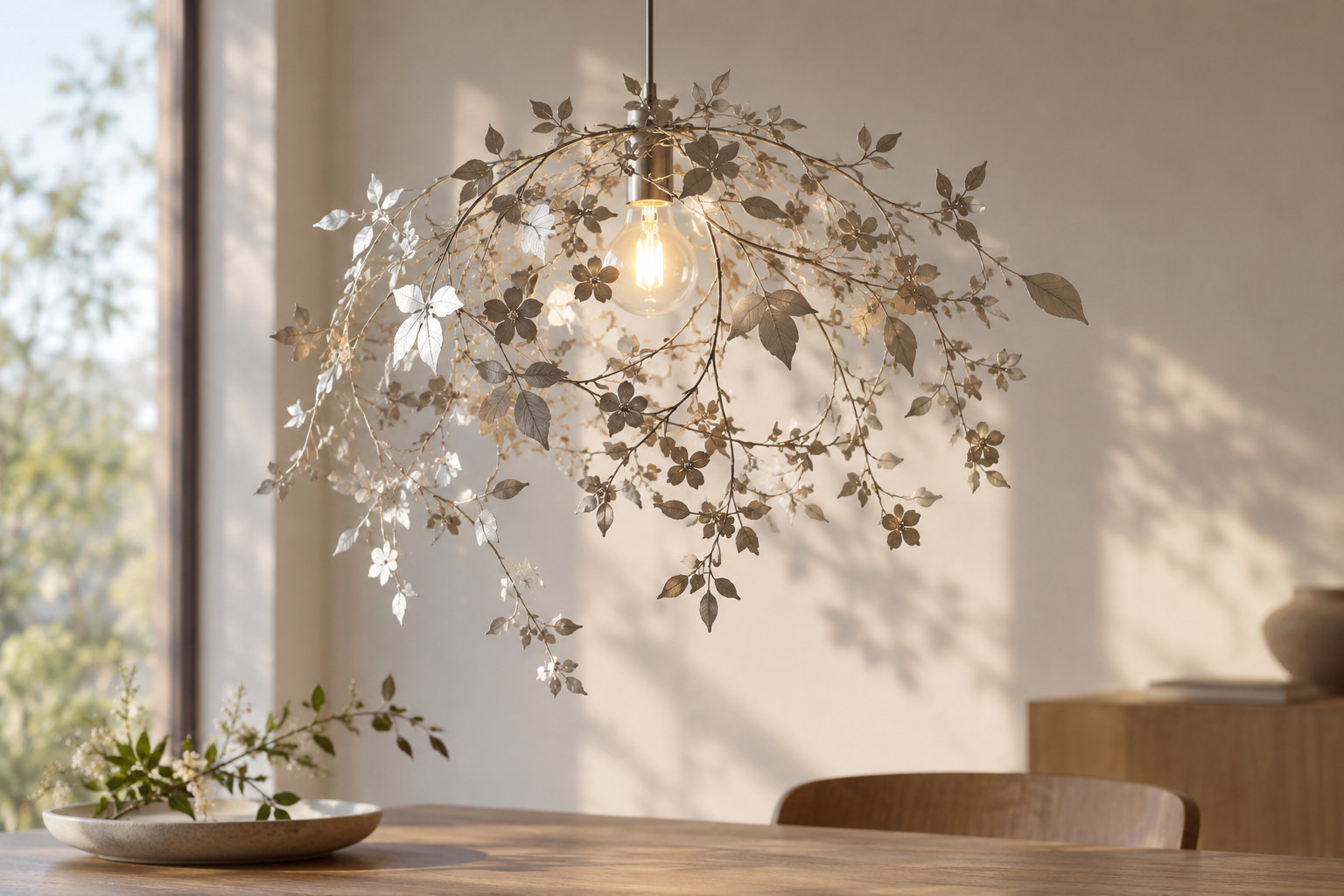
An industrial process grows leaves
Boontje describes seeing photographic metal etching in computer components before recognising its possibilities for Garland. A process capable of making precise, intricate openings could also produce a plant-like pattern around a light.2
That connection gives the ornament a particular character. Its fineness does not depend on pretending that every leaf was laboriously cut by hand. Precision is one of the means through which the pattern becomes possible.
The studio links the design’s inspiration to sunlight seen through trees. The finished idea carries that observation into the relationship between metal, open space and a bulb. Light becomes something encountered through a pattern rather than only beneath a solid cover.2
A sheet acquires a volume
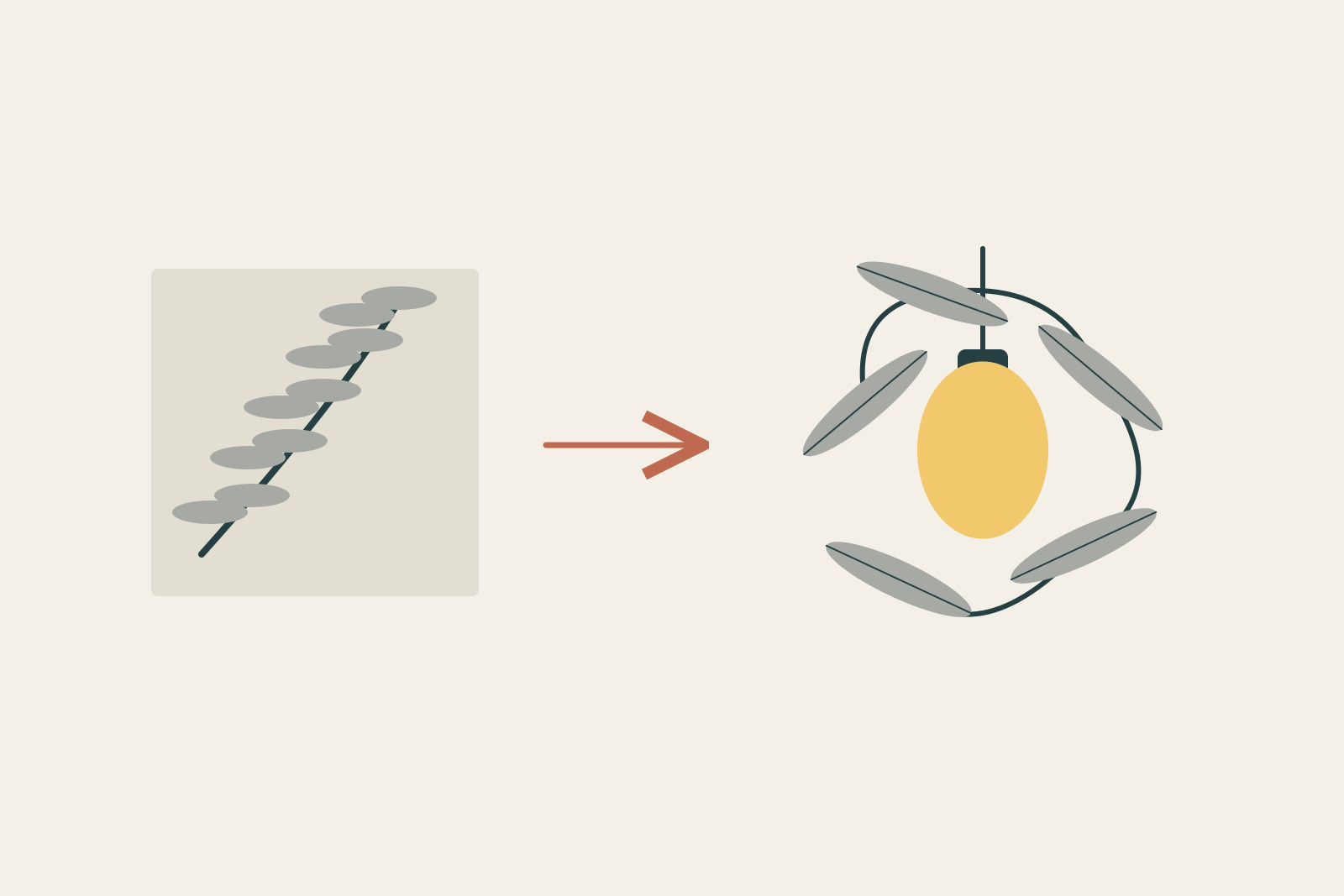
The starting material and the finished shade ask to be understood in different dimensions. A cut sheet can lie flat, yet its leaves can be arranged around the light to suggest a much fuller volume.
That volume remains open. Its edge is irregular, and the surrounding room can be seen through it. The gaps give the design breathing space while the metallic surfaces catch and redirect the eye.
Arrangement therefore contributes to the appearance. A precise manufacturing process supplies the vocabulary; the final gathering of the pattern gives it a position around the light. The result can look loose without losing the clarity of its finely cut edges.
One museum record, several histories
MoMA identifies its Garland Light as 137.2005.2, dates it to 2002 and records silver-plated brass. Artecnica is named as manufacturer, and the work was a gift of the manufacturer.1
Other records help explain the wider history without becoming alternative specifications for that object. Boontje’s studio distinguishes a Habitat design in 2002, an Artecnica version in 2004 and a studio-produced relaunch in 2019. Cooper Hewitt’s curatorial account discusses a separate stainless-steel example and a differently described predecessor sequence.23
The useful constant is the design question: how can a thin patterned sheet become an expressive presence around a bulb? Its particular material and documented date still belong to each version.
Ornament leaves the surface
Decoration is often imagined as something added to an already complete object. Garland makes it responsible for the outline of the shade itself. The leaves do the spatial work.
The next time a light seems to be only a bulb and a cover, Garland offers another possibility: a precisely made pattern can define a place for light while leaving much of that place open.