A dining surface with somewhere to go
A dining table occupies space even when dinner is over. In a room used for several things, the question is what happens to that surface between meals. Ercol's drop-leaf design gives part of it somewhere to go: down beside a narrower central section.
The leaves stay attached. There is no separate extension board to find a cupboard for, and the table can change its outline without another large piece of furniture entering the room.
Ercol's 1965 brochure describes the 384 Round Shaped Dining Table in solid elm and beech. Its two flaps fold down for smaller meals or when more room is wanted.1 The argument for the table begins in that simple change of use, rather than in an elaborate mechanism.
A hinge moves; a support carries
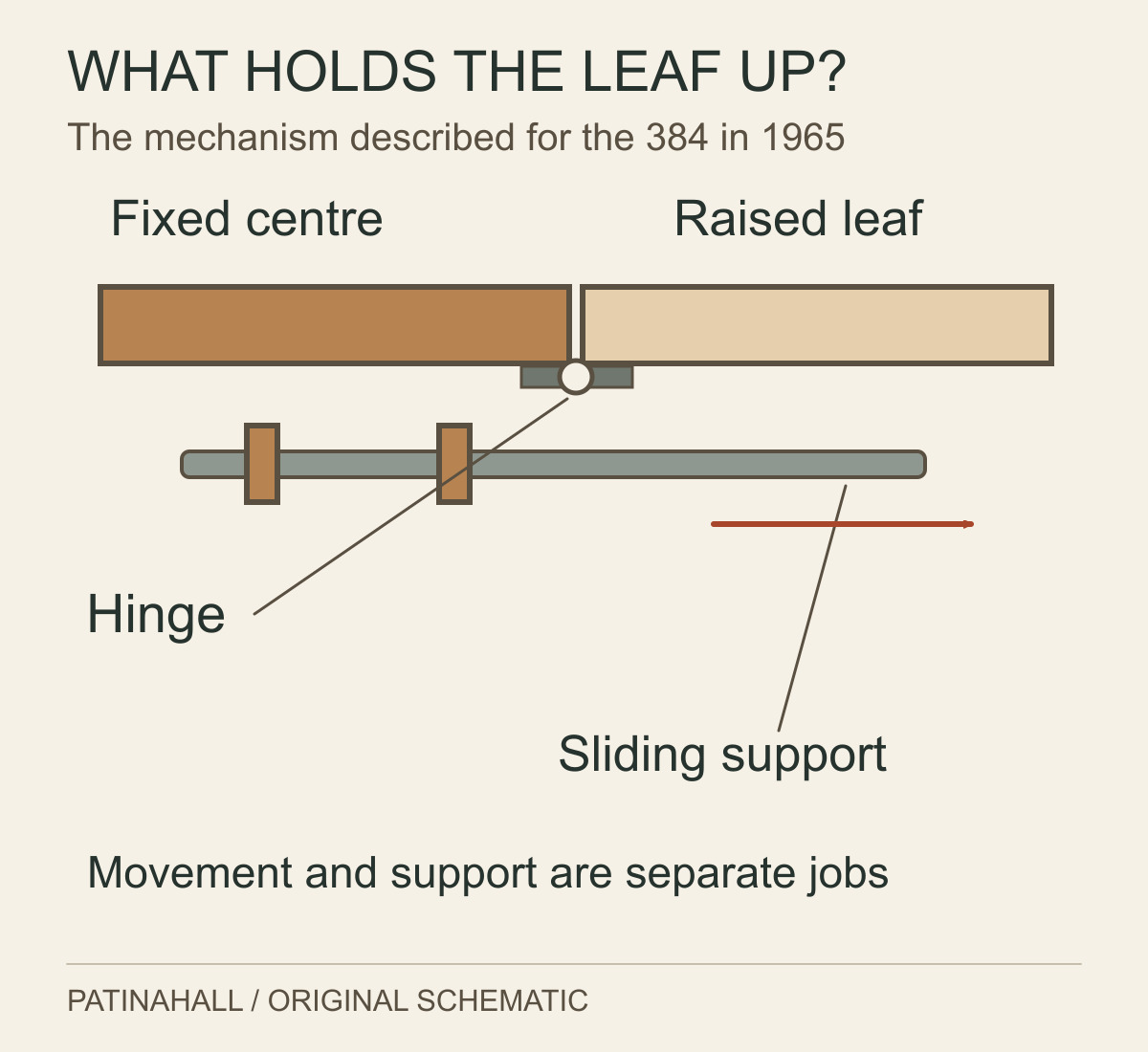
The same brochure describes strong sliding metal rods beneath the hinged flaps. Those parts have different jobs: a hinge lets a leaf rotate, while an extended support carries it when raised.1
That distinction is easy to miss from above. Open, the tabletop reads as one broad surface. Underneath, the arrangement has to account for a fixed centre and two moving sections. The hinges establish where the leaves turn; the supports make the open position useful.
This is also what separates the idea from the familiar gateleg principle, in which a leg assembly swings out beneath a leaf. In the documented 384 arrangement, the support moves beneath the top rather than becoming an additional swinging leg on the floor.
The attraction is partly that the work disappears from the ordinary view. A few moving parts below the tabletop produce a much larger change in the room above them.
The catalogue makes the saving visible
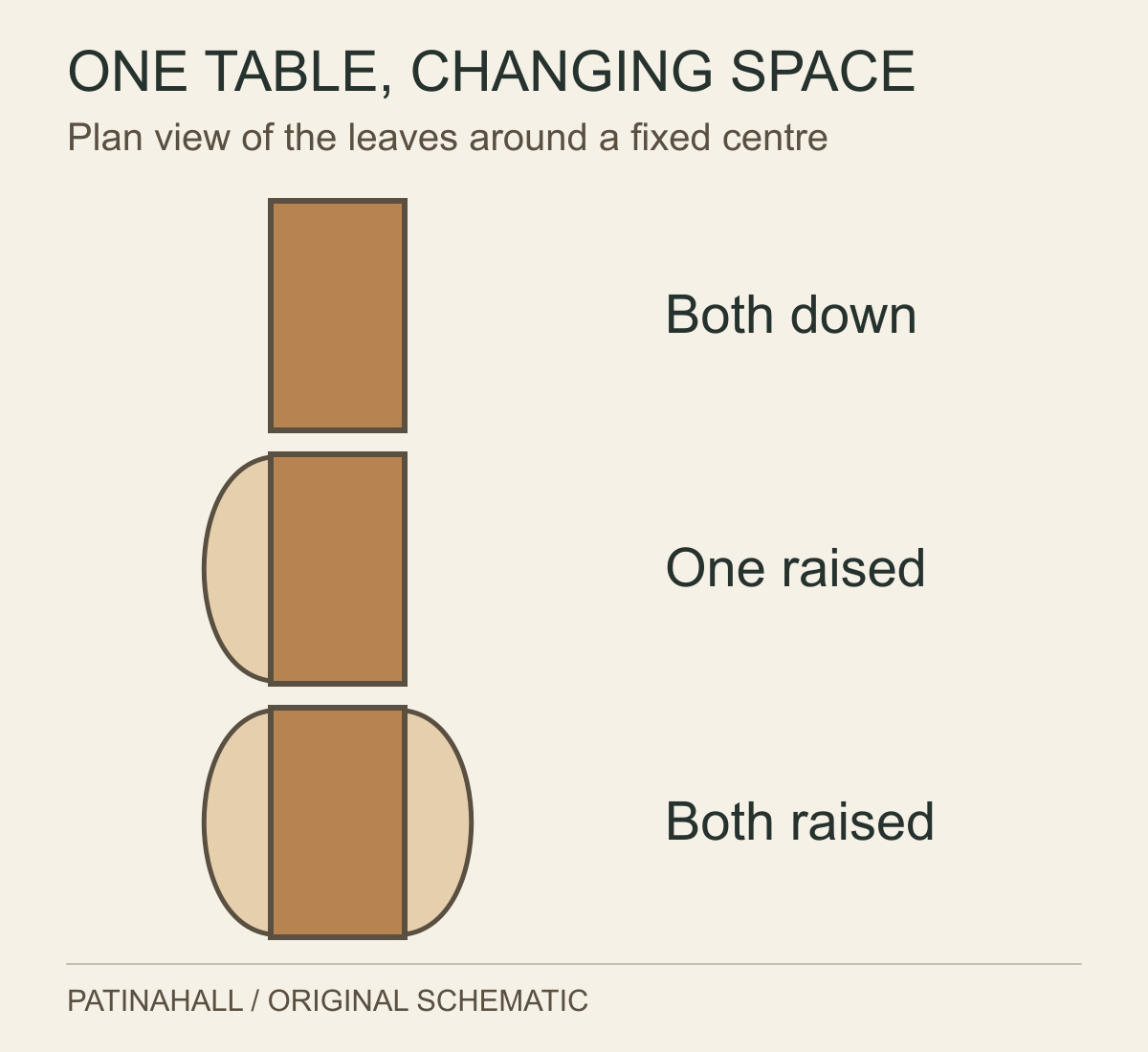
The 1978 Ercol catalogue gives the 384 an open surface of 125 by 113 centimetres and a closed surface of 63 by 113. Its height is 71 centimetres.2
One tabletop dimension is almost halved. The other remains the same. That is a more useful picture of the transformation than simply calling the table compact: folding does not shrink it equally in every direction.
A chair still needs room, and people still need to move around it. But the narrower closed outline changes what the table asks of an unused part of the room. The same object can present a broad dining surface or a much slimmer central top.
Looking at the plan from above makes the design's purpose particularly clear. Most of the change happens at the sides; the middle stays put.
The family resemblance survives a change of specification
Ercol still offers a drop-leaf table under code 7384, credited to Lucian R. Ercolani. The current maker page specifies ash, a width changing from 62 to 120 centimetres, a depth of 110 and a height of 73.3
Those are different figures from the 1978 384 entry. The material specification also differs from the elm-and-beech combination in the 1965 brochure. The folding idea connects the tables, but the catalogue details belong to particular versions.
That is part of the pleasure of an everyday design with a long history. It can remain understandable while its specification changes. The useful idea does not depend on treating every example as identical.
With the leaves raised, the table offers a place to gather. Folded, it gives some of that surface back to the room as open space. Its history is written in a movement a household can repeat every day.