A step becomes a place
Imagine a conventional sitting room from above: a sofa here, two chairs opposite, a table between them. Each object establishes a position and a direction. Moving the conversation means moving furniture.
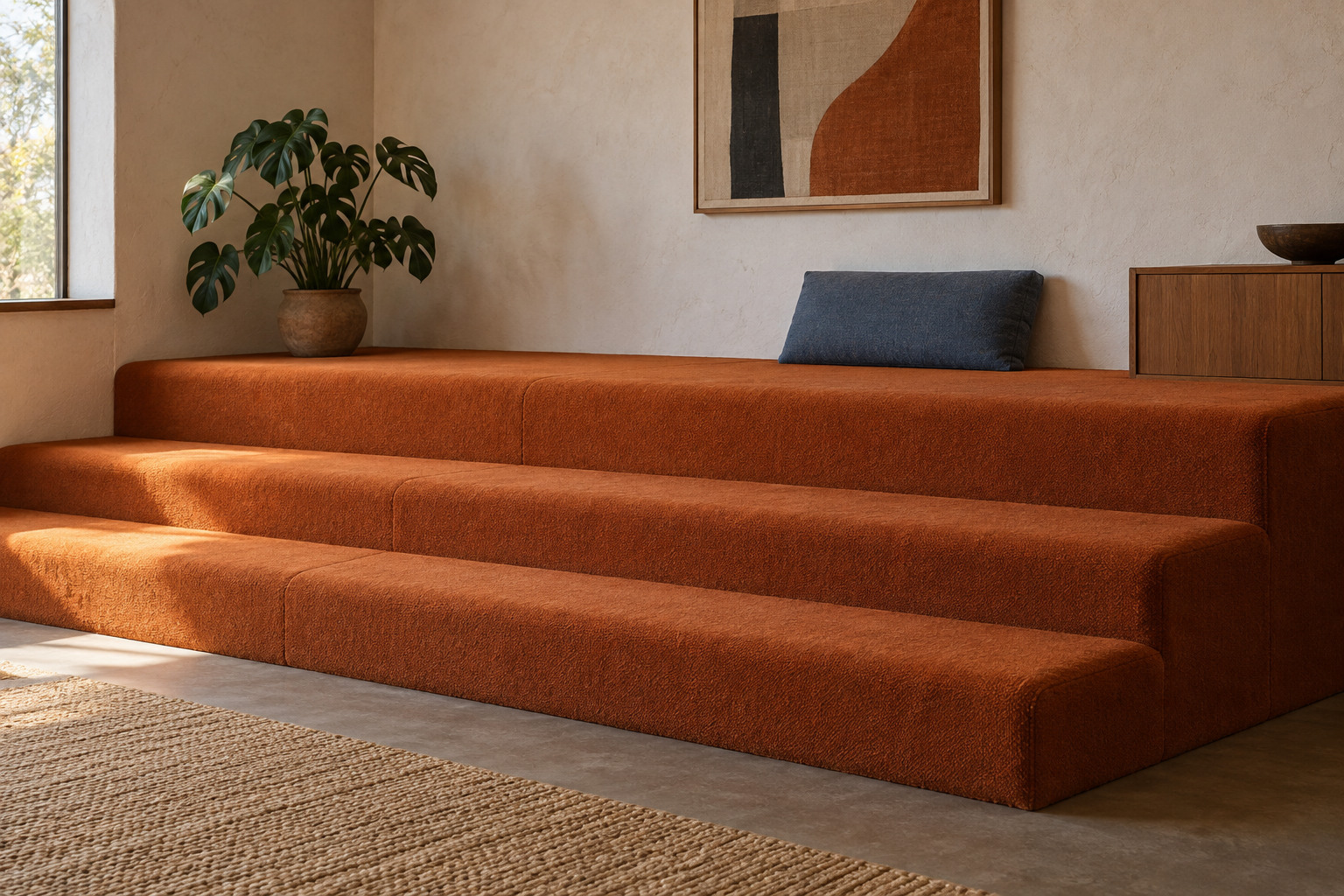
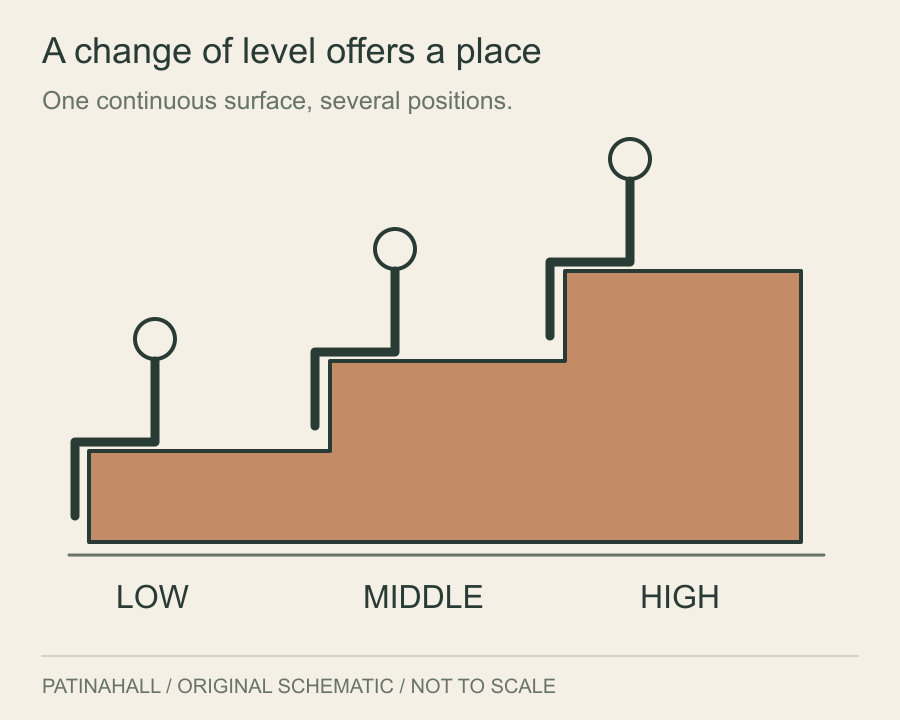
Ditzel’s spatial experiments loosened those instructions. Broad upholstered steps and staggered planes could support several positions within one continuous arrangement. Sit on an edge, lean against the next rise or stretch across a platform: the body helps decide what each part of the room becomes.
Trapholt’s retrospective traced this investigation back to the 1950s. The museum presented her furniture alongside textiles and interiors, making it possible to see that the unusual seats were part of a sustained interest in how people occupy space.1
The room needs a surface
Cover a series of levels in hard stone and it feels like architecture. Give the same outline a yielding, textured surface and it begins to invite different behaviour. Upholstery helps turn a spatial proposition into an everyday place to settle.
That is why Ditzel’s textile work belongs near her furniture. Cloth is the part the hand reaches first. It can make a large volume seem softer, distinguish one area from another, or connect several separate pieces through colour. In a room with fewer familiar chair silhouettes, those cues become particularly useful.
The point is not that a textile determines how everyone will sit. It changes the invitation. A stair-shaped seat remains an experiment until somebody finds a comfortable position on it.
Hallingdal began with a commission
In autumn 1964, Halling-Koch asked Ditzel to develop a textile collection. Hallingdal followed in 1965. Her estate’s account emphasises the unusual brightness of her colour choices and records the later development of the palette.2
The fabric’s construction is less theatrical than the rooms, but just as deliberate. Kvadrat describes a combination of wool and viscose, with the fibres dyed before spinning. Wool contributes resilience; viscose adds lustre and depth to the colour. The familiar woven surface is the result of those different jobs being brought together.3
Look closely and a seemingly uniform colour resolves into yarns crossing one another. Step back and they become a broad field again. That change of scale connects the small decisions of textile design with the larger decisions of arranging a room.
Where would you sit?
Ditzel’s work is often encountered one object at a time, isolated against a clean background. The landscapes suggest a more revealing question: where would you put yourself?
At the edge, ready to join a conversation? Higher up, with a view across the room? Low down, with room to stretch your legs? The answers need not be the same tomorrow.
A useful piece of furniture can solve a problem so thoroughly that we stop noticing it. Ditzel’s upholstered levels do something more playful: they make us notice that choosing a seat can itself be part of the design.