Two objects made for ordinary work
The Charles Dickens Museum records DH105 as a mahogany pedestal writing desk and a walnut and fruitwood smoker’s armchair. Dickens bought the furniture in 1859 and used it in the study at Gad’s Hill Place in Kent until his death in 1870.1
The desk’s form is practical and familiar. Storage at either side leaves an opening for the sitter; the broad top offers a working area above it. The chair belongs to a different task, supporting a person rather than organising papers. Together they turn a patch of floor into a workplace.
Knowing the writer’s name changes the way we look, but the furniture does not stop being ordinary in its functions. That is part of its appeal. Large imaginative worlds can depend on a very recognisable arrangement of wood, paper and a place to sit.
The desk is only one part of the evidence
A surviving desk cannot show us the sequence in which a paragraph was written. Manuscripts and corrected proofs can take us closer to that process.
The V&A’s National Art Library holds many of Dickens’s manuscripts, along with letters, proofs and early editions from the collection of his friend and biographer John Forster. These materials arrived with Forster’s library in 1876. The collection includes manuscripts for works associated with Dickens’s later years, while other major manuscripts are held elsewhere.3
The distinction is useful. Furniture gives us the setting and scale of work. A manuscript preserves changes, crossings-out and the passage from a handwritten page towards print. Put the two kinds of evidence in conversation and the study feels less like a stage set waiting for a famous person to return.
The room after the writer
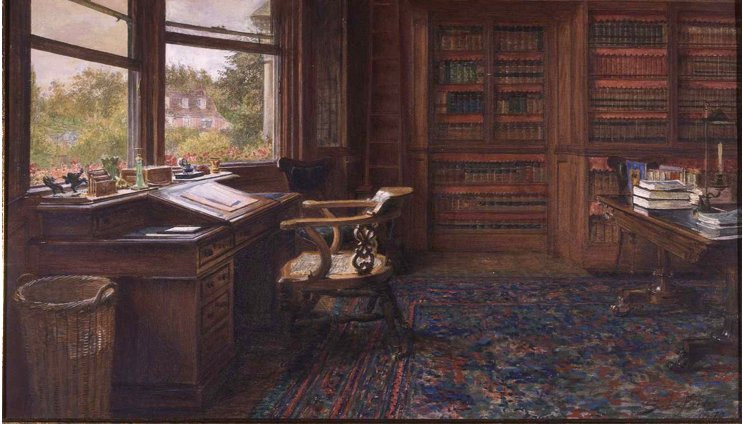
Luke Fildes’s 1870 watercolour, The Empty Chair, presents the study through an absence. The chair is there, the desk is there, but the person who made the arrangement meaningful has gone.
The National Heritage Memorial Fund’s account connects the surviving furniture with this later visual memory, including Fildes’s picture and Robert William Buss’s Dickens’s Dream. The objects became part of the writer’s public image as well as his private routine.4
In the empty study, an ordinary chair becomes unusually expressive. Its position suggests a person who might have just stood up. The room offers enough familiar detail for the viewer to supply the missing life.
From a Kent study to a London museum
The furniture is now displayed at the Charles Dickens Museum in Doughty Street, London. The fund supported its acquisition so that the desk and chair could remain on permanent public display there.2
This later address belongs to the furniture’s museum history. Its documented working life with Dickens took place at Gad’s Hill. Keeping those places separate makes the story richer: objects can travel while carrying associations with an earlier room.
The desk cannot give us a formula for writing a novel. It offers something more tangible: the scale of a working place, and the surprising power of a chair after its occupant has left.
