Design story

40/4: the chair designed for the room after the meeting

The 40/4 chair was designed with the empty room in mind. Its slender parts settle closely together in a stack, allowing a room full of seats to become usable floor space again.

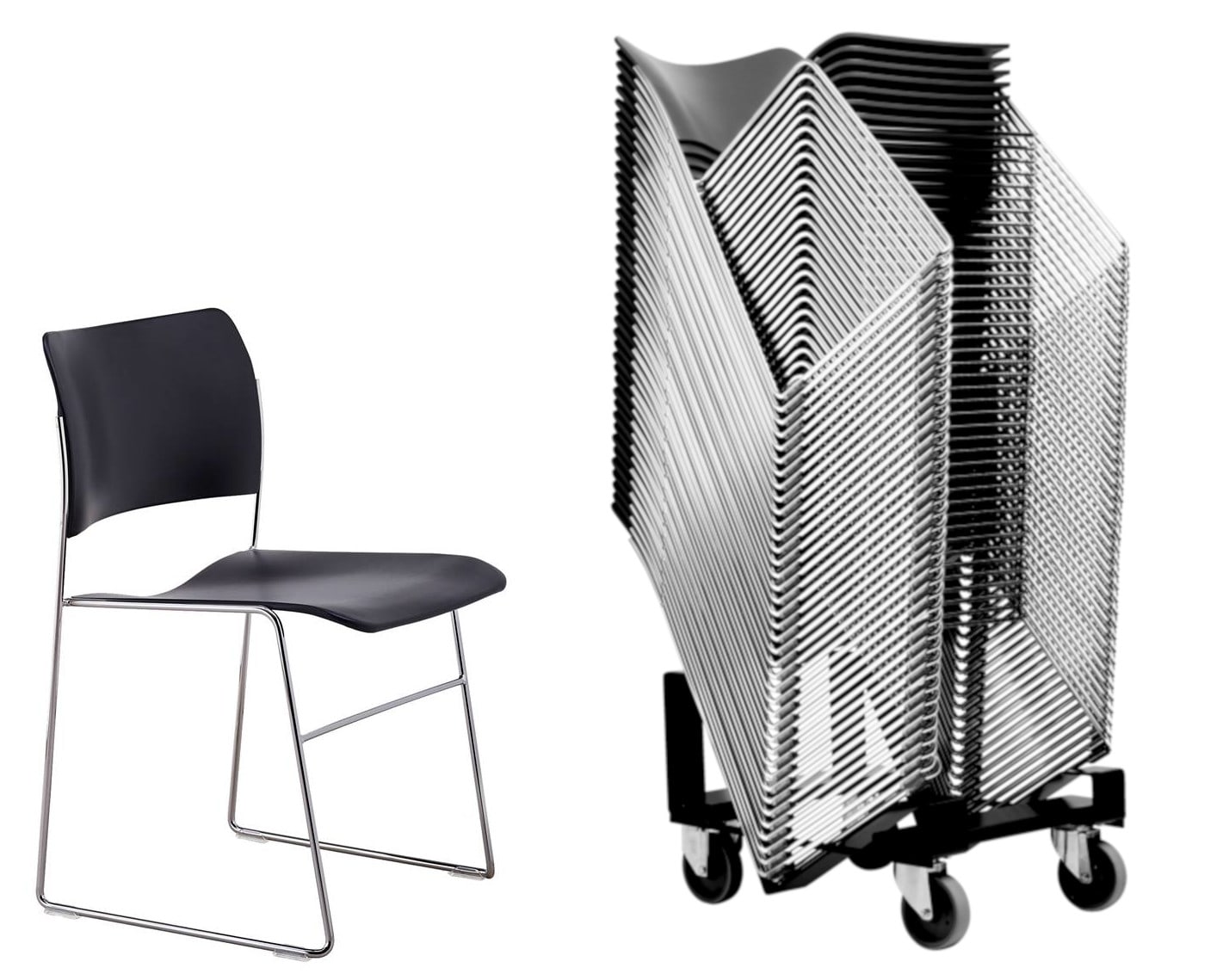
A 40/4 chair beside a tall stack on a wheeled trolley, showing the thin seats and closely nested metal frames.
A 40/4 chair and its compact stack. This source composite combines two photographs; the stack was flipped and converted to greyscale. Howe Furniture; composite by Cblinford, CC BY-SA 4.0. JPEG re-encoded; metadata removed. Source: David Rowland 40-4 Chair with Stack.
On this page
Key facts & takeaways

At a glance

Subject
David Rowland 40/4 chair
Entry
Design story
Last reviewed
6 September 2026

Three things to remember

  1. The name describes the design’s close-stacking ambition.
  2. Small gaps between chairs matter when multiplied through a whole stack.
  3. Current variants and trolleys have their own specifications; the name is not a universal stacking instruction.

Design the room twice

Before a meeting, chairs cover the floor. Afterwards, the same room may need to become a rehearsal space, a place to exercise or somewhere to lay out work. The 40/4 treats those two conditions as one furniture problem. It must provide a useful seat and then give space back.

HOWE explains its name as forty chairs stacked within four feet. The point is not simply that one chair can sit on another. It is how little height each additional chair contributes. A small saving repeated many times becomes a meaningful difference to the room.2
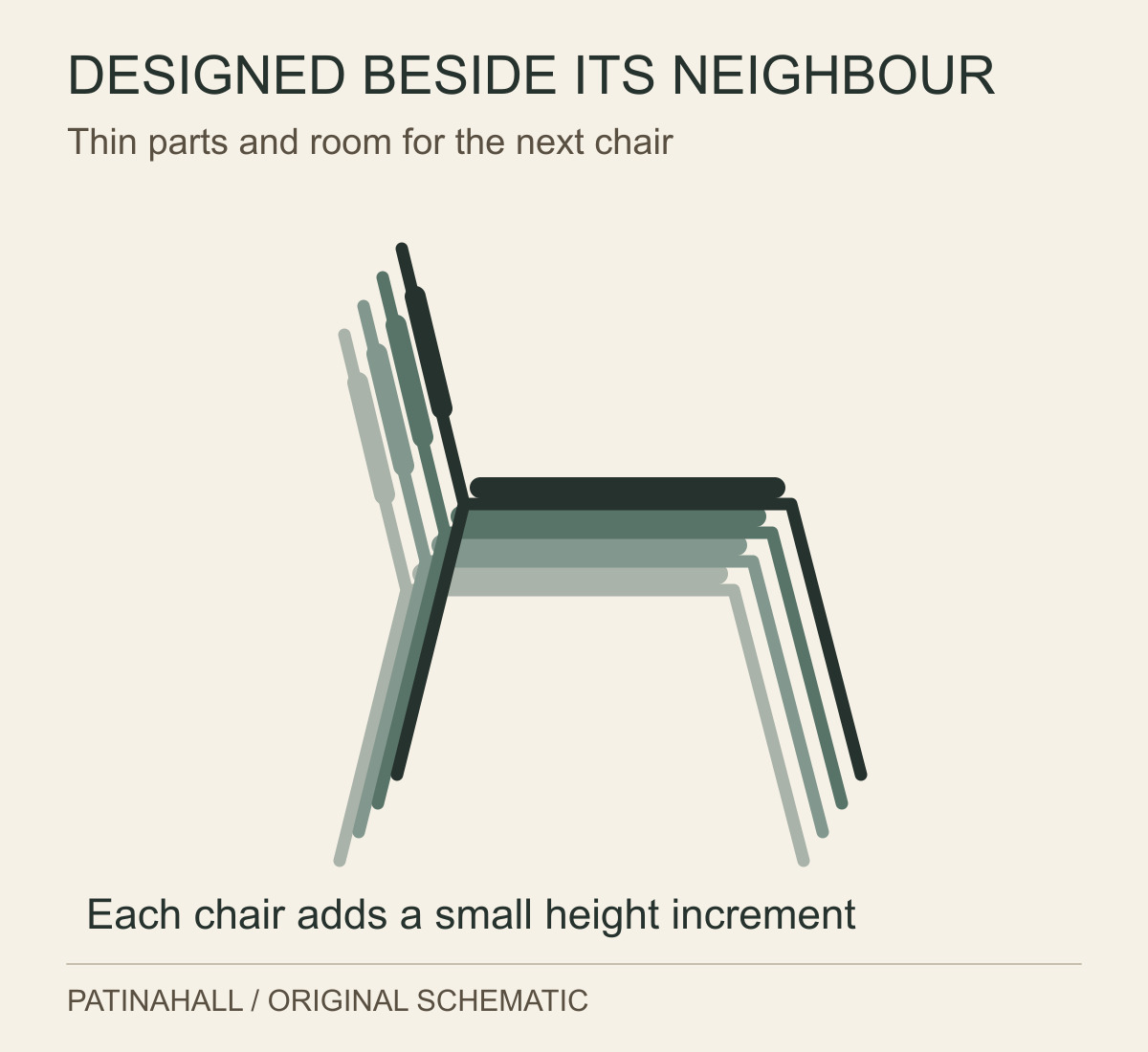
Four simplified chair profiles overlap in a close stack, with small vertical offsets between their seat and back outlines.
Repeated profiles illustrate the small increment central to the 40/4 idea. The four depicted outlines are not a forty-chair capacity test or a scale drawing of a trolley. Original PatinaHall schematic, not to scale.

A stack is a problem of tiny gaps

Look at several stacked chairs as a single object. The lower chair establishes most of the height; each chair above adds another increment. Thick seat cushions, projecting arms and parts that collide can all enlarge that increment. Close stacking asks the designer to consider the spaces around components as carefully as the components themselves.

Rowland’s slender frame and thin sitting surfaces make that intention visible. MoMA’s 1964 example has a chrome-plated steel-rod frame with a seat and back made from vinyl-coated steel sheet. The material record describes a notably lean arrangement: narrow structural lines supporting thin, shaped surfaces.1

The chair has effectively been designed beside another copy of itself. Its usefulness depends on what happens between neighbours: whether the frames clear one another and how closely the sitting surfaces settle together. Empty space becomes a part of the design that only appears when the chairs meet.
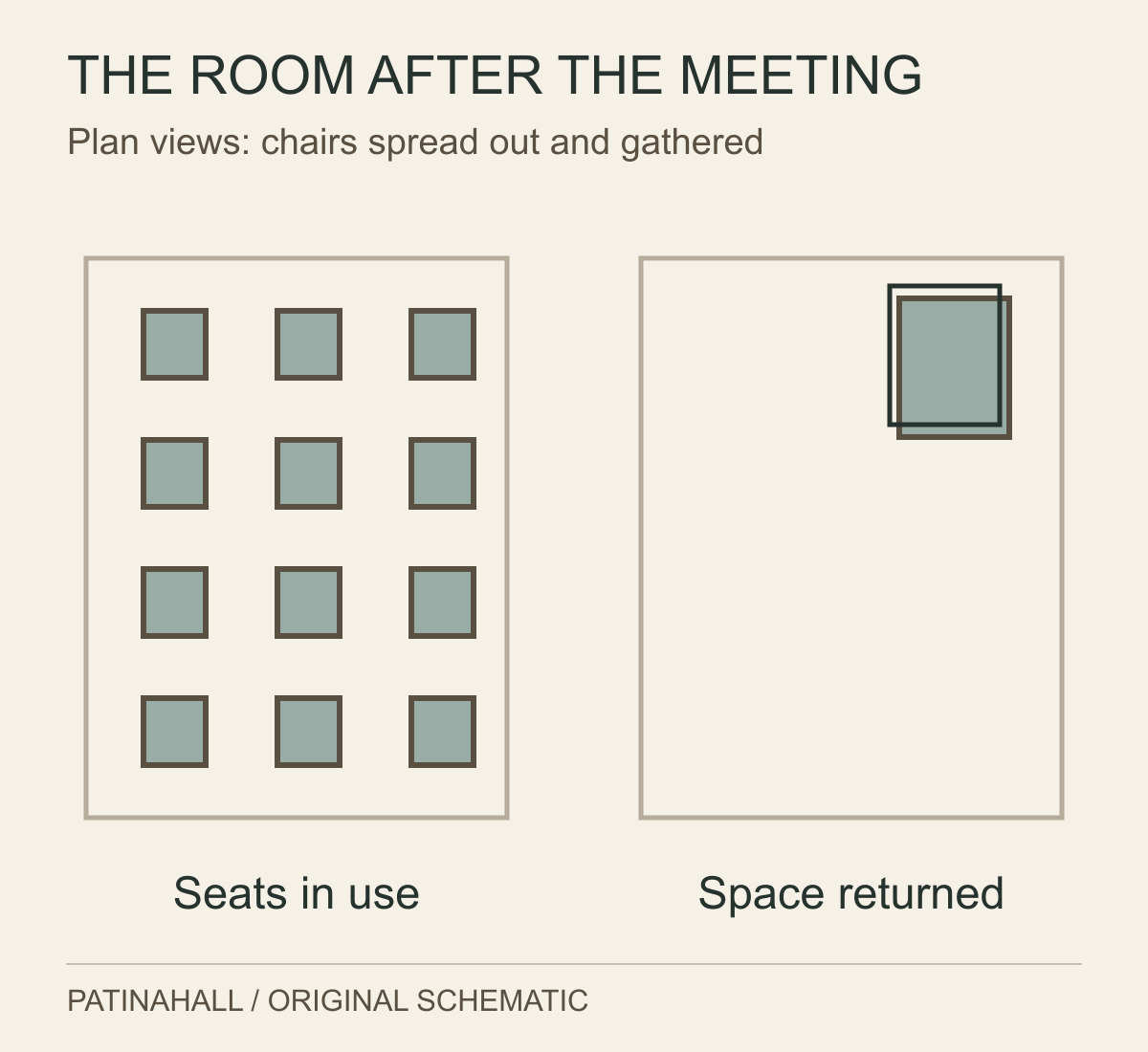
A room plan with individual seat rectangles is compared with the same outline holding a compact group in one corner.
The plan explains why gathering chairs changes a room’s available floor area. Footprints are conceptual and exclude access routes, safe stack heights and handling equipment. Original PatinaHall schematic, not to scale.

Steel first, a larger family later

MoMA names the General Fireproofing Company in Ohio as manufacturer of its early example. HOWE presents the continuing family and dates the initial launch to 1964. These accounts describe different parts of the design’s production life.12

The current manufacturer documentation covers variants for different uses, including changes in seat materials, upholstery and base arrangements. A lounge or upholstered version introduces different requirements from the thin early chair. The exact specification is therefore attached to a version, not contained in the numbers printed in the family name.3

This is a useful way to look at familiar institutional furniture. The common outline can continue while individual components respond to a different room, a different kind of sitting or a changed production programme.

The chair you notice when it is gone

A single 40/4 can look almost under-described: a back, a seat and fine metal lines. Its larger argument emerges when several are put away. The design is concerned with what remains possible around the furniture.

In a home, that might mean a few occasional dining chairs waiting together between gatherings. In a larger room, the same principle operates at a different scale. The object’s achievement is visible in the floor it no longer occupies, ready for whatever happens after the meeting.

Research notesEvidence, connections and limits

MoMA documents the 1964 design and its early materials; HOWE supplies the name account and current family specifications. No claim is made that this was the first stackable chair, that every variant holds forty on every trolley, or that a mark alone authenticates an old example.

Evidence map

Connected subjects and evidence

Reviewed connections

  • David Rowland 40/4 chairdesigned byDavid Rowlanddocumented

    The Museum of Modern Art documents David Rowland in the designed by role for David Rowland 40/4 chair. This relation describes the design family, not the origin of an individual secondhand object.

    Reviewed 6 September 2026 by PatinaHall editorial.
    • Source 1Design, material or production account; scope described in the evidence note
  • David Rowland 40/4 chairmanufactured byGeneral Fireproofing Companydocumented

    The Museum of Modern Art documents General Fireproofing Company in the manufactured by role for David Rowland 40/4 chair. This relation describes the design family, not the origin of an individual secondhand object.

    Reviewed 6 September 2026 by PatinaHall editorial.
    • Source 1Design, material or production account; scope described in the evidence note

Research trail

Sources and further reading

  1. David Rowland. 40/4 Chair. 1964The Museum of Modern ArtAccessed 6 September 2026
  2. 40/4 chair familyHOWEAccessed 6 September 2026
  3. 40/4 product description, March 2025HOWEAccessed 6 September 2026
  4. David Rowland 40-4 Chair with Stack.jpgWikimedia CommonsAccessed 6 September 2026

Last reviewed 6 September 2026. Found an error or a stronger primary source? Contact PatinaHall.