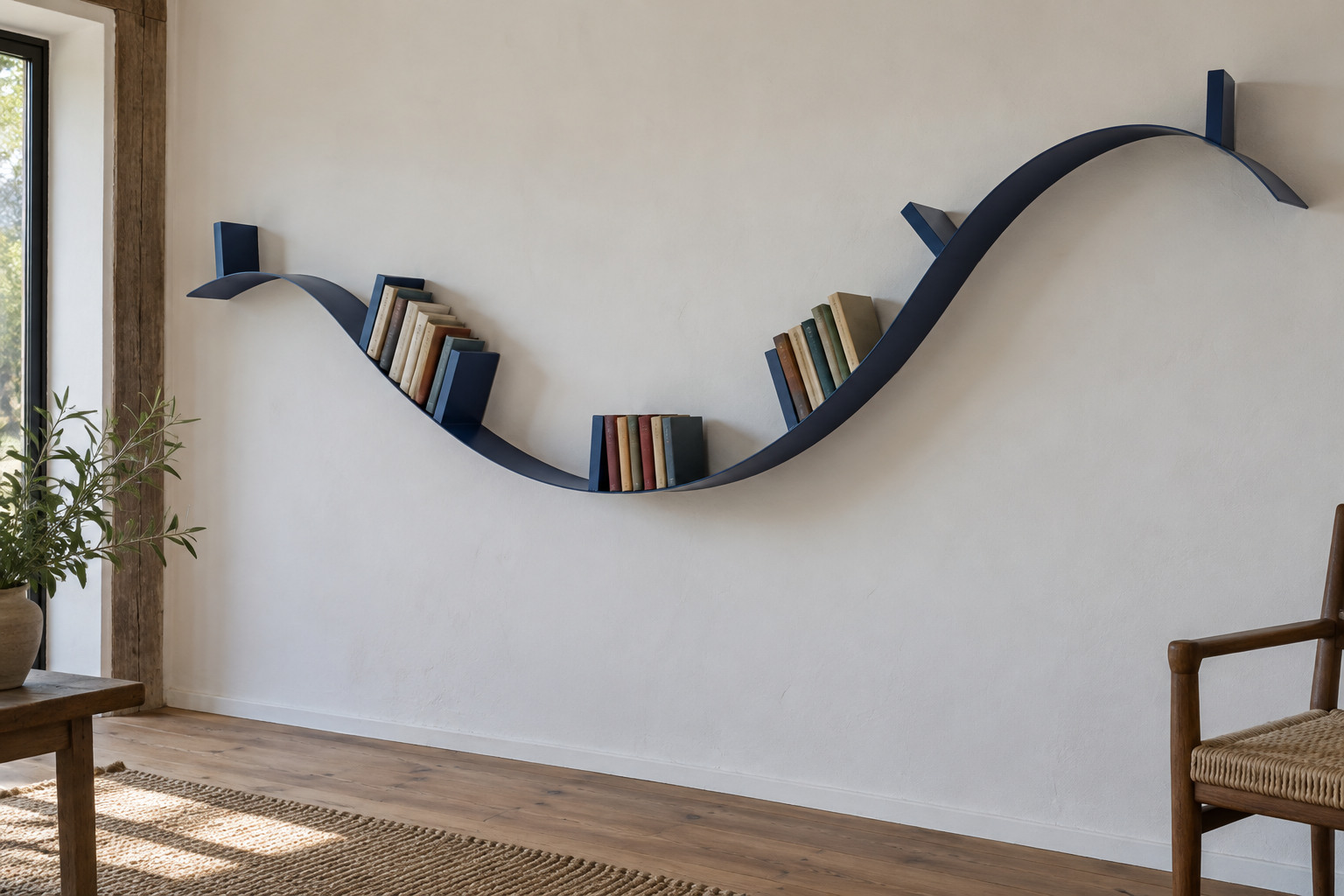
An empty wall and a coil of steel
Arad’s MoMA audio account begins with material already at hand: coils of tempered steel. Moving into a new house supplied the immediate need. He imagined a long S on the wall, then worked with his workshop to make and install the shelving.
The appeal was the freedom from parallel shelves. A single line could rise, dip and continue across the wall, making the installation itself part of the object’s character.1
That is a small but fundamental change. A conventional bookcase brings its own rectangular boundary into a room. Bookworm borrows the wall as its field and allows the shelf to describe a route across it.
A bookend does another job
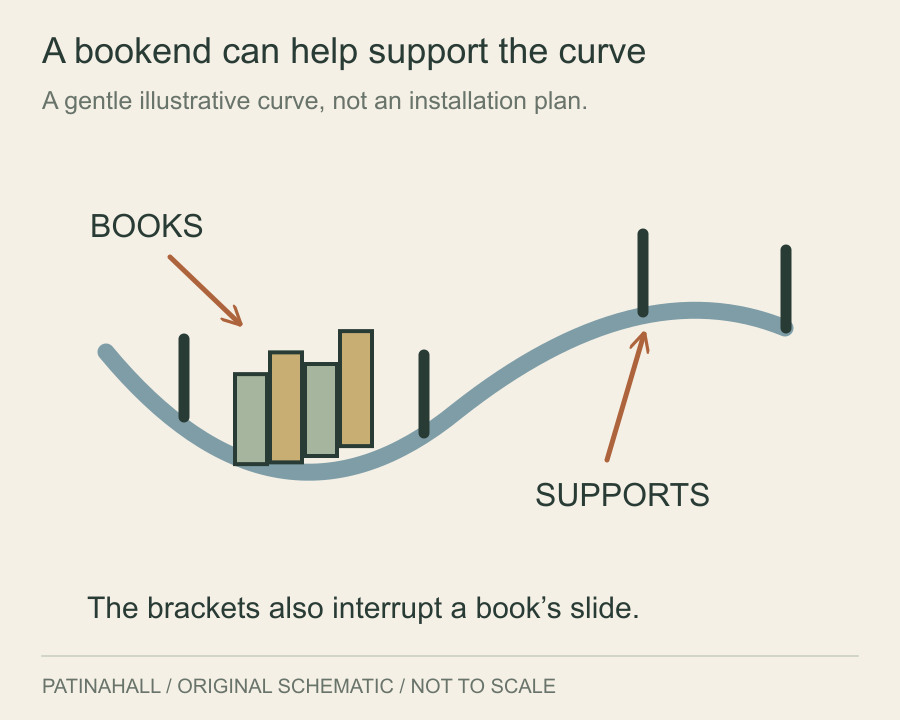
The continuous strip still needs support. Short perpendicular elements hold it at intervals, and those divisions also make places against which books can rest.
Follow the curve and the usefulness of that arrangement becomes clear. The shelf’s changing direction means a row of books cannot simply proceed as though it were sitting on a level board. The supports break the flowing line into manageable sections.
The MoMA store describes the plastic Kartell version as flexible PVC that can be shaped during installation. Its account treats curvature as part of the system, rather than an accidental bend in a straight shelf.3
The result has two scales of order. From across the room, one long line provides the composition. Close up, repeated supports organise individual groups of books. The dramatic outline depends on these small, practical interruptions.
Steel became a different kind of product
MoMA’s 2009 exhibition checklist records Large Bookworm in tempered sprung steel and patinated steel, alongside a coloured plastic Bookworm made by Kartell. Putting them together makes the development visible: a material experiment could become a different kind of manufactured object.2
The plastic version retains the central invitation to shape a continuous shelf, but it is not merely a steel object painted another colour. Material and production change the way the idea can circulate.
It is useful to think of the recognisable curve as the thread connecting versions, not as proof that their construction and histories are identical.
The books finish the drawing
An empty Bookworm can look like a line drawn directly on a wall. Fill parts of it and the line acquires weight, colour and rhythm. The books interrupt its sweep while making its purpose unmistakable.
That tension is why the idea remains enjoyable to look at. The shelf is expressive, yet it leaves room for ordinary possessions to change its appearance. Arad’s imaginary gesture does not stay frozen as a perfect S. It becomes a daily arrangement of books, gaps and curves—and a wall that is doing more work than before.