The mouth has to become a seat
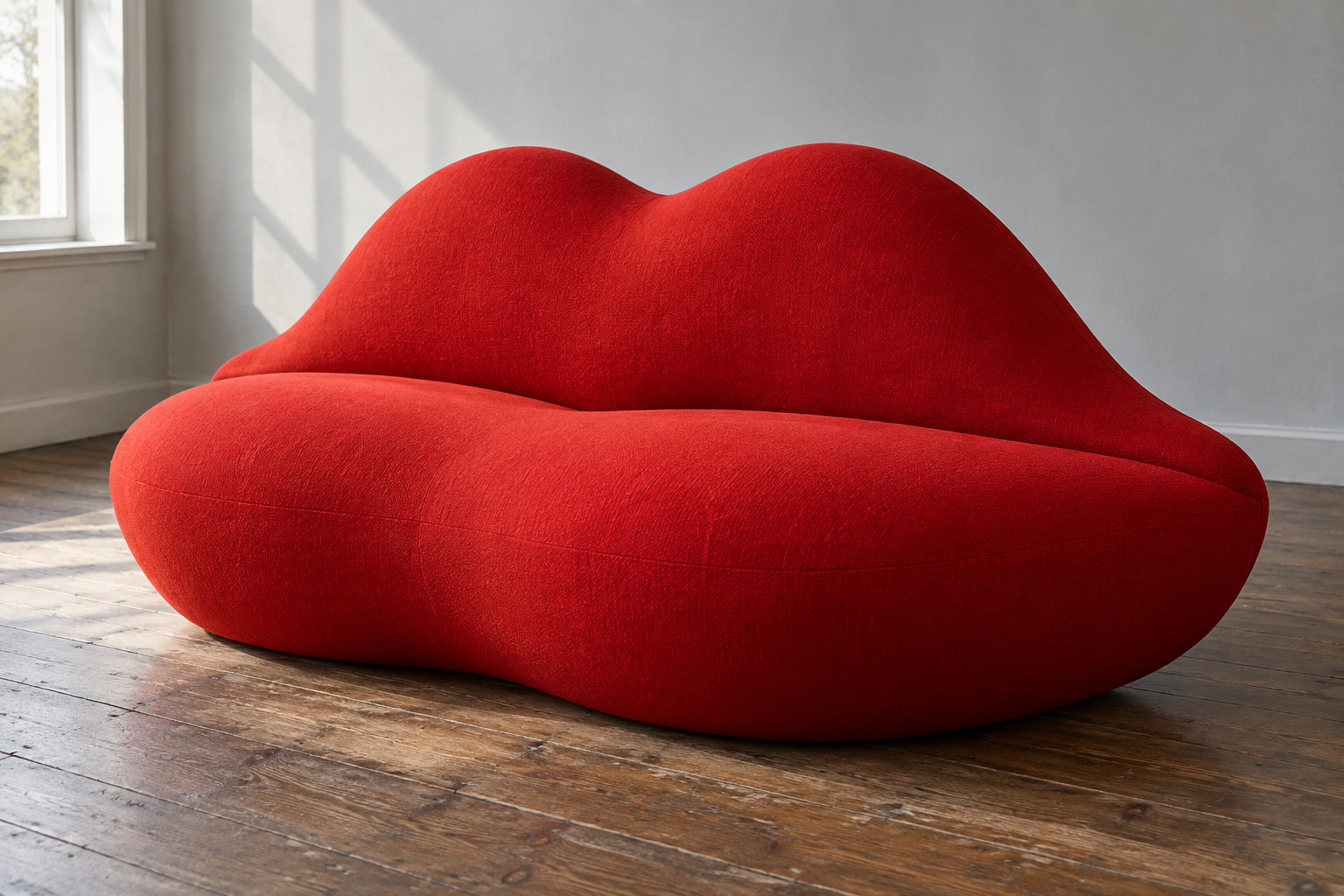
Recognition does much of the work. Two red, rounded forms and the dark line between them are enough to suggest a mouth, even when there is no face around it. The sofa removes almost everything except the feature it wants you to notice.
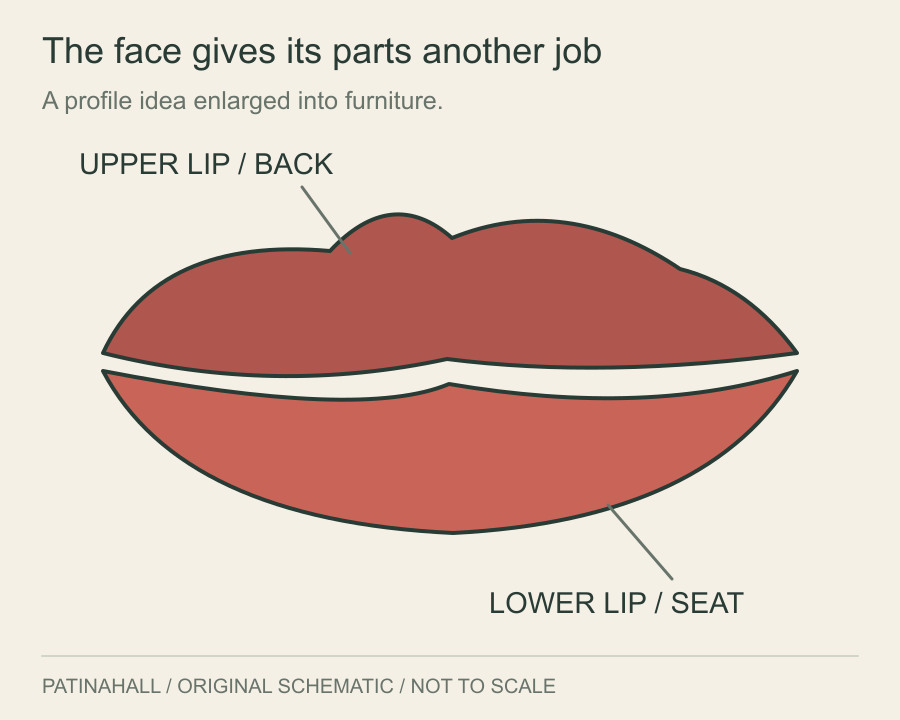
Then furniture imposes its own demands. The lower form must project far enough to sit on; the upper one must rise behind the sitter. Those changes turn the lips from a flat sign into a place with depth. From the side, Bocca becomes less like a picture and more like two substantial, unequal cushions.
Gufram connects the design to Salvador Dalí’s 1935 image of Mae West, in which a face is imagined as a room. Studio65’s sofa is a later design with its own authorship, rather than the original Dalí object under another name.1
Before the showroom, a waiting room
The Studio65 archive places Bocca within the 1970 interior of the Contourella beauty centre in Milan. It was conceived as seating for the entrance hall. That practical setting gives the joke a sharper edge: visitors entering a business concerned with appearance encountered an enlarged fragment of a face.
Franco Audrito’s recollection also describes a prototype that seemed too small once placed in the interior. The team asked Gufram to remake it larger, with a red stretch-fabric covering. A compelling shape on a drawing board still had to be judged against the size of an actual room.3
Imagine the difference between a mouth you can pick up and a mouth you can sit beside. The change is not simply numerical. Scale changes your relationship with the image.
Softness carries the joke
The Museum of Fine Arts, Houston records its Bocca as designed in 1970 and manufactured in 1986, with polyurethane, metal and upholstery. The two dates preserve a useful distinction: the age of the idea is not automatically the age of the object in front of you.2
The upholstered surface matters as much as the outline. A pair of lips carved in stone might retain the resemblance, but it would invite a different encounter. Here the rounded body promises the familiar yielding surface of a sofa. The absurdity remains close enough to ordinary use to be persuasive.
The room supplies the rest of the face
Bocca does not need matching eyes on the wall. Its empty surroundings give the familiar shape room to register, while a person sitting down changes its scale again.
Look first from the doorway, where the mouth reads almost instantly. Then move sideways and follow the depth of the lower lip. The same object changes from a bold image into somewhere to wait, which is precisely the small transformation that keeps it interesting.