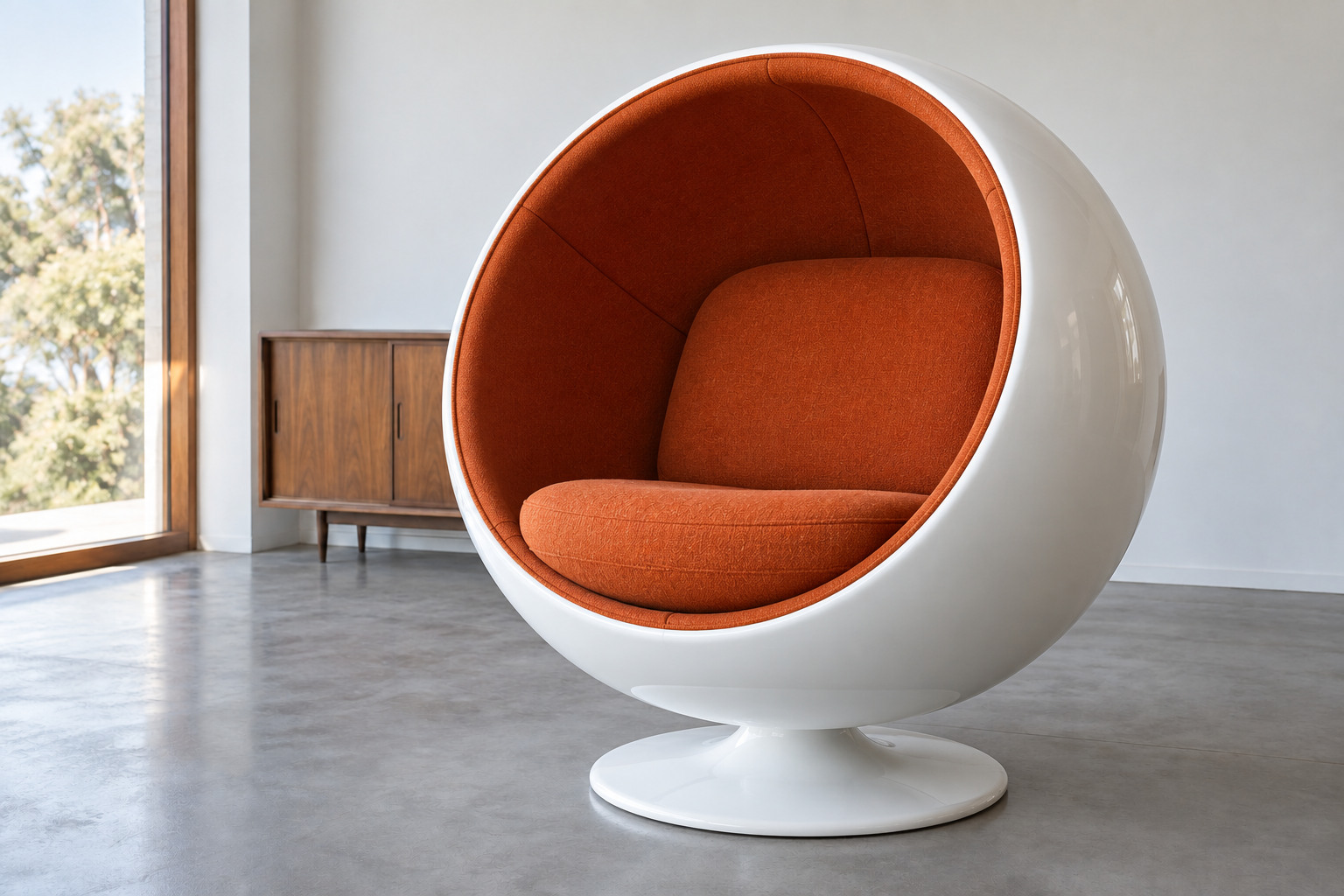
The opening carries the view
From the outside, the Ball Chair reads as a large rounded object. From the inside, the same shell becomes a boundary. The circular opening leaves a framed portion of the surrounding room visible, while the upholstered sides occupy much of the sitter’s nearer field of view.
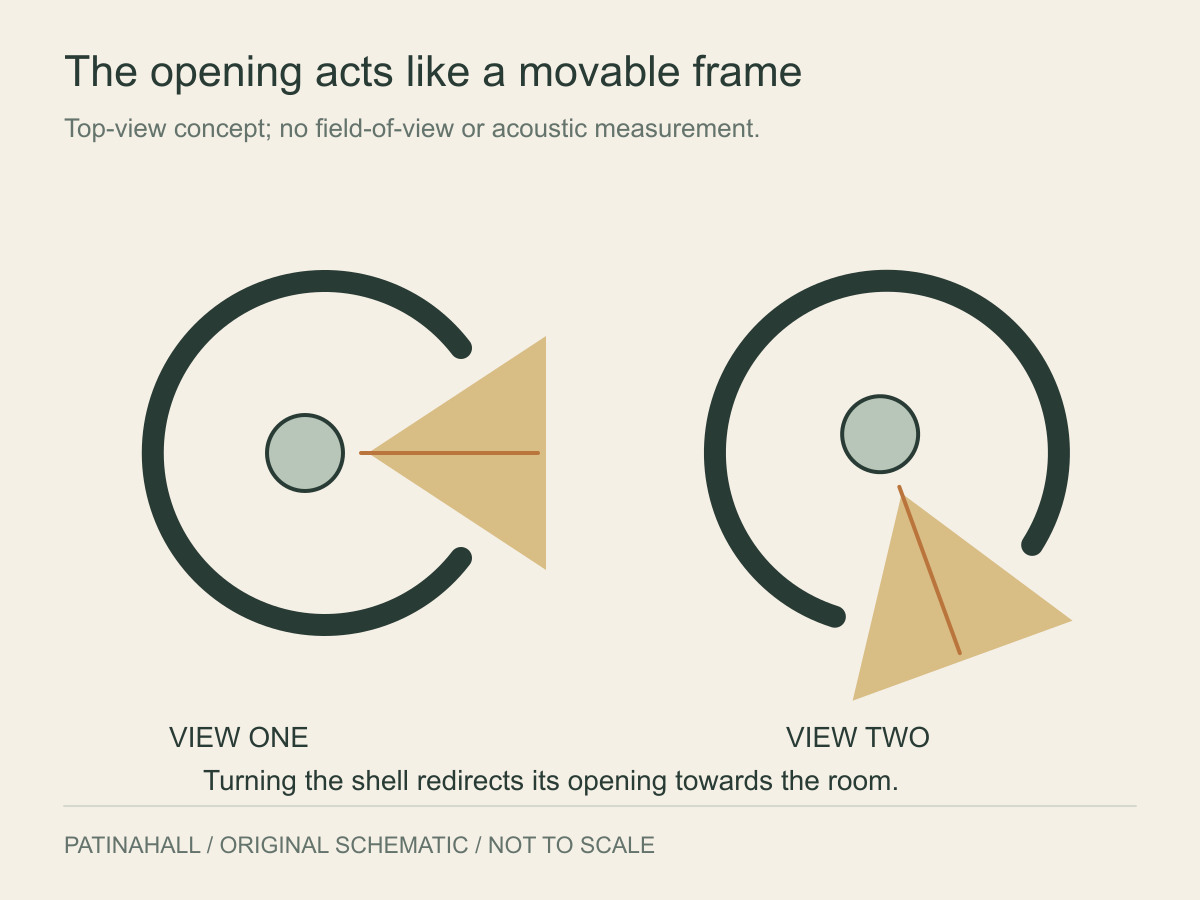
The turning base gives that frame another possibility. An August 1966 report in Architectural Design identified Aarnio’s fibreglass chair as a swivel design when discussing the Cologne fair. Turn the chair and the opening can address a different part of the room.4
This is a spatial effect before it is a style. An ordinary open chair lets the room extend around its occupant. Here, the person sits within a pronounced threshold between an interior and the space beyond.
A prototype made in a school workshop
Aarnio Originals dates an early sketch to 11 January 1963. Its account places the first prototype work in a school woodcraft room available through Aarnio’s father-in-law, with help from his brother. The design’s polished public image began with a much more improvised making environment.1
The shell brought technical problems. A smooth outside did not automatically produce a finished inside, and the large opening required reinforcement. Upholstery then had to turn the hard enclosure into something a person could occupy.
That sequence makes the sphere more interesting. A geometric idea is easy to draw. Giving it an edge that holds its shape, a comfortable interior and a stable support demands a series of less visible decisions.
The chair has more than one date
The manufacturer dates the design to 1963 and its debut at the Cologne Furniture Fair to 1966. LACMA’s collection record separately identifies a 1966 patent filing and names Asko as manufacturer of its example.32
Those dates describe development, presentation and documentation. They need not be compressed into one year attached indiscriminately to every surviving chair.
The distinction also helps with the material story. A museum record describes the object it holds; a current manufacturer describes what it makes now. Both can illuminate the design without making every later edition physically identical to the prototype.
A public object with a private interior
The Ball Chair is conspicuous in a room. Its occupant can nevertheless feel partly withdrawn, because the shell concentrates the immediate surroundings into a smaller space. The outward display and inward experience are different.
That difference explains why the opening deserves as much attention as the sphere. Its size, direction and depth establish the relationship between the person and everyone outside.
Imagine the chair turned a little away from a conversation, then back towards it. The furniture has not moved across the floor. The sitter’s participation in the room has shifted with the view.