Design story

Ribbon: following a chair around the bend

Ribbon tempts the eye to keep moving. Its padded surface turns through the seat, sides and back without presenting them as an ordinary upholstered box. Making that continuity required several kinds of work beneath the covering, in a collaboration between a French designer and a Dutch manufacturer.

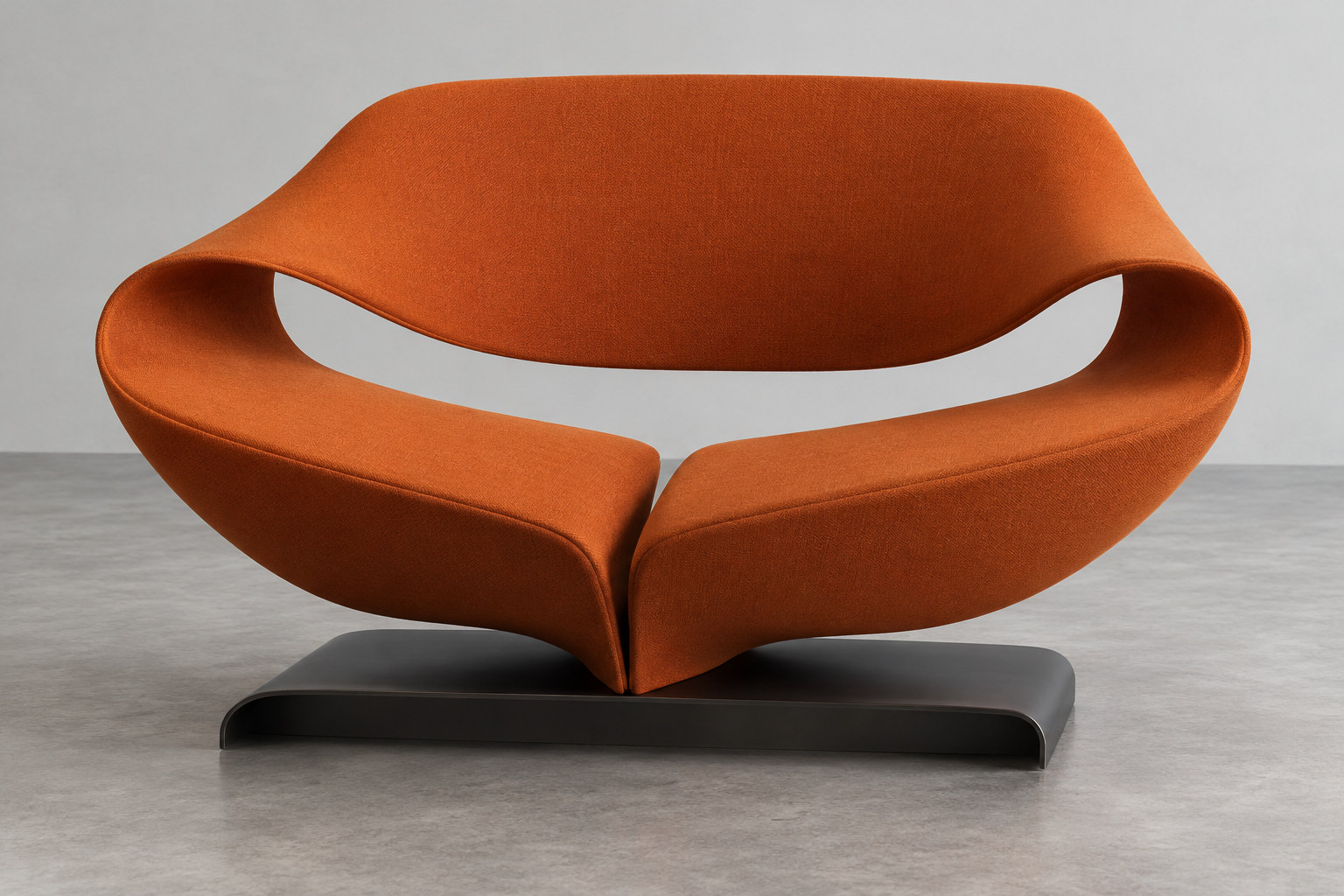
Editorial reconstruction of an orange folded upholstered band with a split seat, open middle and broad low dark pedestal.
PatinaHall editorial reconstruction. It is not a documentary photograph. A flowing upholstered form introduces the idea of continuity. The invented covering and support are not a documented Artifort colourway, internal construction or museum object.
On this page
Key facts & takeaways

At a glance

Subject
Ribbon chair
Entry
Design story
Last reviewed
23 October 2026
Designed
1966documented

Three things to remember

  1. French designer Pierre Paulin created Ribbon for Dutch manufacturer Artifort in 1966.
  2. The appearance of continuity depends on a concealed construction.
  3. NGV separates its 1966 design date from manufacture around 1971.

Follow the upholstered edge

Ribbon invites the eye to travel around it. The seat, arms and back seem to belong to a flowing folded surface, rising above a low base. French designer Pierre Paulin created the chair for Dutch manufacturer Artifort in 1966. Their collaboration makes this a story about making as well as about a memorable outline.1

The form is especially revealing from the side. An opening can separate an arm from the surface below it while the covering makes the surrounding curve appear continuous. The chair has solid parts and gaps, but neither looks like an afterthought.

Continuity has to be manufactured

The visual idea does not mean that the chair is literally one ribbon of material. Artifort describes a tubular metal frame with horizontal springs, moulded foam and stretch fabric, above a pressed-wood pedestal. Several different manufacturing tasks produce the appearance of one gesture. 2

The frame gives the upholstery a support. The padding shapes what the body meets, while the fabric has to follow the changes in direction. The transition between a broad surface and a tighter curve is therefore a place where the covering participates in the design.

Think of the edge as a route rather than a boundary. It turns through the chair and helps connect positions that a conventional armchair often separates into obvious upholstered components.
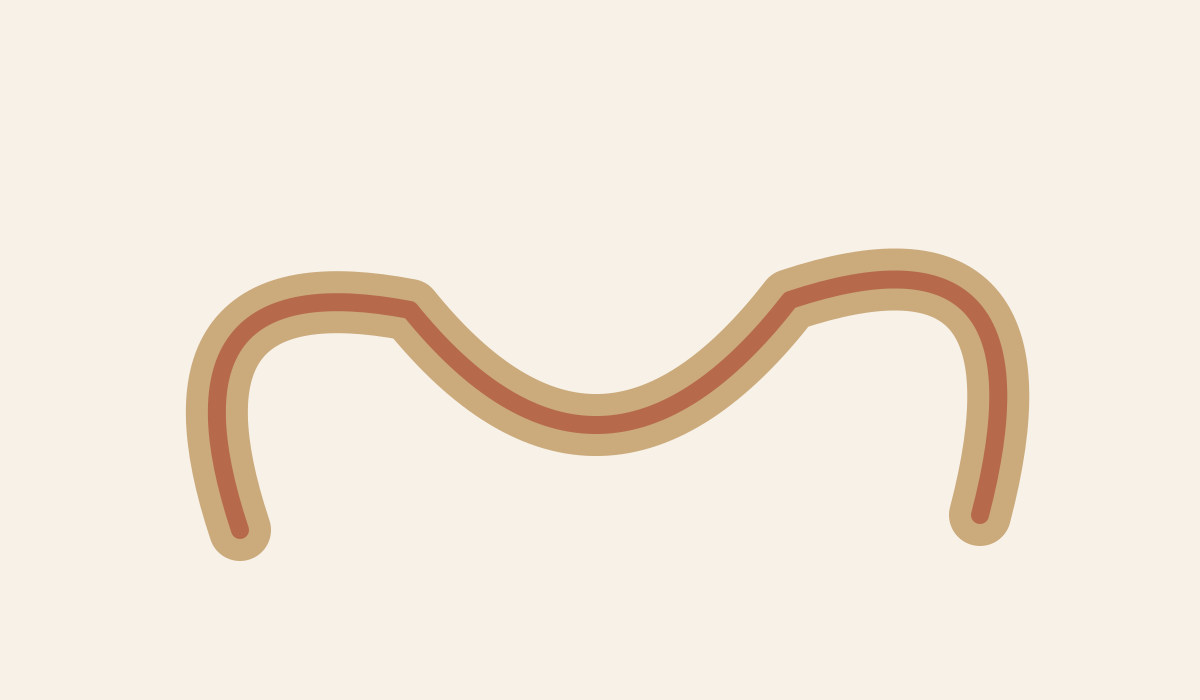
Three nested curved bands distinguish support, padding and the outer covering.
Original PatinaHall schematic, not to scale. A frame, padding and a covering contribute different layers to an apparently continuous upholstered form. This is a material explanation, not a section through Ribbon.

A factory with a reason to experiment

Artifort's history connects its development with foam-covered metal frames and stretch textiles. Those materials and techniques gave designers new ways to shape upholstered furniture. The history belongs to a manufacturer working with different designers, rather than to a single national style.3

That distinction matters here. Paulin's nationality does not become Dutch because Artifort made the chair, and a Dutch manufacturer's contribution does not disappear because the designer came from France. The finished surface required that relationship.

One design, more than one date

The National Gallery of Victoria records its chair as designed in 1966 and manufactured around 1971. The museum can identify the model while retaining the later date of its own example.1

Production choices, coverings and colour can change how strongly the surface reads as a single sweep. The enduring invitation is to follow it slowly, across an arm and around the back, until a familiar seat becomes a surprisingly elaborate journey for the eye.

Research notesEvidence, connections and limits

This is a Dutch-manufacturing story about a French designer. The NGV object and Artifort's current construction sheet represent specific production evidence; their dates and materials must not be assigned to every Ribbon chair.

Evidence map

Connected subjects and evidence

Reviewed facts

  • Designed 1966documented

    This is a Dutch-manufacturing story about a French designer. The NGV object and Artifort's current construction sheet represent specific production evidence; their dates and materials must not be assigned to every Ribbon chair.

    Reviewed 23 October 2026 by PatinaHall editorial.
    • Source 1Ribbon chair, model 582, designed 1966, manufactured circa 1971

Reviewed connections

  • Ribbon chairdesigned byPierre Paulindocumented

    The cited record identifies the designer of this design or coherent project family.

    Reviewed 23 October 2026 by PatinaHall editorial.
    • Source 1Ribbon chair, model 582, designed 1966, manufactured circa 1971
  • Ribbon chairmanufactured byArtifortdocumented

    The source records this production relationship; it does not identify the maker or date of an unreviewed example. Later studio production is not used to date the original design.

    Reviewed 23 October 2026 by PatinaHall editorial.
    • Source 1Ribbon chair, model 582, designed 1966, manufactured circa 1971

Research trail

Sources and further reading

  1. Ribbon chair, model 582, designed 1966, manufactured circa 1971National Gallery of VictoriaAccessed 23 October 2026
  2. Ribbon, model F582ArtifortAccessed 23 October 2026
  3. History: foam-covered frames and stretch fabricsArtifortAccessed 23 October 2026

Last reviewed 23 October 2026. Found an error or a stronger primary source? Contact PatinaHall.