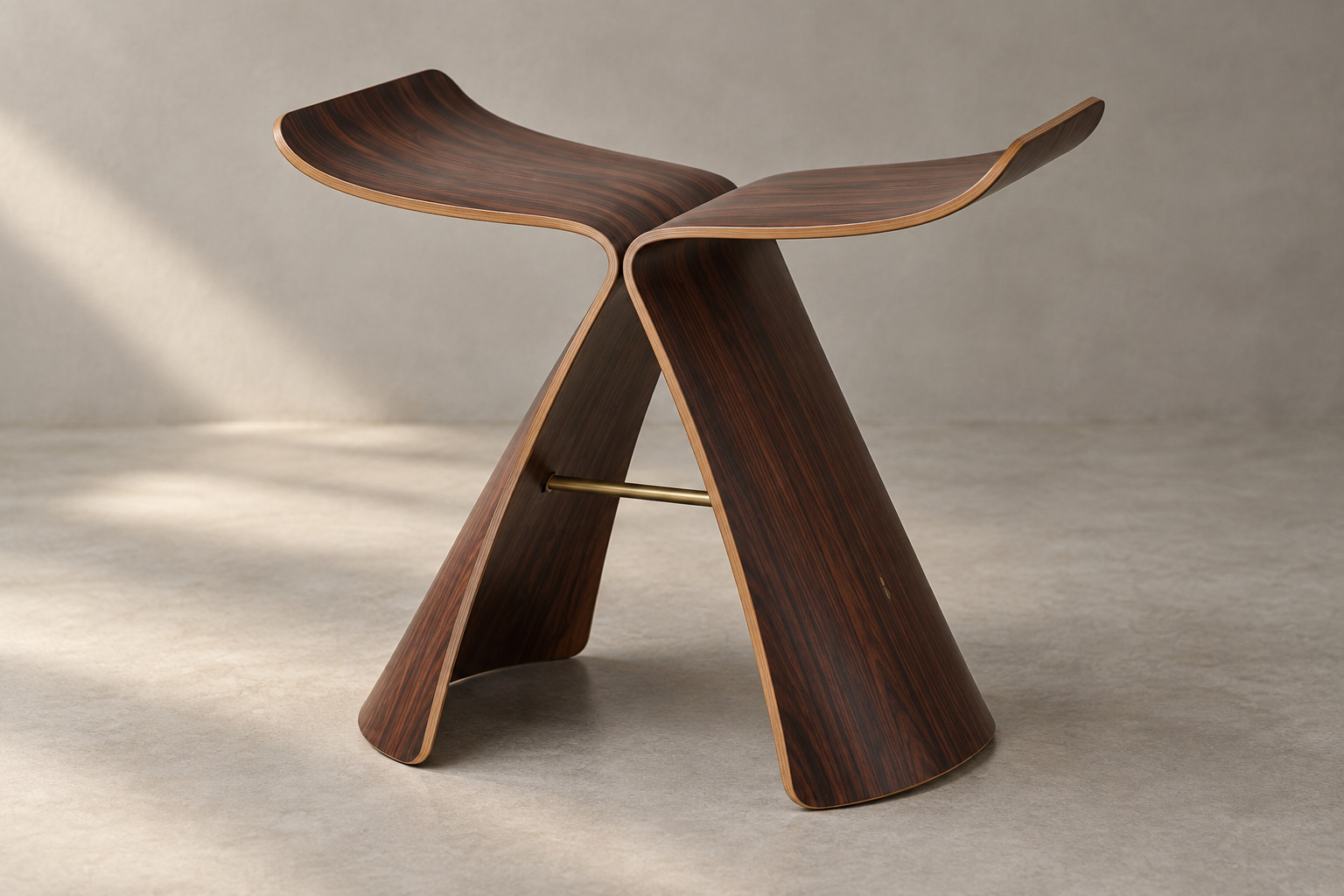
Each wing is also a leg
The Butterfly stool appears to balance on two lifted wings. Follow either side downwards and the illusion becomes a practical arrangement: the curved seat continues into a support that meets the floor. Each moulded plywood half does both jobs.
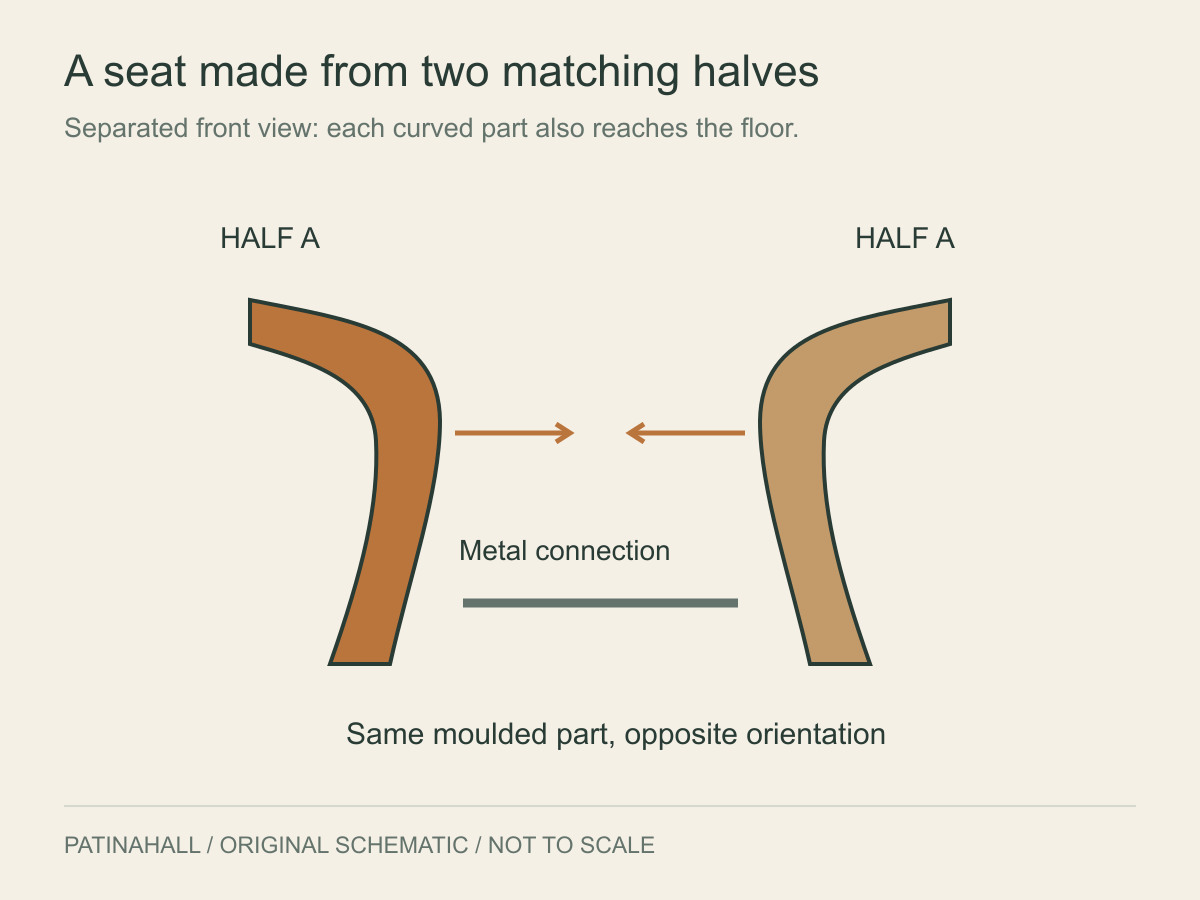
Sori Yanagi’s design uses two matching parts, placed opposite one another, with a metal stay connecting them beneath the seat. Tendo Mokko’s account identifies that small family of components as the basis of the stool. Once you notice the repeated shape, the whole object becomes easier to read.4
There is no separate frame hiding under a conventional seat. The curve is doing the work that several straight members might otherwise divide between them. The narrow space between the halves also remains visible, so the assembly can be understood without turning the stool upside down.
An idea tested in material
The Japan Design Resource Database describes Yanagi’s development through repeated models, including experiments with paper, and his work with Tendo Mokko on moulded plywood. In this account, the recognisable form emerged through making and adjustment rather than arriving fully resolved as a drawing.3
Paper is a useful starting point for thinking about the stool, even though it cannot stand in for the finished material. A flat sheet can suggest a continuous sweep from foot to seat. Moving into plywood introduces another set of questions: how layers hold a curve, how the parts meet and how the connecting metal fits the assembly.
Separate the two halves in your mind and the repetition becomes obvious. Bring them together again and a single moulded shape has become a complete seat. The factory’s ability to reproduce a curve is part of the design’s economy.
Why one date is not enough
Museum labels attach dates to different moments in an object’s life. The Met records the Butterfly stool as designed in 1954, while specifying that its own example was manufactured in 1987. That example combines rosewood-faced plywood with metal components catalogued as stainless steel and copper alloy.1
MoMA dates its Butterfly stool to 1956. Tendo Mokko also identifies 1956 as the design’s public debut at Tokyo’s Matsuya Ginza department store. The dates describe a development history and particular collection records; they need not be forced into a single birthday.24
This distinction is useful well beyond Yanagi. A design can remain recognisable while being made over a long period. The date when a museum acquired one, the year its example was produced and the year the form was developed answer different questions.
The name helps, then gets out of the way
Butterfly is an unusually effective name. It gives the eye a quick route into the two rising sides, and then the stool offers a second pleasure: understanding how little is needed to produce that silhouette.
The halves are alike, but their meeting creates something neither part can do alone. The metal tie is visually slight beside the wood, yet belongs to the assembly. The gap at the centre keeps the form from becoming a solid lump. Repetition, connection and empty space all contribute.
You can appreciate the stool before knowing any of this. Knowing it changes where you look. Instead of stopping at the wing-shaped outline, the eye follows the curve down to the floor and back up again, tracing a piece of furniture that makes its own construction unusually easy to remember.