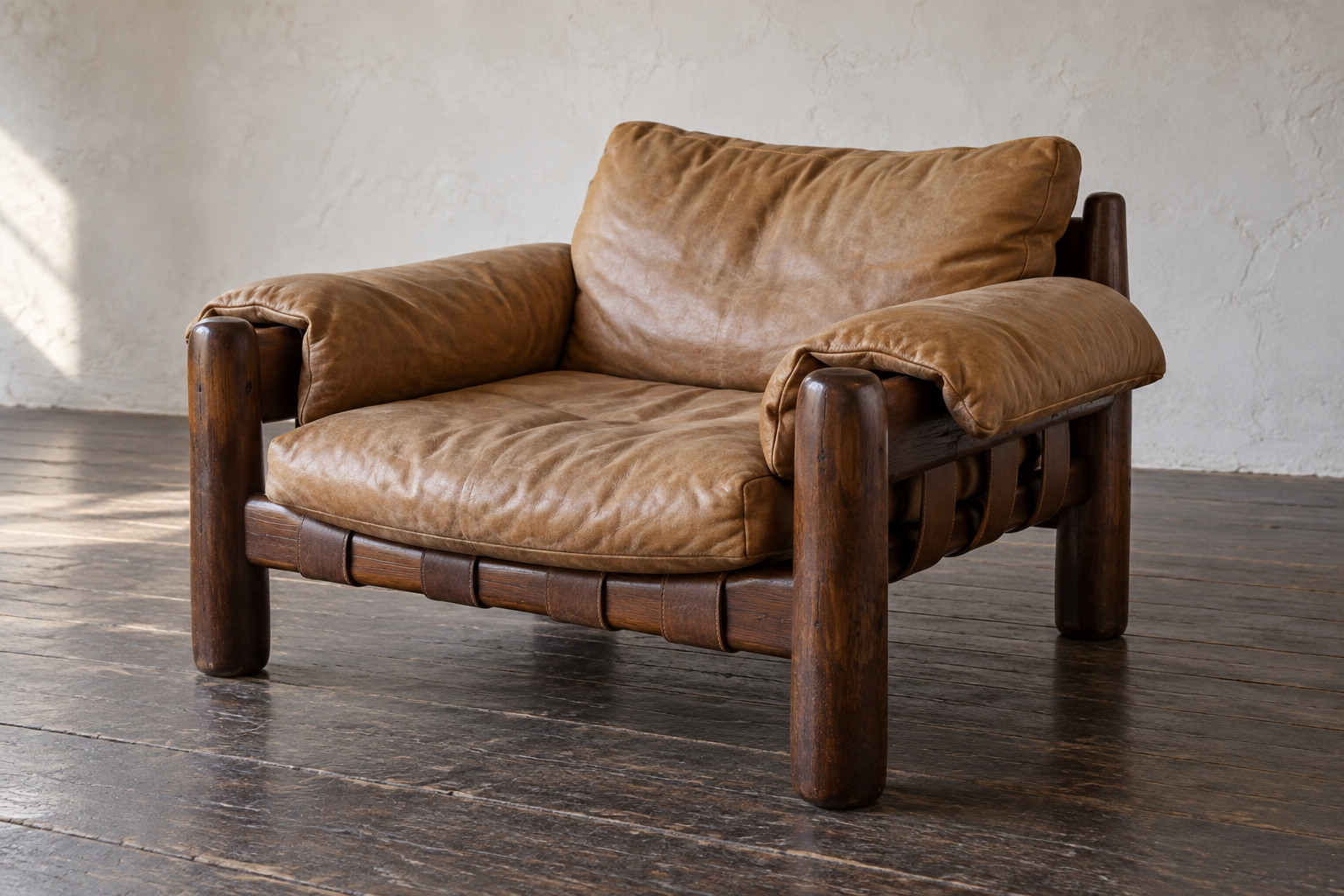
A sofa paid for with photographs
Stupakoff’s studio request reached Rodrigues in 1957. According to the Instituto Sergio Rodrigues, the handmade jacaranda furniture was expensive for the photographer, so the two arranged an exchange: Stupakoff would photograph the first Oca catalogue.
The story brings the chair down from the museum pedestal and back into a working relationship. One person needed somewhere to relax; another had a young furniture business that needed good pictures. The object and its image developed together.1
The photographs had a life of their own. An account preserved by the institute describes a 1958 session on Leblon beach, where the incoming tide caught the furniture. The broad, informal seat was meeting a suitably informal setting, with the less convenient side effect of seawater.2
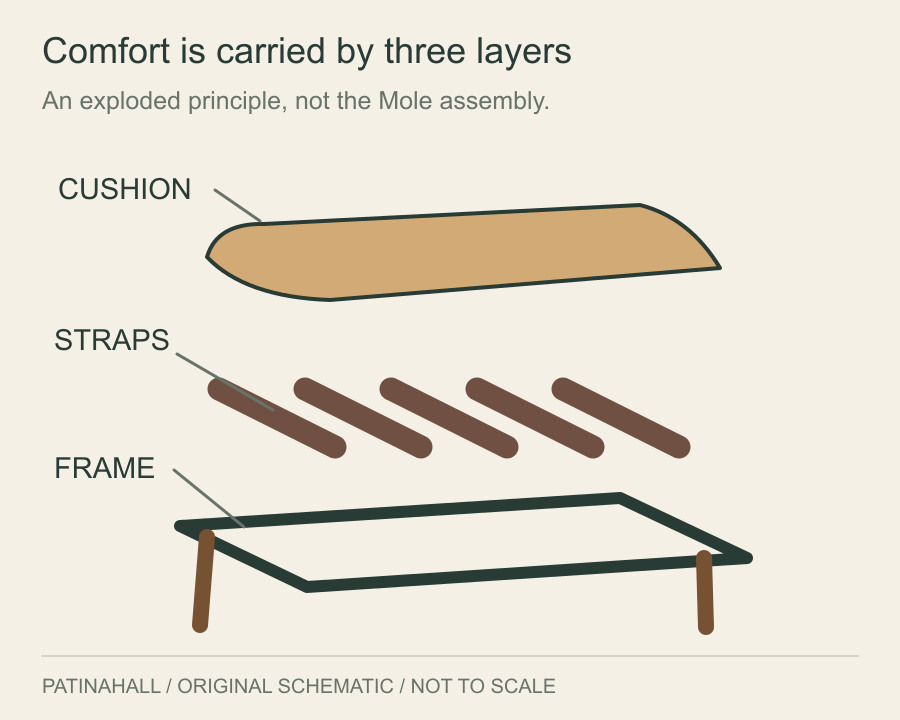
Three layers of relaxation
Look past the cushions and the structure becomes easier to understand. The substantial wooden frame holds its position. Leather straps span the space within it. Loose upholstery settles into that suspended support.
Each layer contributes something different. Wood establishes the chair’s boundary; the straps make a flexible supporting surface; the cushions provide the immediate contact with the sitter. The whole object can look solid and unhurried while its centre yields.
A drawing of Mole in the institute’s archive is useful beside the finished furniture. It encourages us to trace the frame and see the upholstered mass as something carried, rather than as the chair’s entire construction.3
The visible thickness of the timber is therefore only half the story. The open spaces between its members are where much of the design happens.
The first answer was not the last
The institute describes the original 1957 version as comparatively rigid. Rodrigues revised the idea for the 1961 furniture competition at Cantù, where it won first prize. An Italian production version became known as Sheriff; a later demountable development, Moleca, addressed the practical business of packing and assembly.1
Those changes make the familiar silhouette more interesting. It was not delivered fully resolved by a single moment of inspiration. A request led to a piece of furniture, which led to revisions and different manufacturing arrangements.
The history also helps separate names that are often treated as interchangeable. They belong to a development, with differences worth looking for, rather than one unchanged object travelling under several labels.
A chair that remembers a posture
Mole’s generous width can dominate a photograph. Imagine someone stretching out in it and the proportions begin to make a different kind of sense.
The chair is an invitation to stop holding the body in a tidy upright outline. Its frame remains composed while the sitter is allowed to become less so. That is the memorable thread back to Stupakoff’s request: a designer taking seriously the way a person wanted to spend a little unproductive time.