The furniture arrived as packing
In the preface to Box Furniture, Louise Brigham recalled spending two summers in a remote mining settlement on Spitsbergen. Supplies came in during the short navigable season. Their wooden boxes stayed behind. Ordinary furniture timber was scarce, but a great deal of useful wood had already arrived around the food and equipment.2
She used those boxes to furnish the home of her hosts, the mine manager and his wife. It was an unusually clear design problem: make a domestic interior from the material already there. The container had completed one journey and was ready for another kind of work.
Her book appeared in 1909, with drawings credited to Edward H. Ascherman from Brigham’s designs. The surviving public-domain volume lets us follow the argument in her own plans and room illustrations.16
The useful part was already assembled
A packing box contains more labour than its boards suggest. Somebody has cut the timber, established right angles and joined the sides into a volume. Keep enough of that structure and you begin with a compartment, rather than with a pile of planks.
Brigham did not insist on keeping every box intact. Her introductory advice distinguishes designs that use the whole container from those that require it to be taken apart. She discusses selecting sound boxes and adjusting proportions when available sizes differ. Even the choice of a dovetailed box depends on whether a side must come off.3
That makes her approach more interesting than a simple instruction to reuse everything. She was choosing which earlier work to retain and which to undo. The thrift lies partly in the judgement: a ready-made corner is valuable only if it helps the next object.
Eight herring boxes become Boy’s Delight
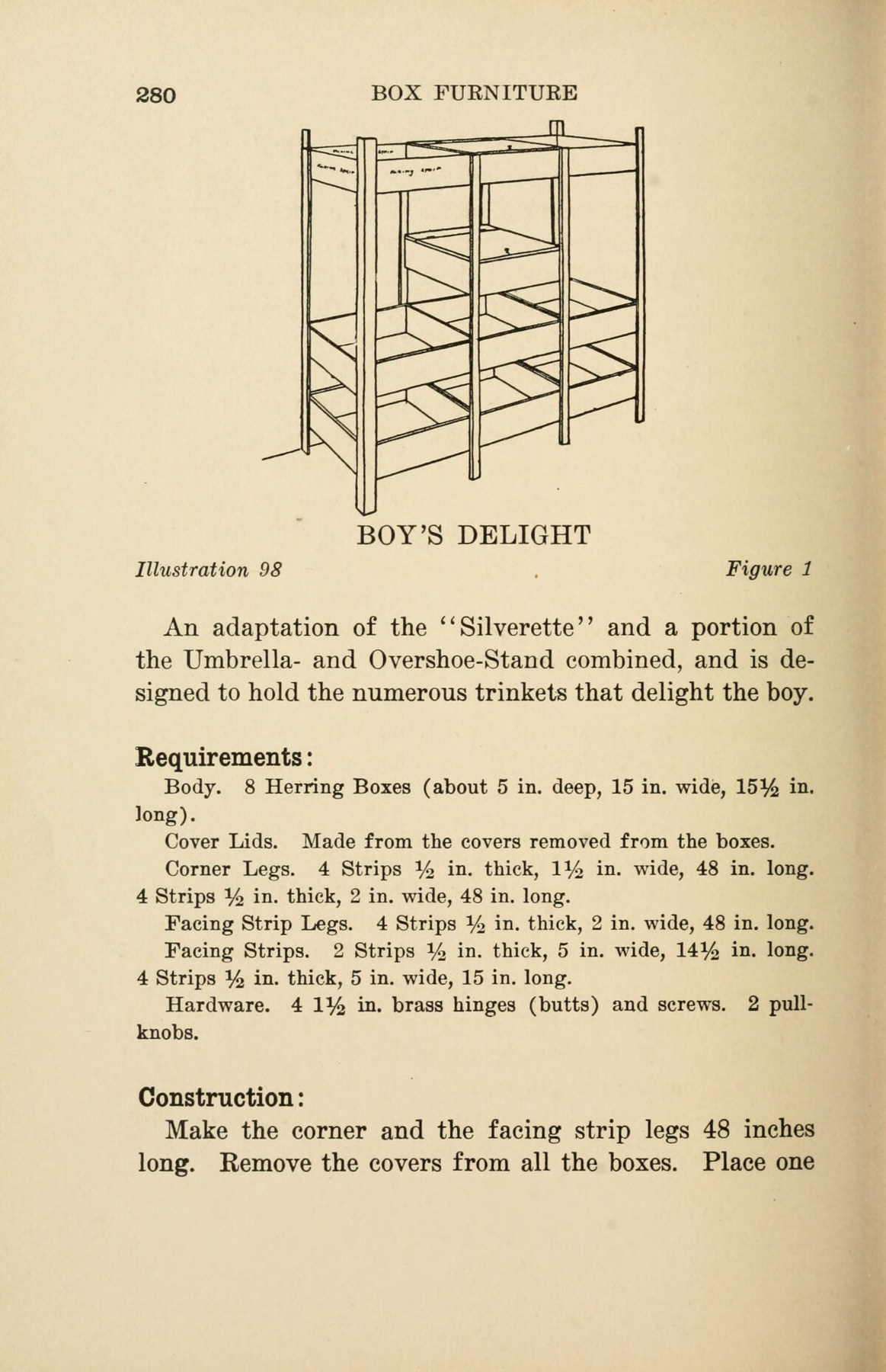
One of the book’s most memorable designs starts with eight herring boxes. Brigham calls the result Boy’s Delight. Two groups of three boxes form the main storage structure, arranged to open in different directions; two more sit at the top with hinged lids. Added strips tie the assembly together and give it legs.4
The finished drawing is surprisingly composed. Different-sized openings offer places for different possessions, and the upper compartments create a small private territory above the open storage. The original container still determines much of the furniture’s rhythm.
It is tempting to read the illustration as a modern kit waiting to happen. Brigham’s book shows something less standardised: a method that accommodates the boxes a maker can obtain. Selection, alteration, fastenings and finishing still require work. Free packing material does not make the finished cabinet effortless.
She was furnishing the whole room
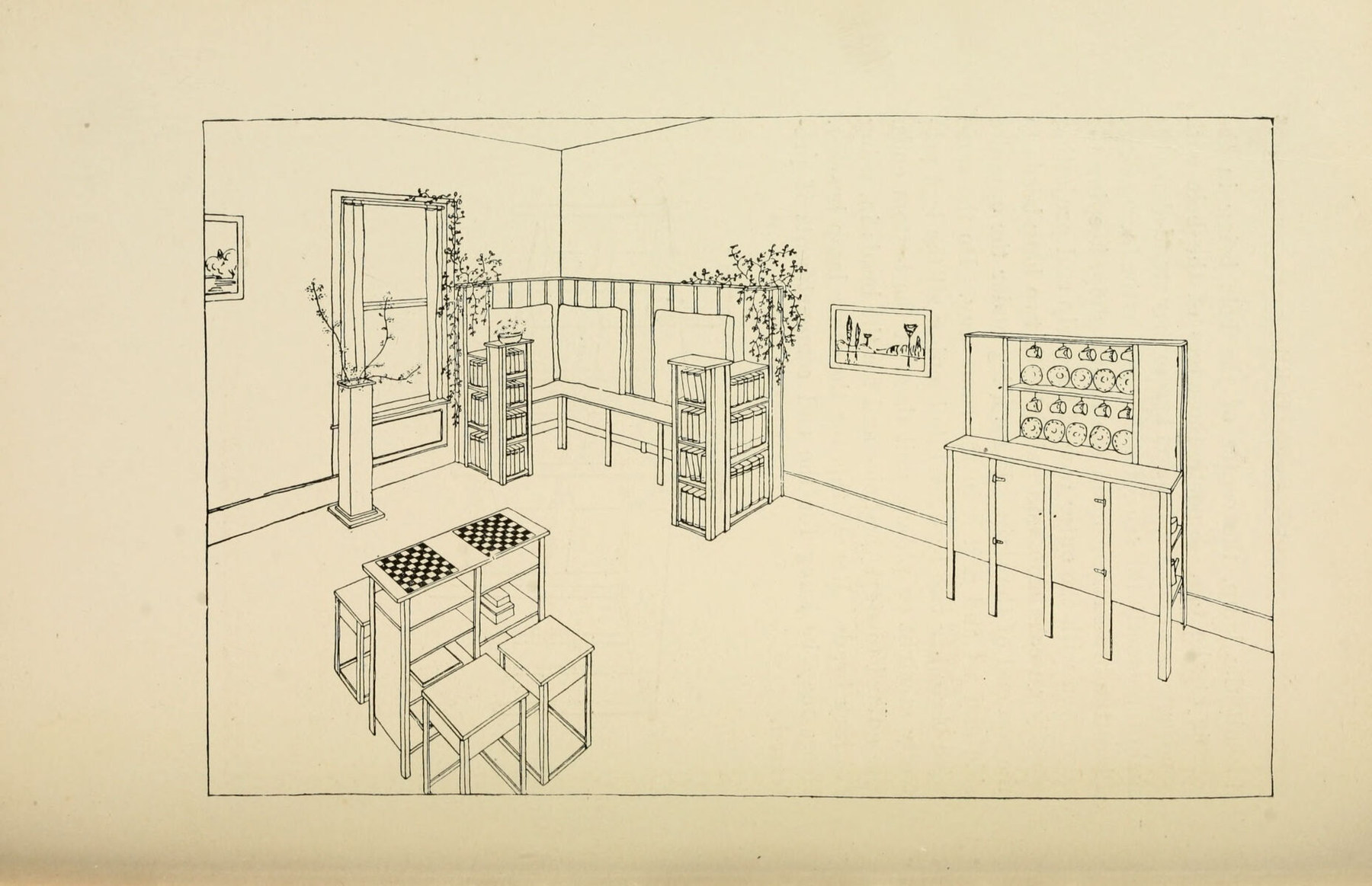
The Copenhagen club-room makes the ambition visible. Brigham describes yellow walls and ceiling, furniture finished in an oak tone, and olive-coloured cushions. The period room drawing gathers seats, tables and storage into a coordinated interior. The boxes supply the starting material; colour and arrangement make the room.5
This is the part easily lost when her work is reduced to an amusing chair made from scraps. The book asks how an entire setting might feel, how its pieces relate and how ordinary containers can acquire a shared character.
Return to the room illustration and look for the box-shaped volumes: beside the seats, inside the storage furniture and under the long table. A container’s practical geometry has been organised into somewhere to sit and spend time. Brigham’s sharpest observation was that the useful beginnings of furniture were already hiding in plain sight.