A sofa that did not persuade its customers
Before the boards and nails, there was a sophisticated piece of furniture. Day-Night, designed by Enzo and Elio Mari for Driade in 1971, changed between a sofa and a bed by rotating its back. Triennale’s account describes its commercial failure as part of the background to Enzo’s later attempt to teach people about design.2
That connection is revealing. A clever mechanism does not automatically help its audience understand why it matters. The designer can solve a problem and still fail to communicate the value of the solution. Mari’s response brought the reader into the process rather than merely showing another finished product.
A booklet that handed over the work
The instruction booklet Proposta per un’autoprogettazione appeared in 1974. According to the Design Museum, Mari sent it to people who requested it, asking them to cover postage. He also wanted photographs of what they made, including their changes to his proposals.1
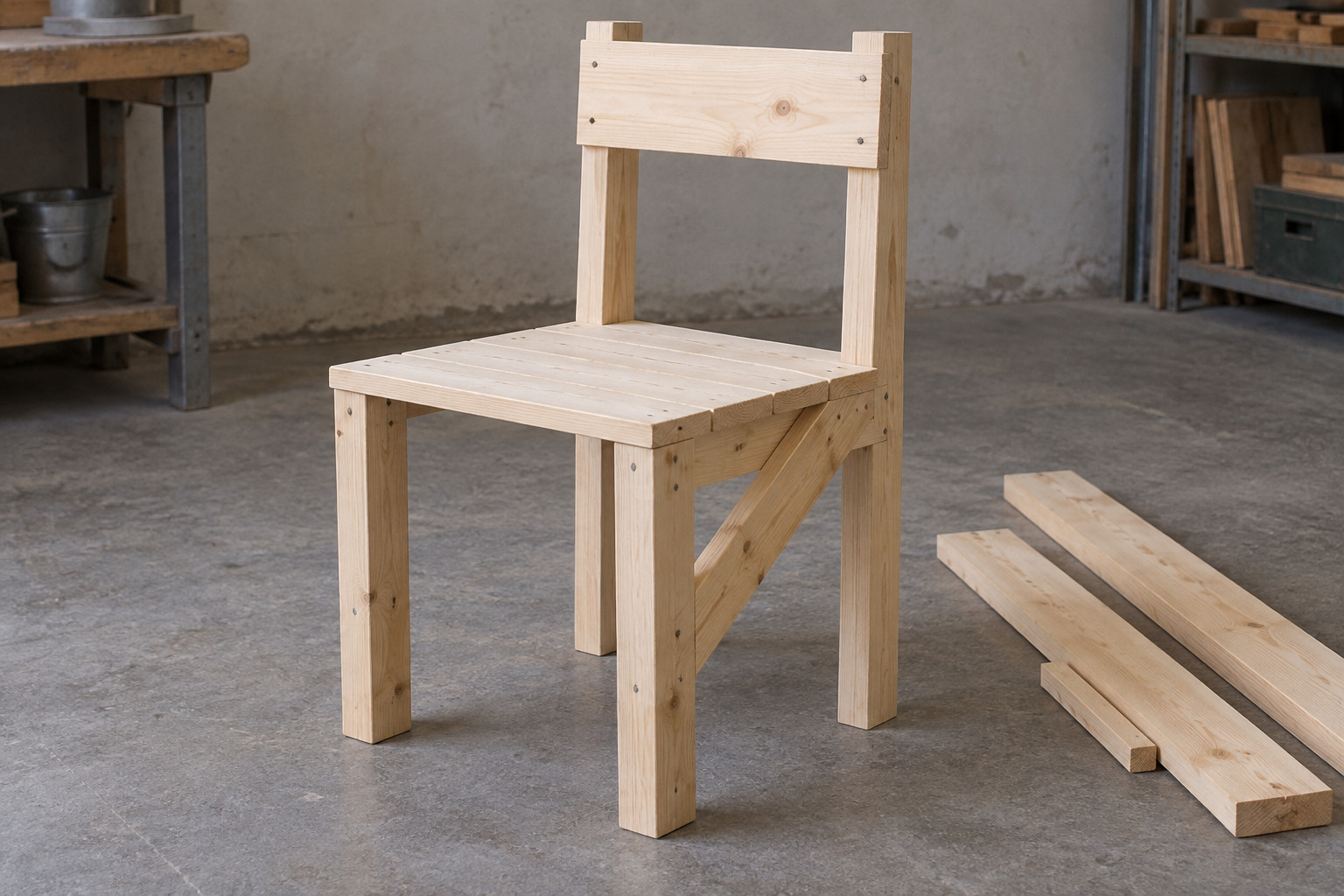
The drawings used ordinary timber and nails to explain simple furniture. The ambition was educational. Once someone had assembled a chair, decisions that usually remain hidden inside a bought object became less mysterious: why a support sits there, how the pieces overlap and what work the structure requires.
Triennale’s collection dates the project to 1973. That date and the booklet’s publication year belong to the development of the same undertaking, rather than to two competing claims about when a particular chair left a factory.3
The diagonal that explains itself
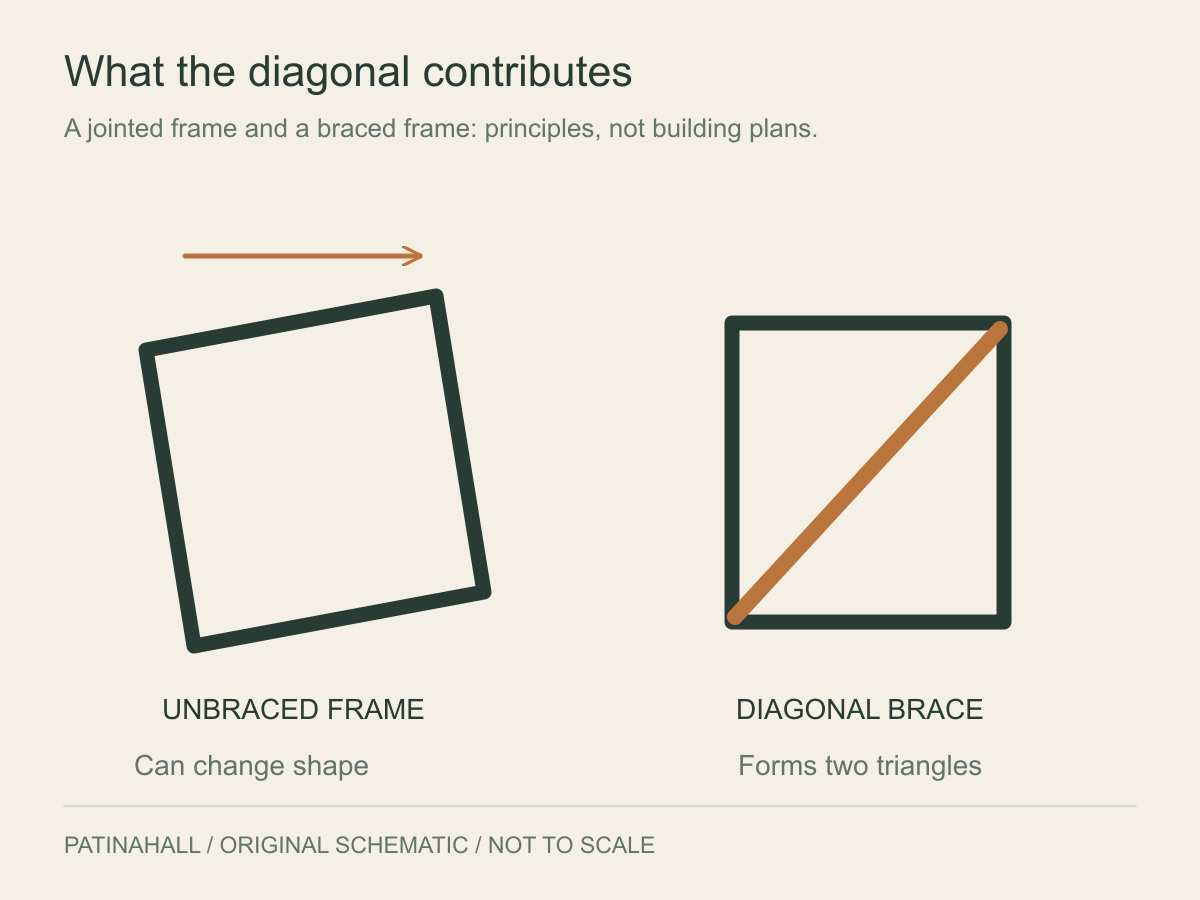
Look at a plain rectangular frame in the accompanying diagram. If its corners can turn, the rectangle can lean into a sloping shape. A diagonal connection restrains that movement. It is a simple structural principle, and seeing it makes a bracing board look less like an arbitrary stylistic gesture.
Visible construction gives the eye somewhere to follow the explanation. An overlapping board shows which element crosses which. A nail head marks a connection. The chair does not have to imitate a seamless manufactured shell in order to become understandable or useful.
Rough timber does not remove the need for thought. The maker still has to decide how boards meet and where support belongs. Those decisions are the lesson: the apparent plainness gives them fewer places to hide.
What the reader could send back
The invitation to return photographs matters as much as the outward journey of the drawings. It allowed the project to include a response: here is what I understood, here is what I changed, here is what happened when I made it.1
A finished chair gives a person somewhere to sit. The process also offers a new way to inspect the next chair in a shop. Which parts carry the load? Which are added for appearance? Which operations account for the cost?
Mari could not answer those questions for every future object. He could make them harder to ignore. The most durable thing leaving the workshop might be the reader’s attention.