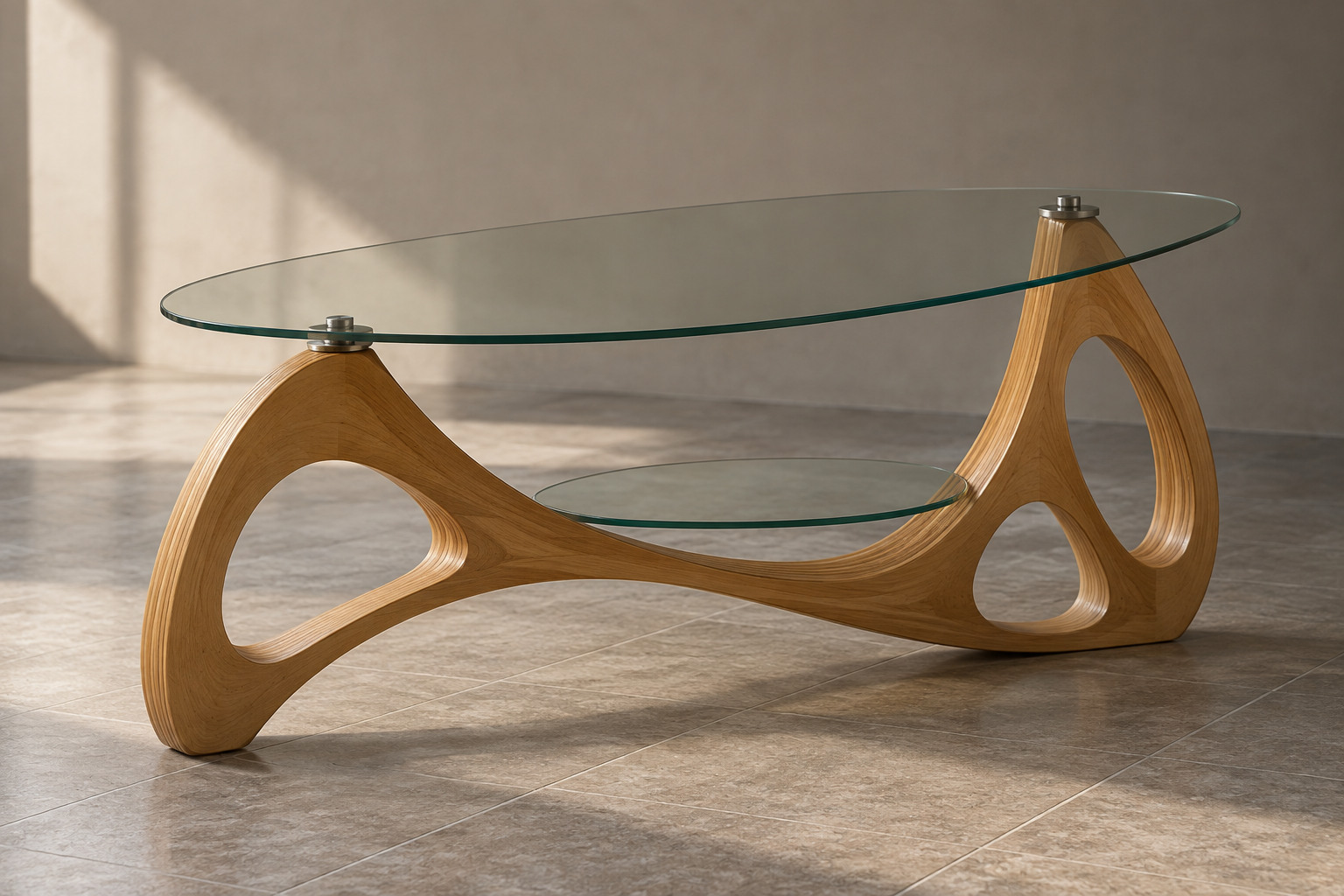
A line is not yet a piece of wood
On paper, a curve can turn as tightly as the pencil allows. In furniture, it must become a material with thickness, edges and somewhere to meet the floor. Arabesco makes the distance between those two conditions especially interesting.
Its broad wooden body behaves visually like a ribbon, changing direction as you walk around it. The openings allow the room to remain visible through the object; they also make the edges easier to follow. There is no single front view that explains the whole table.
Zanotta’s account of Mollino’s working process describes the importance of full-size drawings and the development of the form through making. Even the openings belong to that sequence: their placement has to answer to a body that already curves in space.2
The transparent part has work to do
Vitra Design Museum’s account of a historical Arabesco describes thin maple layers joined with hot glue and formed while pliable. Apelli & Varesio made a very small group of these tables, bringing cabinetmaking knowledge to Mollino’s unusual geometry.
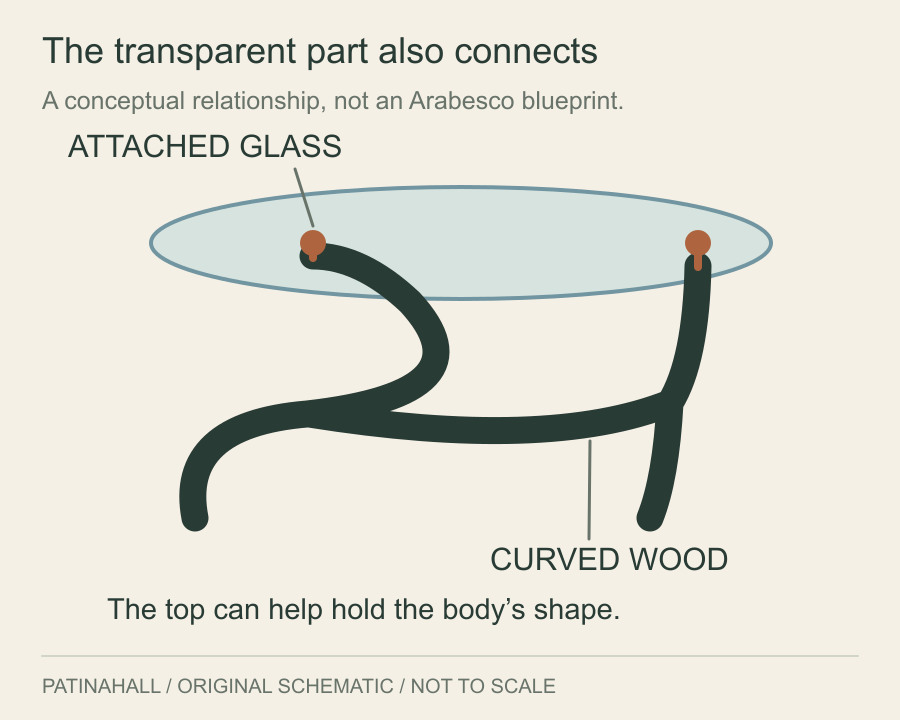
The same account identifies a less obvious contribution from the glass. Screwed to the two highest points of the wooden body, it helps prevent the curved form from warping. What first looks like a nearly invisible surface also helps keep the visible sculpture under control.1
That relationship rewards looking beneath the tabletop. The attachment points connect two materials with very different appearances: warm, patterned wood and clear, reflective glass. Transparency makes the wood seem freer while the actual connection makes it less free to move.
A later edition is another act of making
Arabesco’s design is dated to 1949; the Vitra example is recorded as 1950. Zanotta’s technical sheet identifies a 2020 edition in homage to the earlier design, with its own material description and dimensions.3
This is not an inconvenient footnote. A drawing can be revisited using a different production setup, different available materials and different expectations of repeatability. A recognisable outline can continue while the means of achieving it change.
The useful comparison is therefore between versions, with each allowed its own history. A photograph of one does not automatically reveal how another was made.
Walk around the curve
Try reading Arabesco from the floor upwards. Notice the places where the wooden body settles, the stretches where it rises, and the gaps that prevent it becoming a solid block. Then look at the glass edge and the points where it meets the wood.
The table’s apparent fluidity becomes more compelling when those moments are visible. Mollino’s line did not escape the workshop. It acquired the discipline that allowed it to leave.