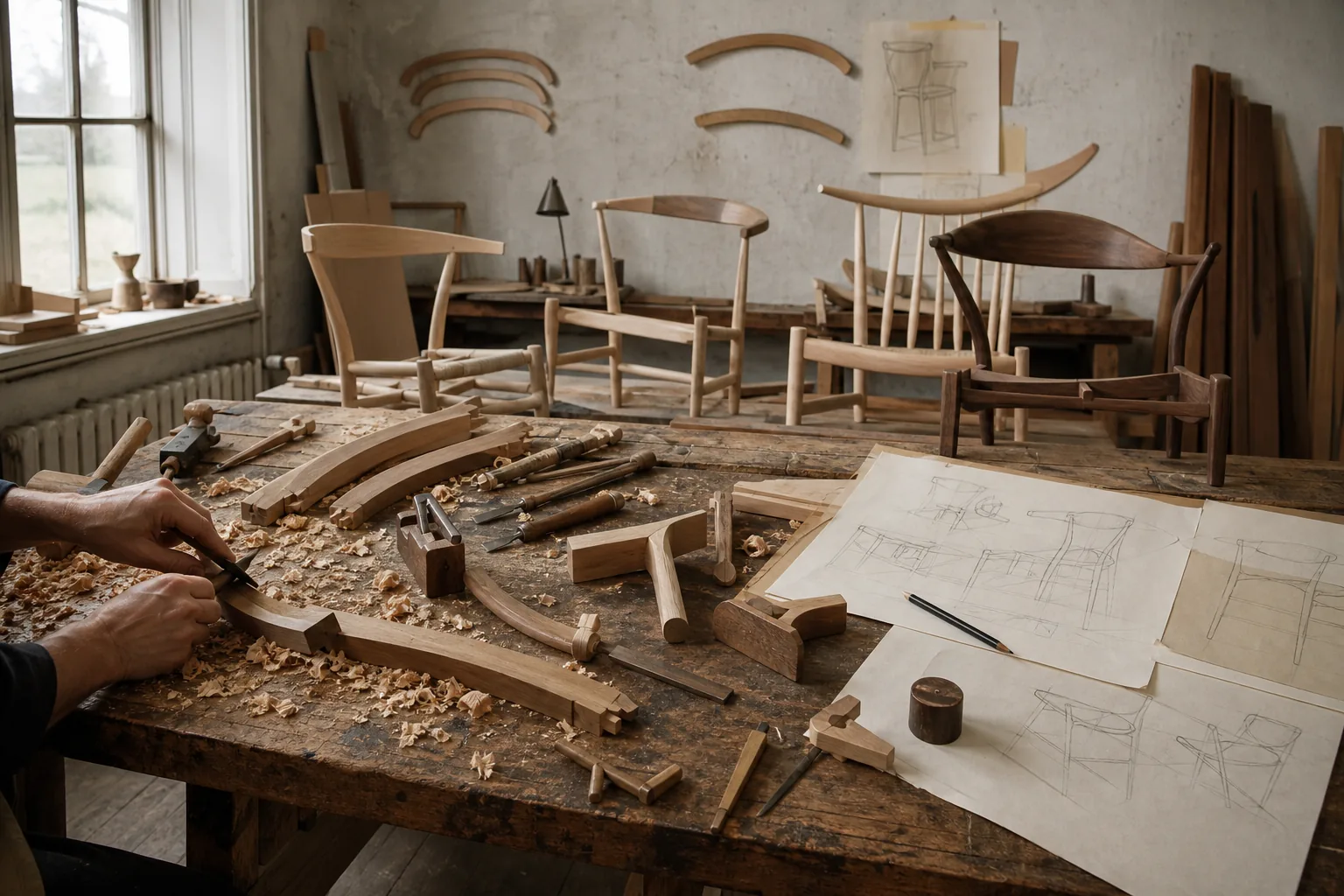
The chair starts when sitting ends
Most chairs are judged by what happens after you sit down. The Valet Chair is equally interested in the minute after you stand up: jacket off, trousers folded, pockets emptied, tomorrow already beginning to form. Hans J. Wegner gave each action a surface, then made those surfaces look inevitable together.
That is why the design is more convincing than a chair with a box attached. A backrest becomes a hanger. A seat acquires a hinge and a second working position. The space beneath becomes a shallow compartment rather than dead volume. The object does not store an entire wardrobe. It edits one untidy ritual down to the few things that otherwise land on the nearest chair.
The Metropolitan Museum of Art dates its example to about 1953 and names Hans J. Wegner as designer and Johannes Hansen Snedkermester Møbler og Inventar as manufacturer. Oak, teak, brass and leather all appear in that exact object, number 2007.49.96.1 Those facts anchor one museum chair. The more interesting question is how so many small domestic jobs were made to read as one design.
A backrest learns the shape of a jacket
The top rail is the first answer. It broadens and lifts at the ends like a wooden clothes hanger, offering a jacket the sloped support that an ordinary narrow chair back lacks. Yet it remains exactly where a sitter expects a backrest to be. Function arrives through a change of profile, not through an extra accessory screwed onto the chair.
This double reading is typical of the wider method explored in our Hans J. Wegner profile. A familiar furniture part is not decorated with an idea; its outline is reconsidered until it can perform another useful act. From across a room, the Valet Chair still looks composed. Up close, its anatomy starts issuing quiet instructions.
The hanger is also a clue to scale. This is furniture for the body even while the body is absent. Shoulders determine the width of the rail. The fall of a jacket determines its curve. The owner remains present as a set of expected garments rather than as a sitter.
Lift the seat and the chair changes jobs
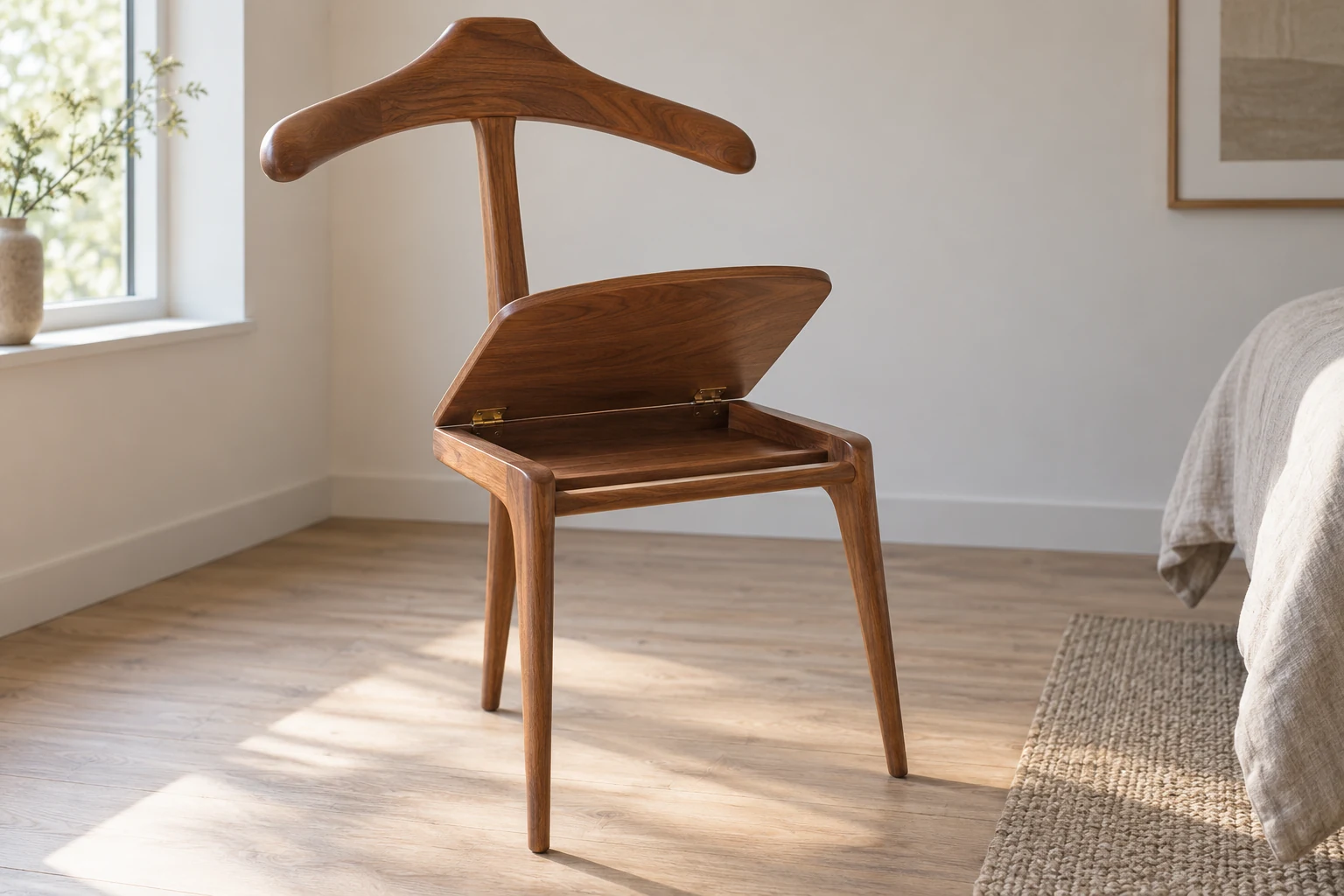
The seat carries the design’s most satisfying piece of choreography. Raised on brass hinges, it exposes a support over which trousers can be folded. The movement also opens the shallow compartment below, ready for keys, a wallet or other pocket contents. Lower the seat and those two tasks retreat; the object returns to being somewhere to sit.
PP Møbler describes the same sequence in its current PP250 account: the back serves as a hanger, the hinged seat receives folded trousers, and the space beneath keeps small belongings together.3 None of the operations requires a hidden spring or theatrical release. The intelligence lies in assigning two states to one part.
That restraint matters. A larger compartment would turn the chair into a chest. More fittings would make it resemble hotel equipment. Wegner stops at the contents of one person’s pockets and the clothes removed at the end of a day. The design feels generous because its limits are so accurately chosen.
Four legs become three
The best-known origin story also concerns editing. PP Møbler says the idea began in 1951 during a conversation among Wegner, architect Steen Eiler Rasmussen and designer Kay Bojesen about the problem of folding clothes at bedtime. Its account continues with King Frederik IX seeing a four-legged version and ordering one. Wegner then worked on the design for two more years, arriving at the three-legged chair associated with 1953; PP Møbler says the king ultimately ordered ten.3
It is a delightful story, but its grammar matters: PP Møbler says. The manufacturer is the source for the conversation, the royal encounter and the orders. Repeating the anecdote without that attribution would turn company history into an independently witnessed fact.
The change itself can be read directly. One rear leg aligns beneath the centre of the hanger-shaped back, while two front legs support the seat and frame the compartment. Three points suit an object whose front and rear already perform different jobs. The result looks less like subtraction for its own sake than a decision to make every support declare where it belongs.
One design, several maker histories
“Hans Wegner PP250 Valet Chair” sounds like a complete identity. For an individual object, it is only the beginning.
The RISD Museum records a 1953 Valet Chair made in Denmark from teak, oak, leather and brass, measuring approximately 94 by 50.8 by 51.1 centimetres. 2 The Met’s chair is also approximately 94 centimetres high and is explicitly connected with Johannes Hansen. PP Møbler, meanwhile, presents PP250 as a current product and lists several present timber choices.
Those records belong side by side, but they should not be collapsed. A design date is not an object date. A current model number is not automatically an early manufacturer’s mark. Present materials do not retroactively specify every earlier edition. To identify a chair, evidence still has to move from the repeatable design to the physical object: labels or stamps, construction, dimensions, materials, provenance and condition.
This is not caution added after the interesting part. It is part of the design’s history. The Valet Chair has lasted long enough to pass through different production contexts while keeping its recognisable sequence of hanger, hinge, rail and compartment.
A second position, illustrated
The editorial reconstruction suggests the partly raised seat, shallow tray and hanger-shaped back described by the reviewed sources. It is not a documented Johannes Hansen chair from 1953 or evidence for another chair’s date, maker or exact hinge construction.
Its value is timing. The seat is raised, so the design can be read in both states at once. The curved back waits for a jacket. The lifted panel exposes the trouser support. The compartment is visible rather than inferred. Three legs keep the whole arrangement poised without making it appear burdened by its errands.
Closed, the Valet Chair can pass as an unusually articulate wooden chair. Opened, it explains why it exists. The design’s lasting charm is not that it promises perfect order. It simply gives the clothes chair—a piece of furniture almost every bedroom invents by accident—a deliberate and beautifully limited form.