
The person behind the listing matters
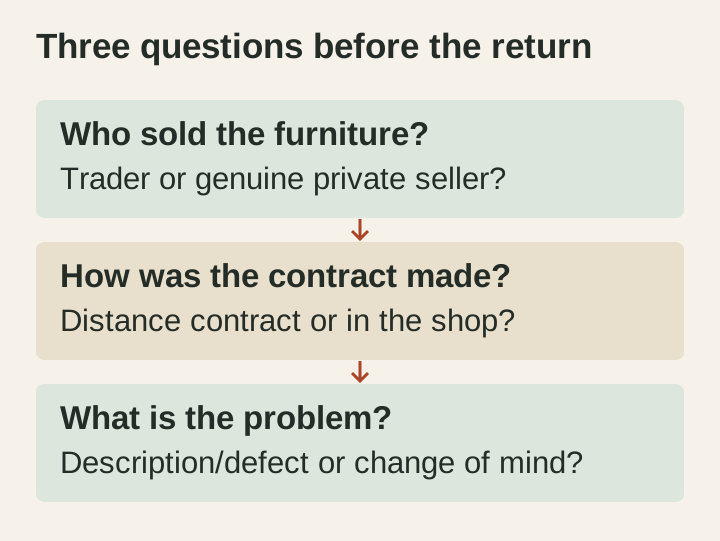
Your Europe explains that online marketplaces must indicate whether a seller is a trader or a private individual. A trader can be a company or someone acting in business; simply calling an account “private” does not necessarily settle that status. Save the seller’s identity, listing, agreed description and terms with the purchase record.[1]
Ask who will appear on the invoice or receipt. The marketplace, payment provider and carrier may each provide a service without becoming the seller of the chair. Keep their different roles visible rather than assuming the platform’s logo gives every transaction the same legal position.
Three common furniture purchases
| Purchase | Conformity or description issue | Change of mind |
|---|---|---|
| Consumer buys from a dealer through a distance contract | EU consumer protections apply to used goods. | A 14-day withdrawal right generally applies, subject to exceptions. |
| Consumer chooses and buys in a dealer’s shop | Consumer conformity protections still apply. | No general EU right to return merely because you changed your mind. |
| Consumer buys from a genuine private individual | National contract law may provide rights; the EU trader-consumer regime does not apply in the same way. | No general EU consumer cooling-off right. |
Collecting an object does not by itself tell you whether the contract was made at a distance. An online reservation followed by a decision in the shop may differ from an online completed purchase collected later. Record when and how you became committed and ask for the applicable terms.[2]
What does conformity mean for a used chair?
EU guidance describes a minimum two-year legal-guarantee baseline for goods bought from a trader. For second-hand goods, some countries permit an expressly agreed shorter period, but not below one year. National rules may provide stronger or differently structured protection. Do not treat two years as a universal expiry date for every claim in every country.[1][3]
The agreed description and known condition matter. A chair sold with a clearly disclosed repair is different from a chair advertised as sound that arrives with an undisclosed broken joint. Record specific defects and what has been separately agreed; a broad phrase such as “vintage condition” leaves too much unresolved.
When something is wrong, identify the mismatch and contact the trader. The appropriate remedy can depend on the defect and circumstances; a unique used object may not have a like-for-like replacement. Do not assume every complaint produces an immediate refund, or that a seller’s commercial warranty replaces statutory rights.
A cooling-off right does not make a sofa cheap to return
For a normal distance withdrawal, Your Europe describes a 14-day notification period from delivery of goods. Return costs can fall to the consumer when the trader has properly informed them; defective-goods returns are a separate issue. Check the exact process, deadlines and any applicable exception before purchase.[2]
For bulky furniture, ask for the practical return arrangement and the disclosed cost or estimate where required. Who books collection, who packs the item and what access must be available? “Returns accepted” is incomplete if a sofa will need a specialist carrier and the budget contains no return allowance.
Keep packaging and handle the piece carefully while deciding. A return right is not permission to alter, refinish or use the furniture beyond the handling needed to assess it. If you discover damage, report that as damage rather than disguising it as a simple change of mind.
Make the important terms easy to find
Before paying
Please confirm the legal seller, trader or private status, exact condition and included components. When is the contract concluded, which national terms apply, and what are the cancellation and return arrangements for this bulky item? Please distinguish a change-of-mind return from the process for damage or a description problem.
This is an EU consumer overview, checked on 10 September 2026. For an actual dispute or cross-border uncertainty, use the relevant national consumer authority or European Consumer Centre with your purchase record. The useful preparation is a clear agreement made before the object leaves the seller.