Open the doors and the room gains an office
The Wooton Patent Secretary compresses an office by putting storage on moving walls. Two deep, compartmented wings swing away from a broad central case; a writing leaf lowers into the space between them. Papers that were hidden now surround the user. Close the leaf, bring the wings together and the office becomes a locked cabinet again.
That change is the design’s real subject. A modern filing cabinet stores papers but leaves the work elsewhere. A conventional desk supplies a surface but asks the room to hold much of the filing. Wooton’s secretary makes storage, access, writing and concealment different states of one large object.
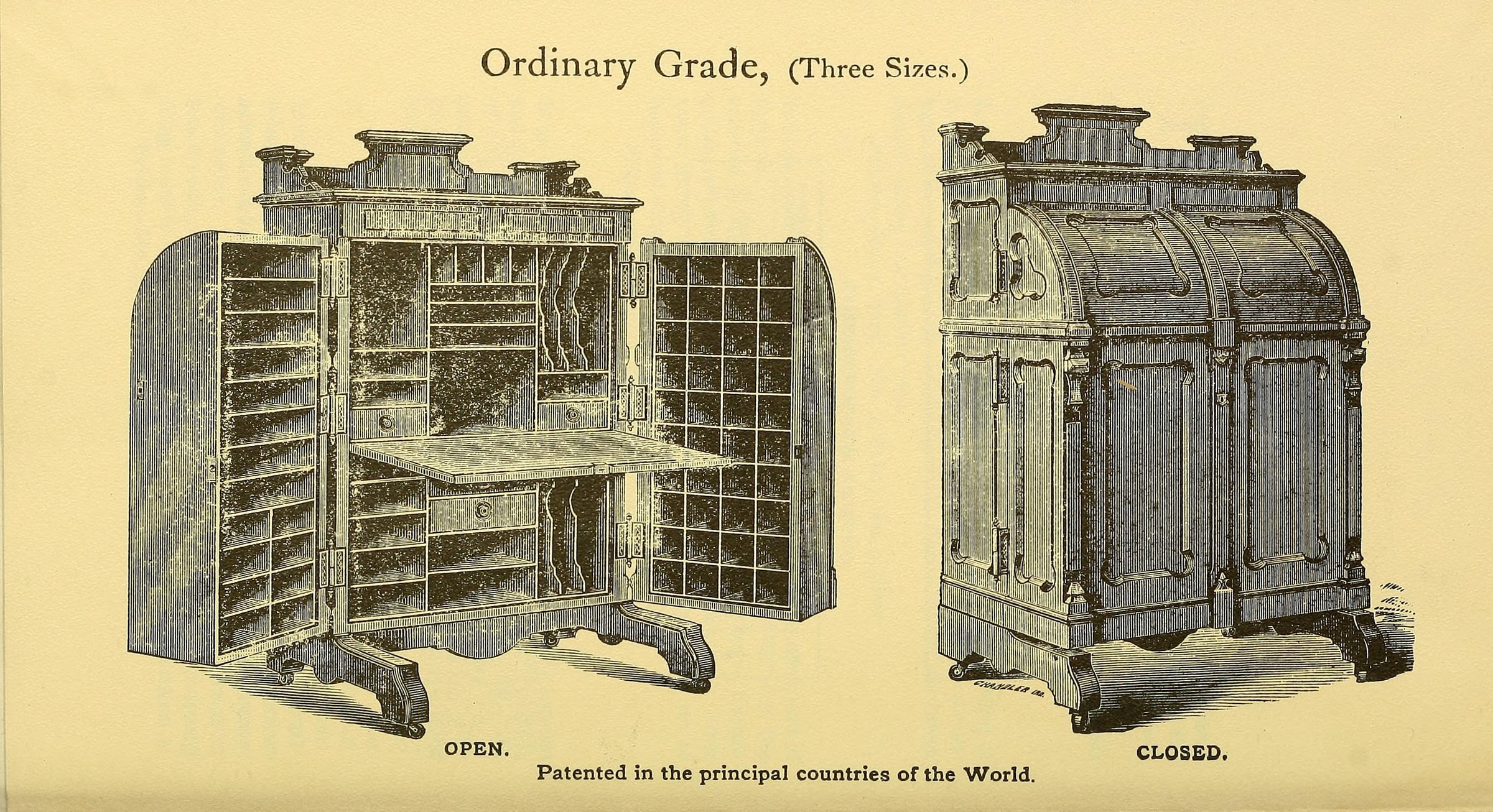
The company’s 1876 illustrated catalogue presents the Ordinary Grade open and closed on one plate.3 In the first view, dozens of rectangles spread across three surfaces around a projecting desk. In the second, almost every useful opening has disappeared behind a symmetrical cylinder-front façade. It resembles a before-and-after advertisement, except both conditions belong to the same piece of furniture.
The patent is a sentence about three parts
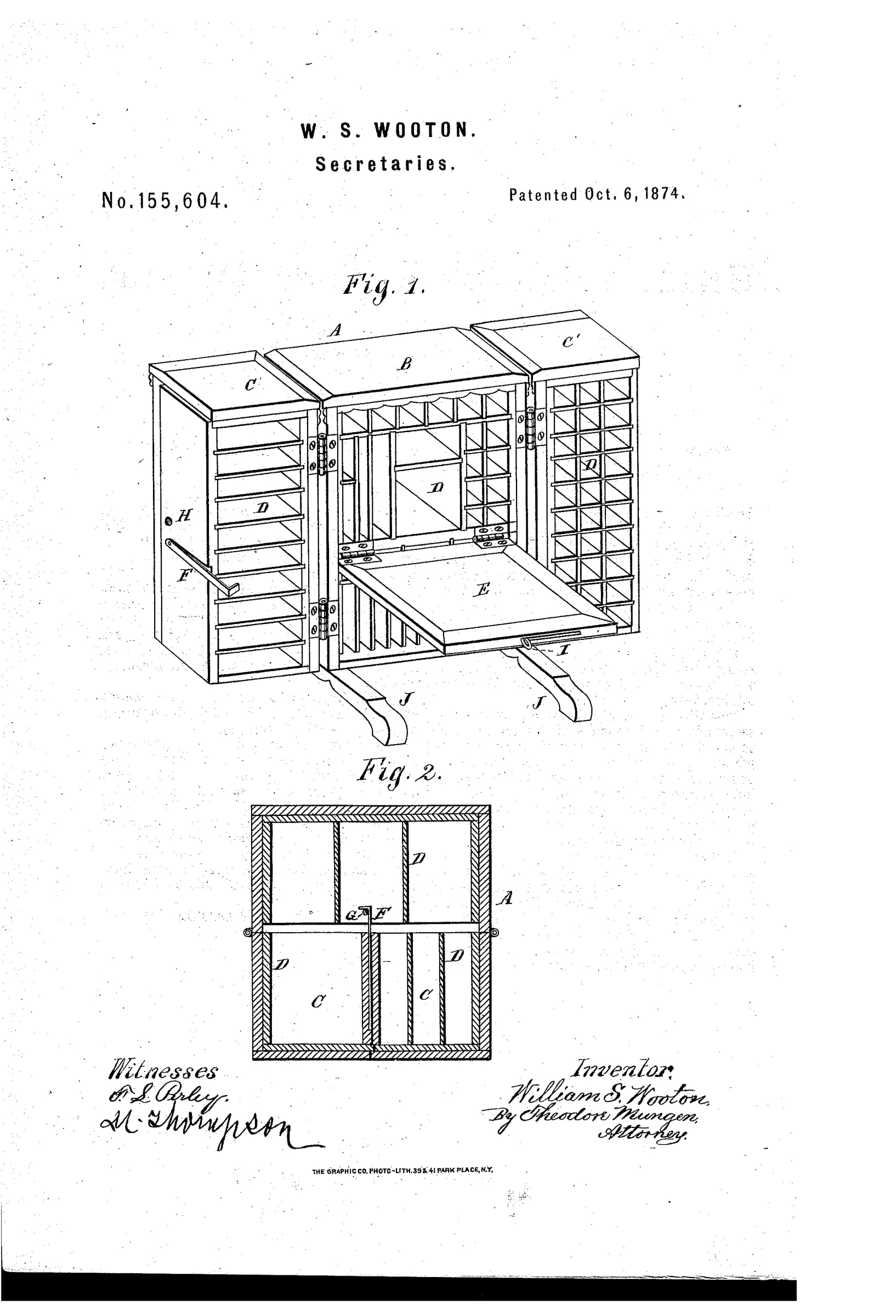
US Patent 155,604, issued to William S. Wooton on 6 October 1874, strips the idea of its Victorian ornament. Its principal claim describes a secretary made in three parts: a broad central section and two narrower sections whose combined width corresponds to the centre. All carry compartments or pigeonholes. The smaller sections are hinged to the larger one and become doors; a folding desk completes the arrangement.2
The geometry explains what the façade alone cannot. These are not thin doors covering a cabinet full of shelves. The doors have depth and storage of their own. When they open, they increase the working frontage. When they close, their contents rotate into the footprint and face the central case.
Patent drawings also show spring catches, supporting members and the folding leaf, but the lasting insight does not require mechanical mystery. One central body plus two storage-bearing wings creates a room within reach of a seated person. The furniture enlarges when used without requiring the room to accept that width all day.
Order requires choreography
An open Wooton secretary promises that everything has a place. It also asks the user to perform a sequence.
The Smithsonian’s detailed study describes pigeonholes in the right wing, shelves in the left and a central body combining drawers, shelves and additional openings. Many models included a letter box. A green-felt writing flap lowered from the centre; depending on the version, cast brackets or sliding metal rods helped support it. A narrow upper flap could reveal still more storage, and double casters allowed the substantial cabinet to move.1
Before the wings can meet, the work surface must be cleared and folded. Papers have to return to compartments. The user is not merely storing information but rehearsing closure. That can feel like discipline made useful—or like a large piece of furniture supervising the end of the working day.
A British critic writing in 1876 noticed the cost of all that access and called it “much ado … to write a note.”1 The complaint is perceptive. Wooton’s design saves floor space in its closed state by making the open state an event. Convenience depends on which moment you choose to measure.
One design, four grades
The secretary’s crowded interior tempts us to imagine one definitive Wooton desk. The company sold a family instead.
The Smithsonian study reconstructs four advertised grades. Ordinary was the plain, substantial entry level. Standard added veneered panels, decorative metal hardware, a four-tumbler lock and a French-polished finish. Extra brought more incised detail and a more elaborate cornice. Superior could carry marquetry in contrasting woods, ebony trim, gold-enamelled hardware and the most emphatic cresting.1
Size and interior arrangement varied too. The 1876 catalogue plate beside this article is explicitly labelled Ordinary Grade and offers three sizes. It is excellent evidence for how one advertised version changed between open and closed; it is not a universal section through every Wooton secretary. 3
This is also where the famous number needs a label. An 1884 London advertisement claimed “one hundred and ten compartments” under one lock and key. The Smithsonian study preserves that statement as promotion from a particular moment, not a specification common to every grade and size. 1 The number is memorable because it turns order into spectacle. Evidence should keep it attached to the advertisement that made the boast.
A sheet of paper refuses to fit sideways
Spencer Fullerton Baird’s order brings the grand system down to the width of a page. Baird, a Smithsonian administrator and scientist, ordered a Standard Grade size 2 secretary in 1875. He wanted pigeonholes deep enough for thirteen-inch foolscap paper. The company first suggested placing the paper sideways and resisted a custom change because business was pressing. The desk was eventually shipped in January 1876.1
It is a wonderfully ordinary dispute. A cabinet promoted as universal office order met one administrator’s documents and discovered that paper has a grain of its own. Baird did not need abstract capacity. He needed a particular sheet to enter in the direction his work required.
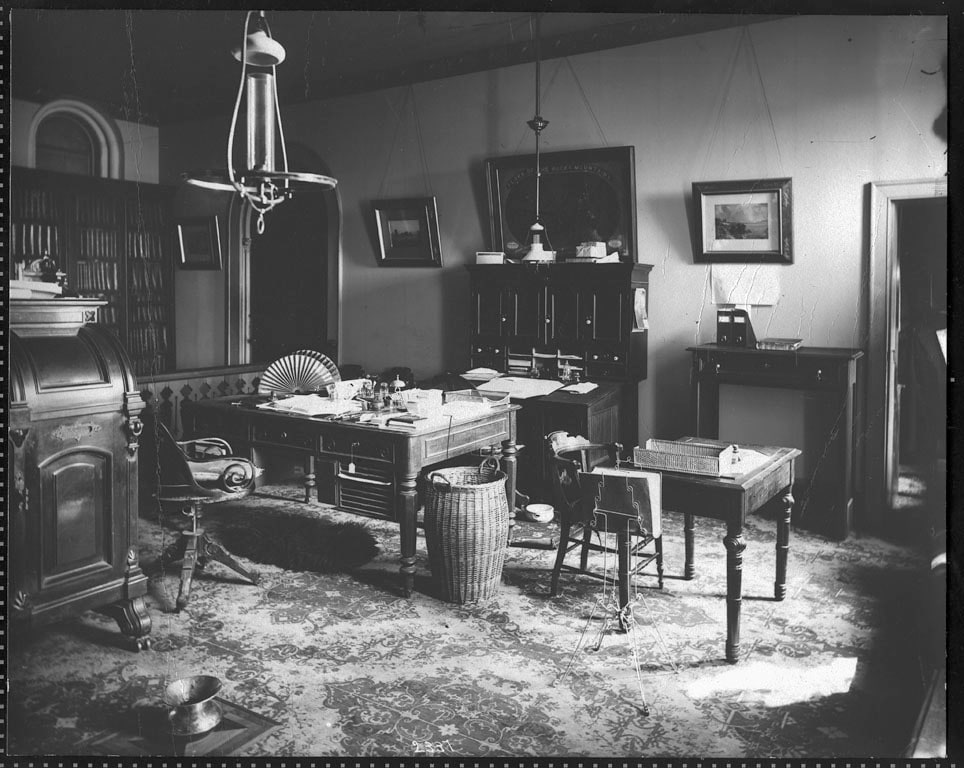
The Smithsonian study traces the secretary in his office from 1878 to 1887. A photograph made by T. W. Smillie in 1878 places it at the far left of a room already crowded with tables, chairs, boxes, books, pictures and people. 4 The desk does not dominate the image. That is precisely why the view is valuable: it restores the celebrated cabinet to the visual pressure of an actual workplace.
Open against the wall, its pigeonholes join a much larger information system. The secretary did not eliminate clutter from Baird’s office. It gave one portion of that clutter a border, hinges and a key.
Closing time
By 1876 the Wooton Desk Company was producing in expanded Indianapolis premises and promoting its cabinet secretary and rotary desk nationally and abroad. The Smithsonian study records production at 150 desks a month after the move and notes that the designs were commended at the Centennial Exhibition for compactness, convenience and utility.1
Those three virtues meet most clearly at closing time. Compactness is the cabinet with its wings shut. Convenience is the fan of compartments brought within reach. Utility is the writing surface between them. No single state contains the whole design.
Nor does one name settle the identity of a surviving desk. Patent date, company history, grade, size, materials, hardware, internal arrangement, marks, provenance and condition remain separate questions. The 1874 patent explains a construction; the 1876 plate documents an advertised Ordinary Grade; Baird’s papers and office photograph follow one ordered example. None can authenticate another cabinet by resemblance alone.
The secretary’s promise was therefore more modest—and more interesting—than perfect organisation. It could not make work disappear. It could gather work around a person, then fold that temporary office back into furniture and turn the key.
