Begin with the fringe, then look down
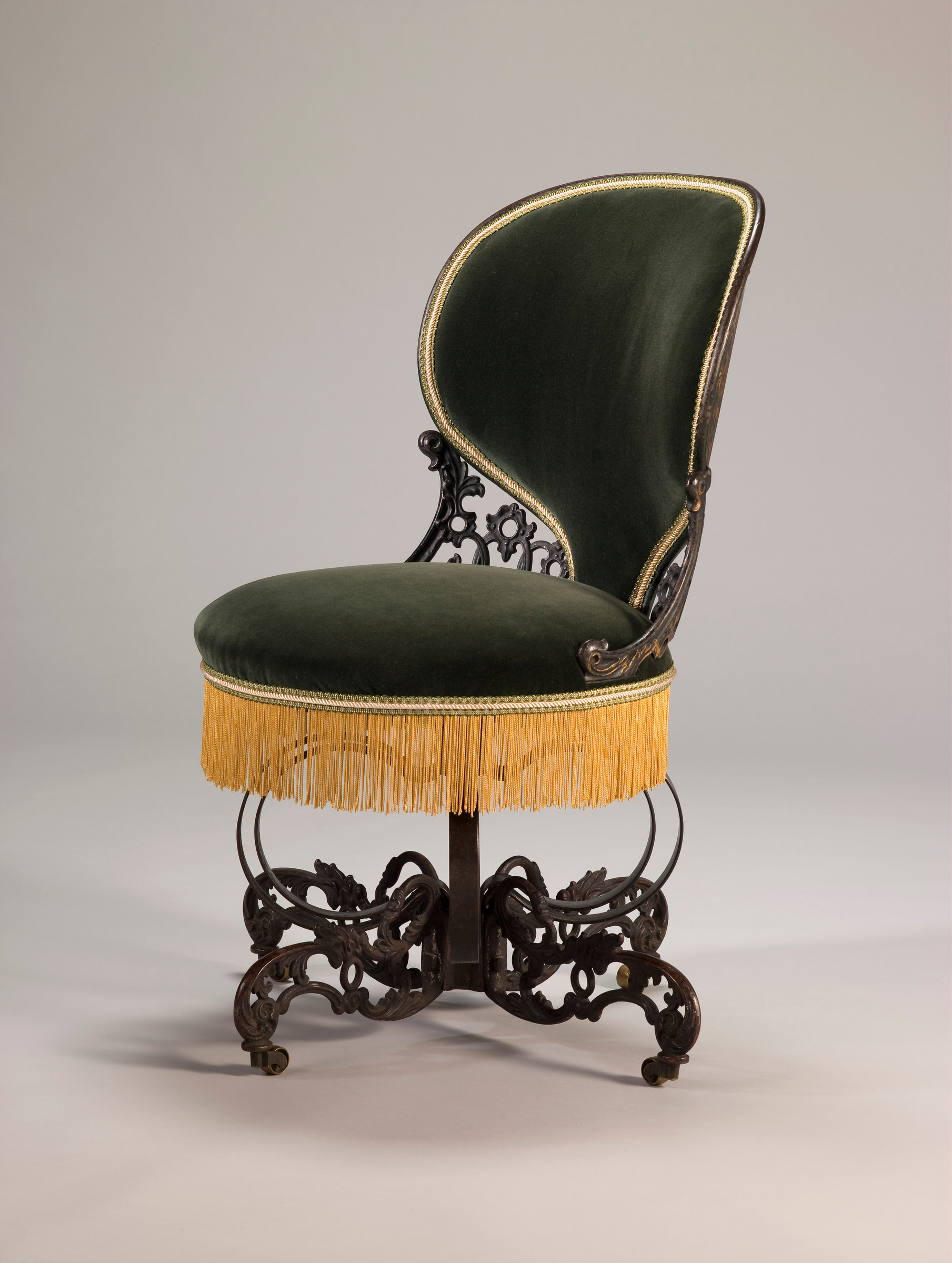
Warren's chair stages a small act of misdirection. The eye meets a broad green back, a deep upholstered seat and a curtain of gold fringe. Scrolling foliage rises beside the sitter. Only after that soft, ornamental first impression does the structure below come into focus: dark metal bows, a central vertical support, an elaborate cast base and four small casters.
The Saint Louis Art Museum dates this exact object to about 1850. It names Thomas E. Warren as designer and the American Chair Company of Troy as maker. The recorded structure combines painted and gilded iron, painted steel and wood. Crucially, the museum calls both the cotton velvet upholstery and silk fringe replacements.1
That last word changes how the photograph should be read. The present trim beautifully performs the chair's contrast between softness and machinery, but it cannot be treated as untouched evidence of an 1850 colour or fringe scheme. The exact object's secure story begins with its museum identity and metalwork; the current textile layer belongs to its later material life.
The chair breaks the four-leg rule
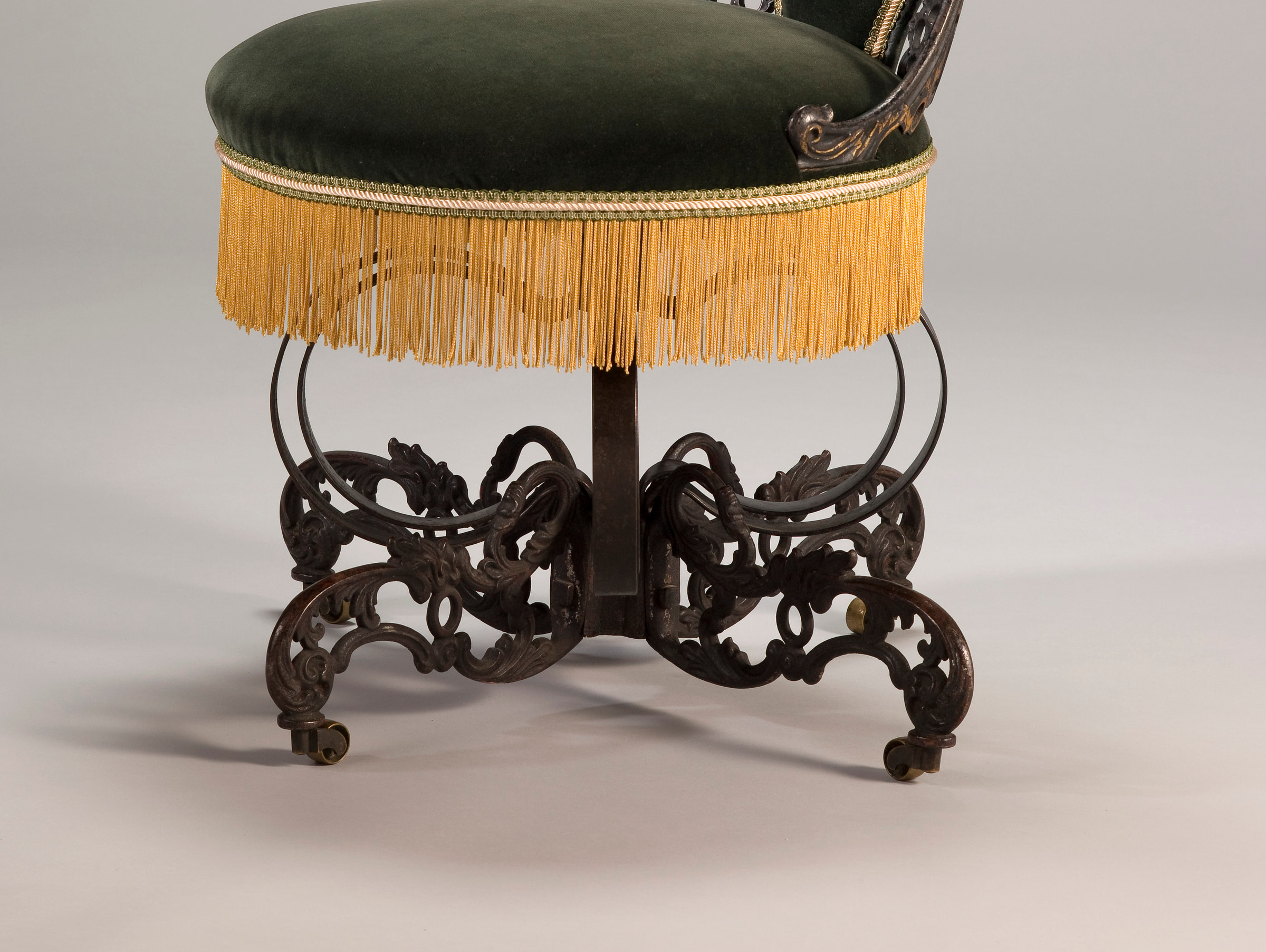
A conventional chair distributes a sitter through four fixed legs. This one gathers the seat onto a central support, then opens outward into a mobile base. The photograph's cast scrolls are decorative, but they are not merely a screen in front of a normal wooden chair. They organise the route from seat to floor.
Museum records for Warren's chair type describe three behaviours that now feel ordinary in an office: it tilts, turns around a central axis and rolls on casters. The Met calls its related example an innovative chair that swivels and tilts; Brooklyn documents rotation through 360 degrees, tilt in all directions and movement on small wheels.3 4
Those motions transform the sitter's relationship with the room. Reaching sideways need not begin by dragging four feet. Leaning is met by a mechanism rather than by the whole chair pitching onto two legs. Turning and travelling become designed behaviours, not misuse.
Four spring groups point in two directions
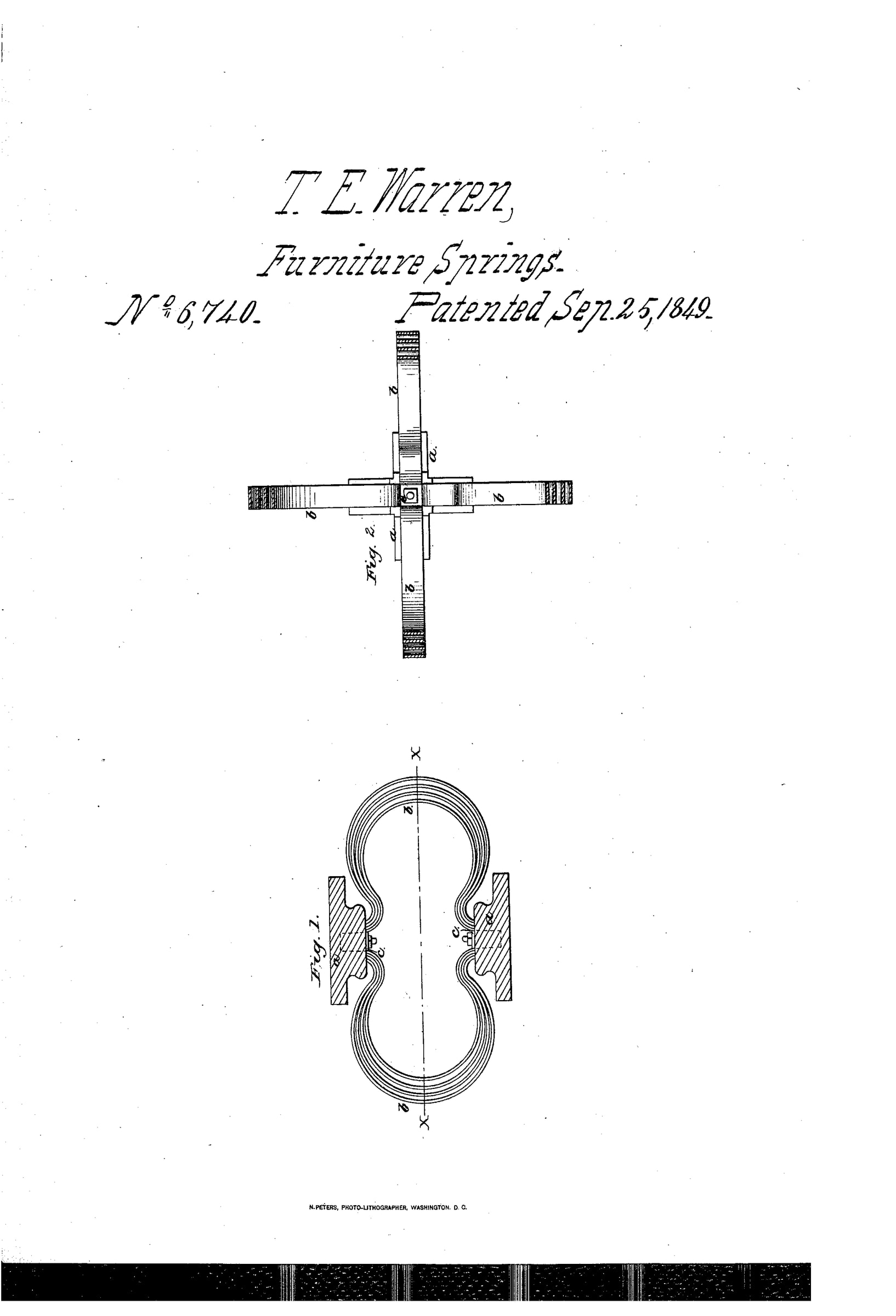
US Patent 6,740, issued to Thomas E. Warren on 25 September 1849, strips away the upholstery and shows the most original component by itself. One figure looks down on four arms meeting around a central fixture. Another cuts through two opposing bundles so their bowed profiles resemble a pair of rounded brackets facing away from each other.2
Each bundle contains curved metal leaves held firmly at their ends. Warren's specification emphasises that adjacent leaves remain separated between those fastenings instead of sliding across one another. Two such sets are placed at right angles. Load from front to back can therefore engage one axis; load from side to side can engage the other.
This is where the word centripetal becomes physically useful. The spring is not one coil under the middle or a set of independent cushions around the edge. Paired curves draw their action back toward a shared centre while the crossed arrangement lets the supported seat respond in more than one direction.
Tilt, swivel and roll are different jobs
The patent sheet also prevents a common simplification. It is a drawing of the spring, not a complete diagram of object 147:1965. It does not show upholstery, the ornamental cast base or casters, and it should not be asked to prove every motion of the finished chair.
The crossed leaves carry and yield under an off-centre load, producing the responsive tilt associated with the design. Rotation belongs to the chair's central mounting. Rolling belongs to the casters at the ends of the base. Museum object records connect those systems in surviving chairs; the patent explains the first system in detail.2 3
Separating the jobs makes the invention more impressive, not less. Warren did not discover one magical component that somehow did everything. The chair is an assembly of distinct freedoms: yield, rotation and travel, coordinated around the sitter.
Modern behaviour wears period dress
The Brooklyn Museum's comparison chair makes the cultural problem explicit. Its label interprets gilded Rococo Revival iron and dense trim as ways of softening the unfamiliar presence of industrial metal and mechanism in a domestic object. On that exact Brooklyn chair, the upholstery and applied trim are modern while original fringe survives, a material history different from the Saint Louis object's fully replacement textile scheme. 4
The broader point survives that difference. Warren did not give movement a neutral technical casing. Cast leaves curl into foliage, steel bows become symmetrical loops and wheels emerge beneath ornamental feet. New behaviour is made socially recognisable through an older visual language.
The design was public enough to travel. The Met records that a similar chair by the American Chair Company appeared at London's Crystal Palace exhibition in 1851 and was identified by a contemporary reviewer as Warren's invention. That statement concerns a similar exhibited chair, not proof that Saint Louis object 147:1965 crossed the Atlantic.3
What 147:1965 holds still
Seen from a distance, the exact Saint Louis chair can look like an amusing ancestor of today's task chair. Seen closely, it offers a better lesson. Its modernity is divided among behaviours, while its appearance records the effort to make those behaviours acceptable within mid-nineteenth-century taste.
The object record holds several facts still: designer, manufacturer, Troy origin, circa-1850 date, dimensions and recorded materials. The patent fixes a dated mechanical claim and explains its crossed leaves. Comparison records show how chairs of the type tilt, swivel and roll. None of those sources says that the present velvet recreates an original colour, that this exact chair was the Crystal Palace exhibit or that its concealed parts should be operated today.1 2
That boundary keeps the chair surprising for the right reason. We do not need to turn it into a fully modern office chair or restore an imagined 1850 appearance in prose. The astonishing thing is already visible: beneath a soft, scrolling silhouette, four crossed spring groups and a mobile centre change sitting from a fixed pose into a designed field of movement.