A library table that refuses to be background
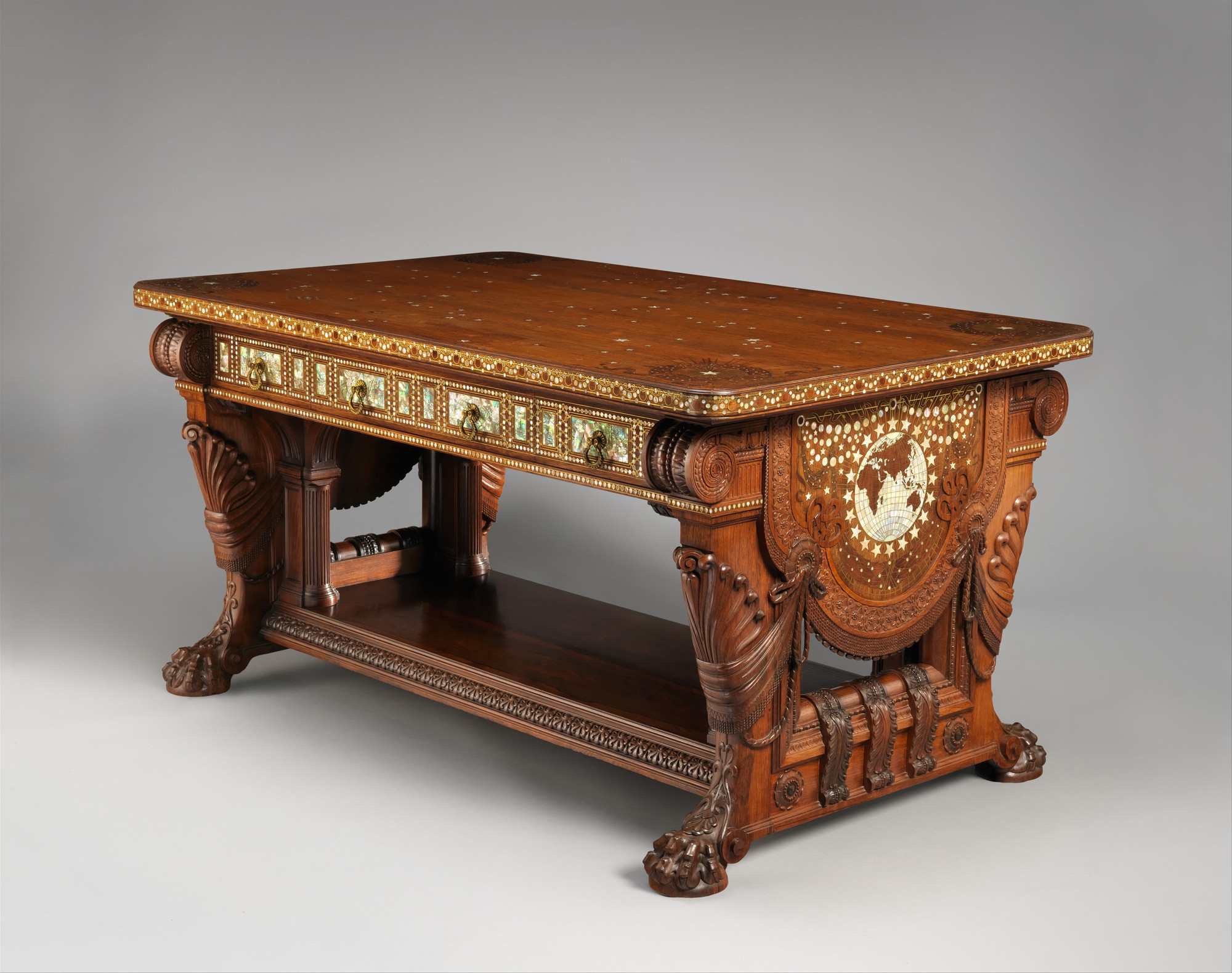
Most tables become background as soon as something is placed on them. This one fights back. It is 152.4 centimetres wide and 90.8 deep, large enough to work at, yet almost every surface insists on being read before it is covered. Stars cross the top. Pearl-like dots run along the edge. The apron flashes with shell, and a globe occupies each end.1
Herter Brothers made the table between 1879 and 1882 for William H. Vanderbilt's new Fifth Avenue mansion. The Met calls it the centrepiece of his library and notes that its rosewood, mother-of-pearl and brass echoed the room's panelling. It was furniture designed as part of an interior, not a prestige object dropped into a neutral box.1
The museum goes further: despite the practical name, it interprets the table as sculpture and as a monument to Vanderbilt rather than a surface intended primarily for study. That claim gives us the right question. Not “where are the drawers?” but “what is this table saying?”
The birthday sky is under your elbows
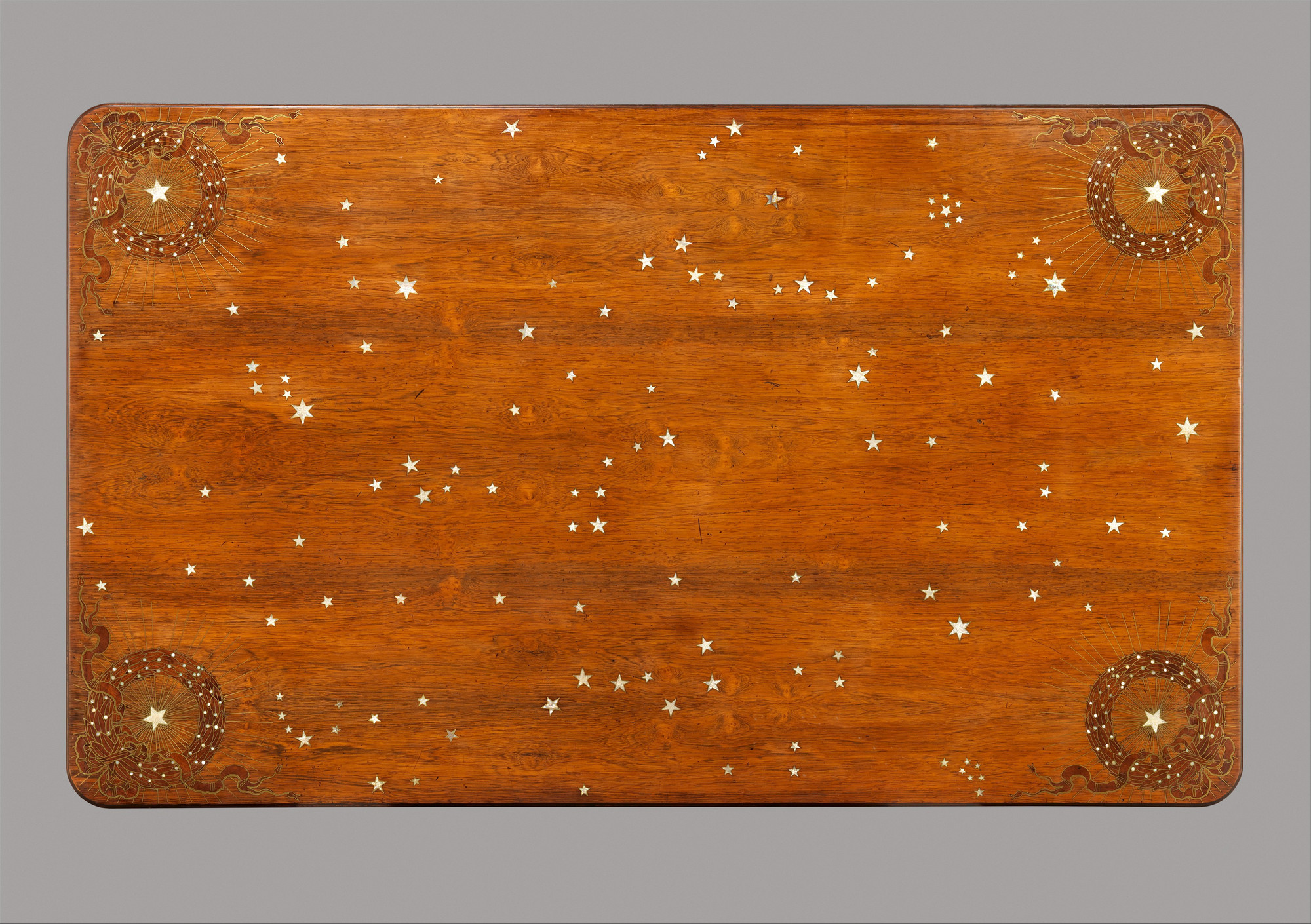
Seen from above, the top stops behaving like a conventional panel of rosewood. Small shell stars scatter across the grain in clusters and loose paths. Four larger stars sit inside wreaths at the corners. Fine brass lines radiate around them, so the broad working surface becomes both field and diagram.
The Met identifies this pattern as the stars over the northern hemisphere on 8 May 1821, the day William H. Vanderbilt was born. A birthday has been scaled up from private date to cosmic event and fitted beneath the reader's books. The image does not merely say that Vanderbilt owned the table. It makes the sky at his arrival part of the furniture.1
That is a curatorial identification attached to this object, not an astronomical calculation PatinaHall has independently repeated. Its importance lies in the design logic: a surface that could have displayed a generic constellation instead carries a date associated with a named patron. The top acts like a portrait without showing his face.
A globe at either end
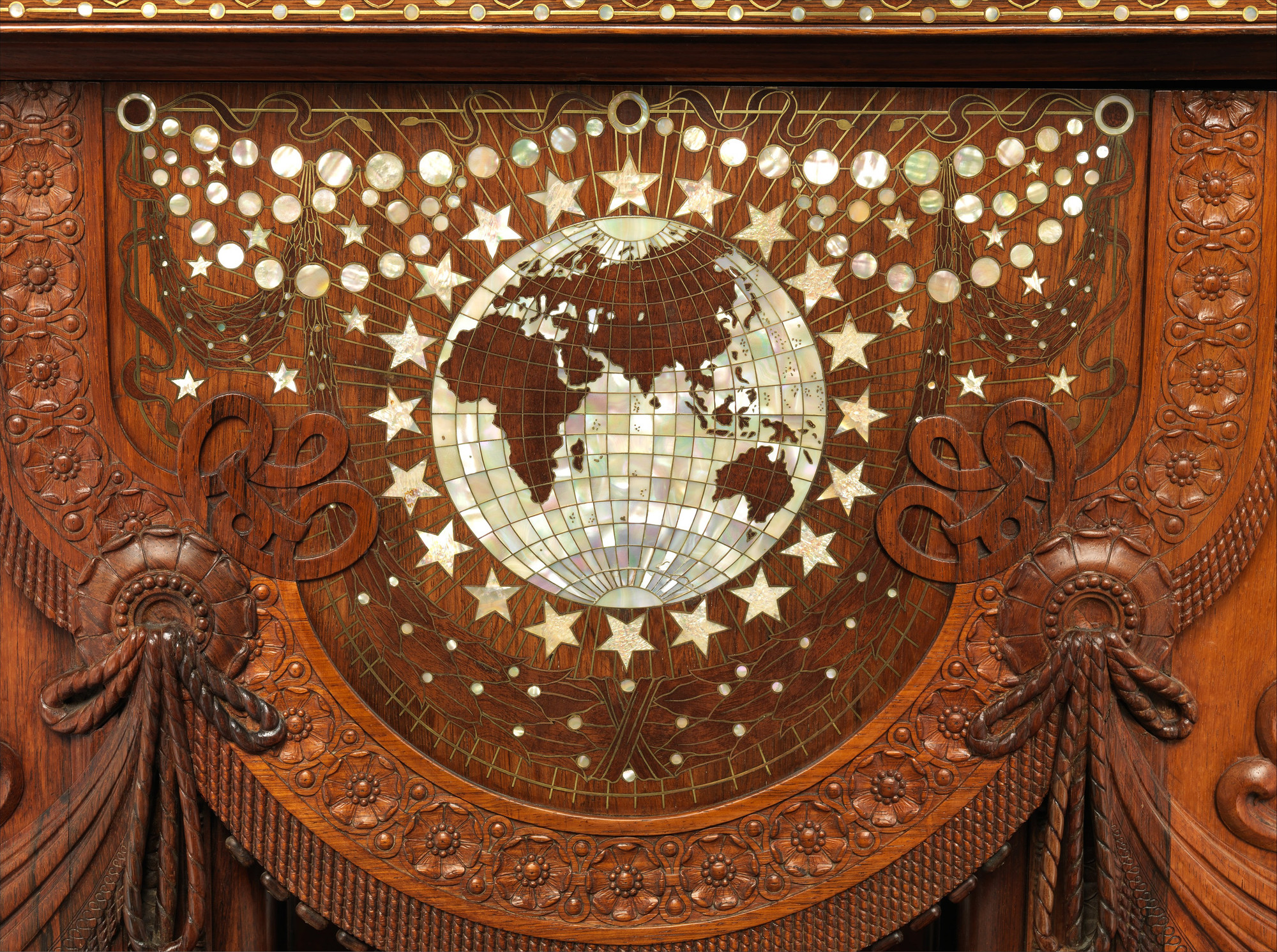
The end panels make the message less subtle. Each contains a shell-inlaid globe surrounded by stars and rays. The Met reads them as an implication that Vanderbilt held the world within his grasp. On an object made for a man whose wealth and status were central to the commission, geography becomes a claim about reach.1
Up close, the globe is not a painted emblem. Pieces of mother-of-pearl and abalone form pale land and sea against dark rosewood; brass describes the grid and rays. The materials change as the viewer moves. Shell catches light, rosewood absorbs it and the thin metal lines remain sharp. The picture is therefore animated by the room even though nothing mechanical moves.
Carved drapery hangs below and beside the globe, held by circular bosses and framed by floral bands. This is a useful reminder that the table's imagery is not confined to flat inlay. Carving, material contrast and architectural framing all participate in the same assertion.
Historical styles become a status language
The Met connects the table's heavy form, lion-paw feet and stylised palmettes to marble furniture of the Roman Empire. It links the corner wreaths enclosing a star to Napoleonic heraldry. Neither reference is a quiet lesson in design history. Empire and conquest have been selected as languages appropriate to a modern American fortune.1
The feet are especially effective because they do two jobs at once. They carry the table physically while giving its weight an animal image. Above them, thick supports, carved swags and a long lower shelf make the base feel more like architecture than a set of ordinary legs. The visual mass helps the cosmic imagery avoid floating away into delicacy.
Then the shell inlay changes the tempo. Small reflective discs run in rows; stars interrupt broad wooden planes; pale panels break the apron into a rhythm. Monumentality is assembled from both heavy carving and tiny points of light. Rosewood, brass, mother-of-pearl and abalone are not simply an expensive list. Each receives a different visual task.
The table belonged to a room
The Vanderbilt library was conceived as a coordinated environment. A Met record for a surviving side chair describes it as masculine, solemn and quiet, with rosewood furnishings and panelling carved in a Renaissance manner and inlaid with brass and mother-of-pearl. Against that setting, the table's materials would have continued the room while its scale made it the centre. 3
Herter Brothers worked beyond individual furniture. The firm designed and decorated the mansion's interiors, coordinating woodwork, furniture, walls, ceilings, floors and textiles. The Met's exhibition history calls the Vanderbilt House the firm's most important commission and dates its completion to 1882.2
This wider role matters because a photograph against a grey museum background can make the table look self-contained. Originally, rosewood panelling repeated its material language around it; chairs established the human scale; books and antique objects supplied the library's purpose. The table was exceptional, but it was not alone.
Furniture as portrait
Object 1972.47 survives with unusually precise coordinates: Herter Brothers, 1879–82, New York, rosewood, brass, mother-of-pearl and abalone, made for the library of William H. Vanderbilt. The Met's interpretation then connects its visible programme to a patron: Roman and Napoleonic references, world-embracing globes and a sky fixed to his birthday.1
Those sources do not tell us how often Vanderbilt sat at it, which books he opened there or what he privately thought of seeing his birthday written in stars. Calling it a monument describes the table's role and iconography; it is not evidence of daily behaviour.
The distinction makes the artefact stronger. We do not need an invented scene of the owner at work. The physical table already shows how Herter Brothers turned a commission into portraiture without a painted likeness. A name is absent from the top, yet the room, the world and even the sky have been arranged to point back to one person.