A chair with the parts still showing
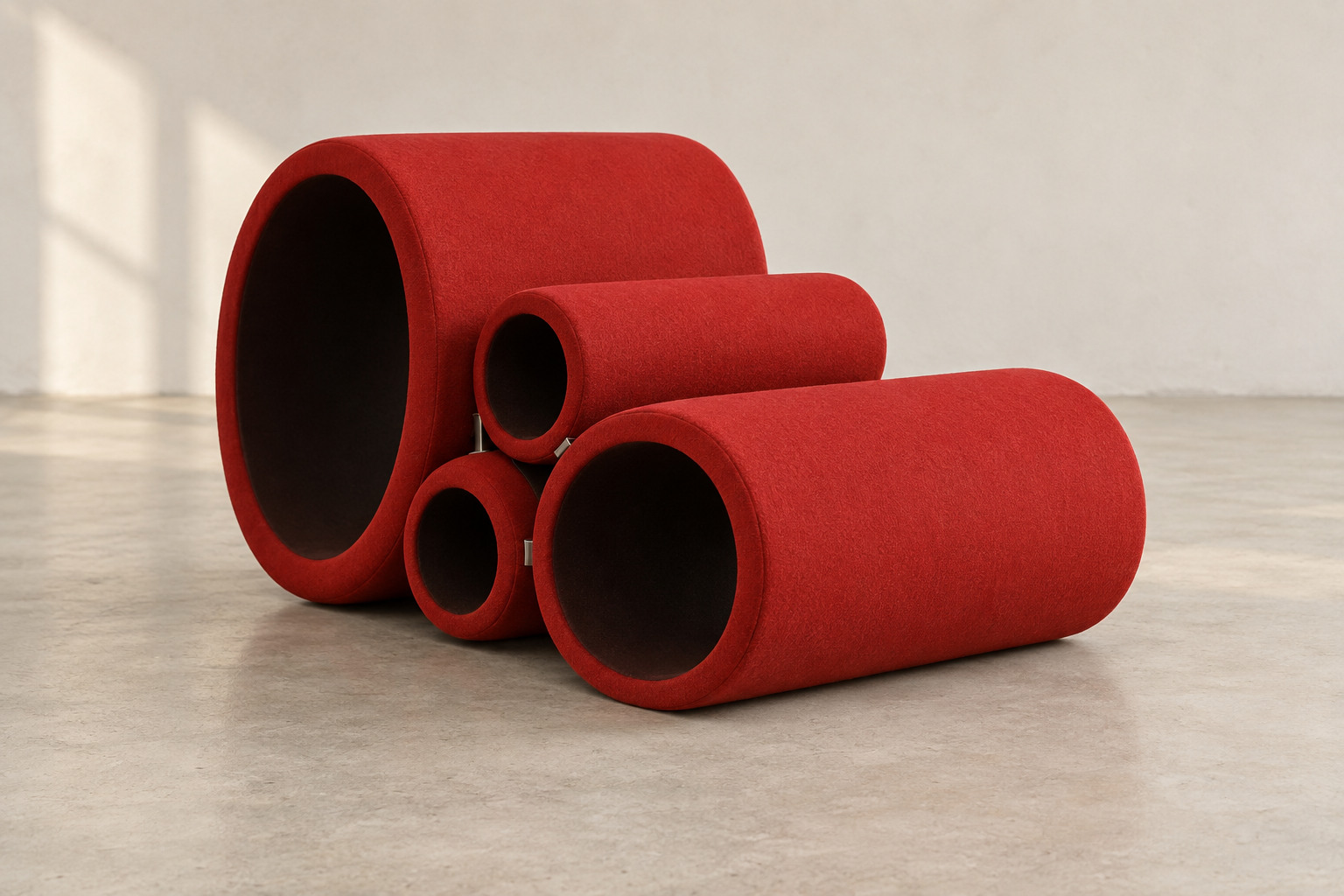
Four padded cylinders sit together on the floor. There is no familiar division into seat, back and legs. The large and small tubes acquire those roles through their arrangement, with connectors holding the chosen combination together.
Joe Colombo designed Tube Chair in 1969. The Met’s description explains its two central possibilities: the hollow components can be assembled in different combinations, and they can nest inside one another for storage. A useful feature of the design is that these are separate operations. Rearranging produces a place to sit; nesting puts it away.1
That distinction is easy to miss in a photograph of a single configuration. The silhouette looks settled, like any other chair. The parts suggest that it need not remain so.
The empty middles have a job
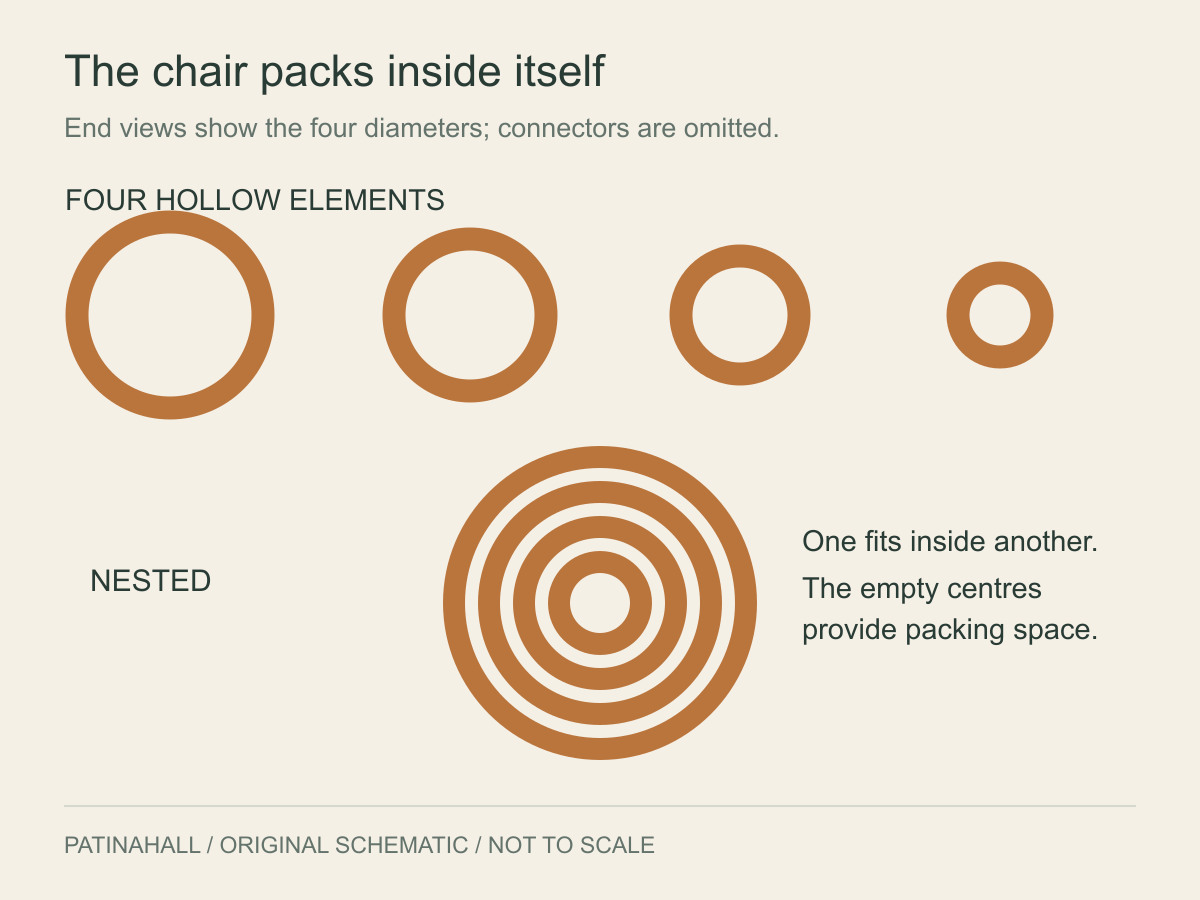
Seen end-on, each cylinder is a ring. The diameters differ, allowing the smaller elements to fit inside larger ones. The hollow space belongs to the packing arrangement as much as the padded outer surface belongs to sitting.
MoMA makes this transformation unusually concrete by recording both assembled and nested dimensions. Its example is about 112 centimetres long in the catalogued seating configuration. Nested, the components occupy a cylinder 61 centimetres wide and about 49 centimetres in diameter.2
The end views below make the principle visible: four separate rings become a set of rings inside one another. The connectors come out of the picture while the empty centres do the packing work.
The packing idea has a small visual joke built into it: the chair carries its own storage space around all the time. You have been looking through it.
Softness is a layer, not the whole tube
The museum records help separate the surface from the structure. MoMA lists PVC, polyurethane foam and fabric. The Met’s more detailed account also includes steel and natural rubber among the components.21
Those materials have different jobs. A hollow structural cylinder establishes the form; foam and upholstery make its outside a different kind of contact surface. Connectors let separate volumes behave as an assembly. Describing the whole thing simply as a foam chair loses the internal distinction that makes nesting possible.
Flexform is the manufacturer named for MoMA’s historical example. Cappellini’s later edition belongs to a continuing production history and has its own stated materials and manufacturing process. Its present specification should not be read backwards as a technical report on every early Tube Chair.23
A room that could be rearranged
The design sits near a moment when Italian furniture was being discussed as a way to reconsider domestic life. MoMA’s 1972 exhibition Italy: The New Domestic Landscape gathered objects and environments under that question. The exhibition record provides the larger setting; Tube Chair offers a compact way of thinking about it.4
Here, the user encounters a choice before settling down. Which combination suits this position, this room, this moment? That invitation does not make every possible arrangement equally useful, and the museum photograph cannot answer how any individual will find the seat.
What the design makes visible is the decision itself. A conventional chair tends to present a completed posture. Colombo’s four tubes leave the components readable, so the possibility of another arrangement stays in the room with you.