Design story

Traccia: the table that might walk away

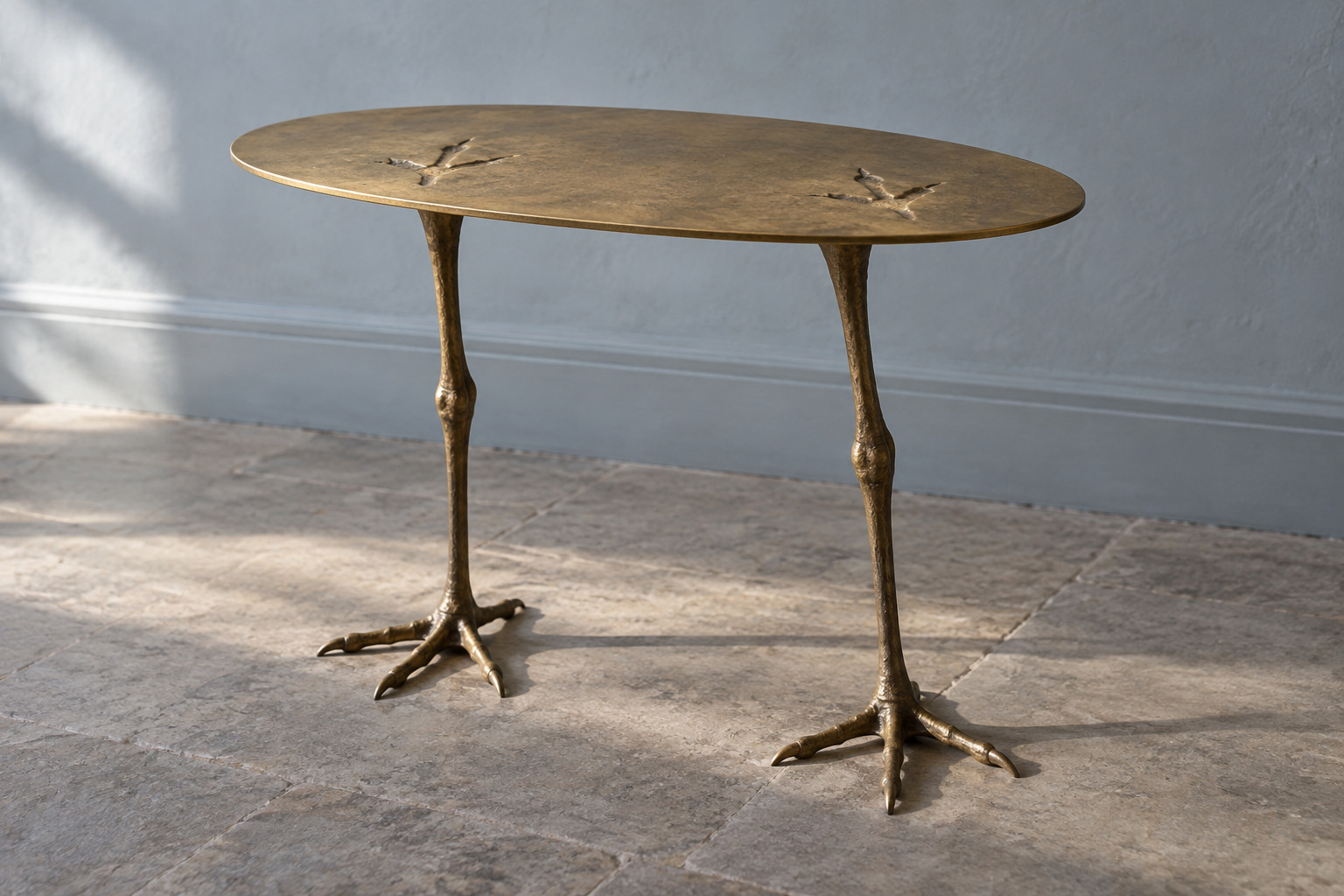
Most tables reassure you by appearing planted. Traccia raises the possibility that the furniture might have somewhere else to be. Two bird-like legs support an oval top, while marks on the surface suggest that a creature has already passed across it. Meret Oppenheim made a table feel poised between standing still and walking away.

A small oval golden table stands on two bird-like legs, with two recessed footprint shapes on its top.
PatinaHall editorial reconstruction. It is not a documentary photograph. The imagined table makes the bird appear both below and above its surface. It introduces Traccia’s visual joke without documenting an original or later edition.
On this page
Key facts & takeaways

At a glance

Subject
Traccia table
Entry
Design story
Last reviewed
11 September 2026
Designed
1939documented

Three things to remember

  1. Two recognisable bird-like feet change the way the whole table reads.
  2. The footprint motif makes the tabletop part of the encounter.
  3. The 1939 conception and later manufactured editions are different events.

A familiar support becomes unfamiliar

A furniture leg is already a borrowed body part in ordinary language. Traccia makes the comparison difficult to ignore. Its two slender supports end in spread, articulated toes, giving the table a recognisable animal stance.

The oval top complicates the reading. It can look like a conventional small tabletop, but above those legs it also suggests a body. The design needs very little information to move between the two interpretations.

Vitra Design Museum places Oppenheim’s 1939 table within the exchange between Surrealism and design. The connection becomes concrete here: an everyday object still performs its familiar job, while its appearance disturbs our expectations about what sort of thing it is.2

The visitor leaves a trace

The surface contains another clue. The Mons museum’s account of its example describes a wooden top with recessed bird footprints and gilded bronze feet. The object is signed and dated 1983, a later realisation of the earlier idea.1

The footprints make the top more than a lid over the supports. They suggest an action that has already happened. A table normally receives the things we place on it; here it appears to retain evidence of another visitor.

Look from the feet up to the surface and the relationship becomes pleasantly uncertain. Are the marks connected to the creature suggested by the legs, or has something else crossed the tabletop? The object leaves the question open. Its stillness contains a small implied event.
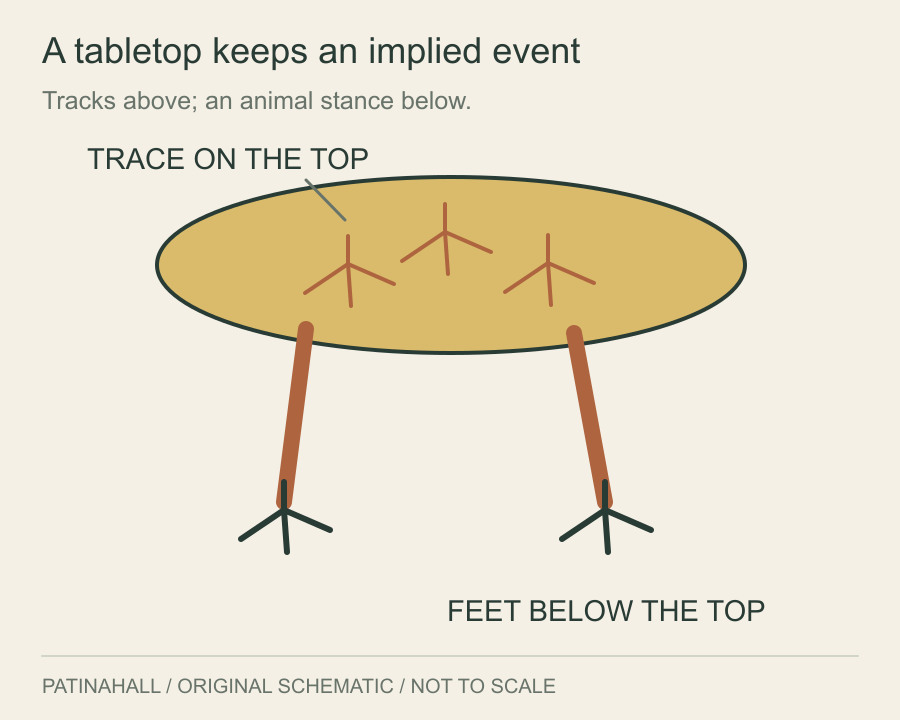
Bird-track symbols cross an oval tabletop above two bird-like supporting legs.
Original PatinaHall schematic, not to scale: the bird appears both as support and as a trace on the surface. The simplified form makes the double image legible without reproducing an edition’s dimensions.

An idea acquires a production history

Cassina’s account places Traccia’s return to production within the Simon editions of the 1970s. That history should be read alongside, rather than substituted for, the 1939 conception and the date of a particular museum example.3

This is a helpful way to approach unusual furniture that reappears decades after its first design. An edition gives an idea another material life. It does not make every later table an original object from the first exhibition.

The distinction also brings making back into the story. A drawing or prototype and a manufactured edition can share a recognisable proposition while belonging to different workshops, specifications and moments.

Leave some ordinary room around it

Traccia’s strangeness is easiest to see beside something unremarkable: a plain chair, an undecorated wall or an empty stretch of floor. The familiar setting supplies the expectations that the table interrupts.

Its scale of invention is modest enough to remain close to use. There is still a horizontal surface waiting for an object. Yet before putting anything there, the eye has already followed the toes and noticed the tracks. The table has introduced a story without moving an inch.

Research notesEvidence, connections and limits

The account follows museum sources for the original idea and the Mons example, with Cassina’s history used for later editions. Materials and marks from one example are not assigned to every version.

Evidence map

Connected subjects and evidence

Reviewed facts

  • Designed 1939documented

    Conception year; later manufactured objects have their own dates.

    Reviewed 11 September 2026 by PatinaHall editorial.
    • Source 2Objects of Desire, Oppenheim Traccia

Reviewed connections

  • Traccia tabledesigned byMeret Oppenheimdocumented

    Museum dates the idea to 1939 and distinguishes a later edition.

    Reviewed 11 September 2026 by PatinaHall editorial.
    • Source 1Meret Oppenheim and Traccia, p.22
  • Traccia tableassociated with placeParisdocumented

    Paris is the location of the 1939 presentation, not a claimed workshop or source of every edition.

    Reviewed 11 September 2026 by PatinaHall editorial.

Research trail

Sources and further reading

  1. Surrealism in the Mons collections: Meret Oppenheim, p.22Museums of MonsAccessed 11 September 2026
  2. Objects of Desire: Surrealism and DesignVitra Design MuseumAccessed 11 September 2026
  3. Traccia: design history and re-editionsCassinaAccessed 11 September 2026

Last reviewed 11 September 2026. Found an error or a stronger primary source? Contact PatinaHall.